What does Ezekiel 4:9 mean?
“Take thou also unto thee wheat, and barley, and beans, and lentiles, and millet, and fitches, and put them in one vessel, and make thee bread thereof, according to the number of the days that thou shalt lie upon thy side, three hundred and ninety days shalt thou eat thereof.” — Ezekiel 4:9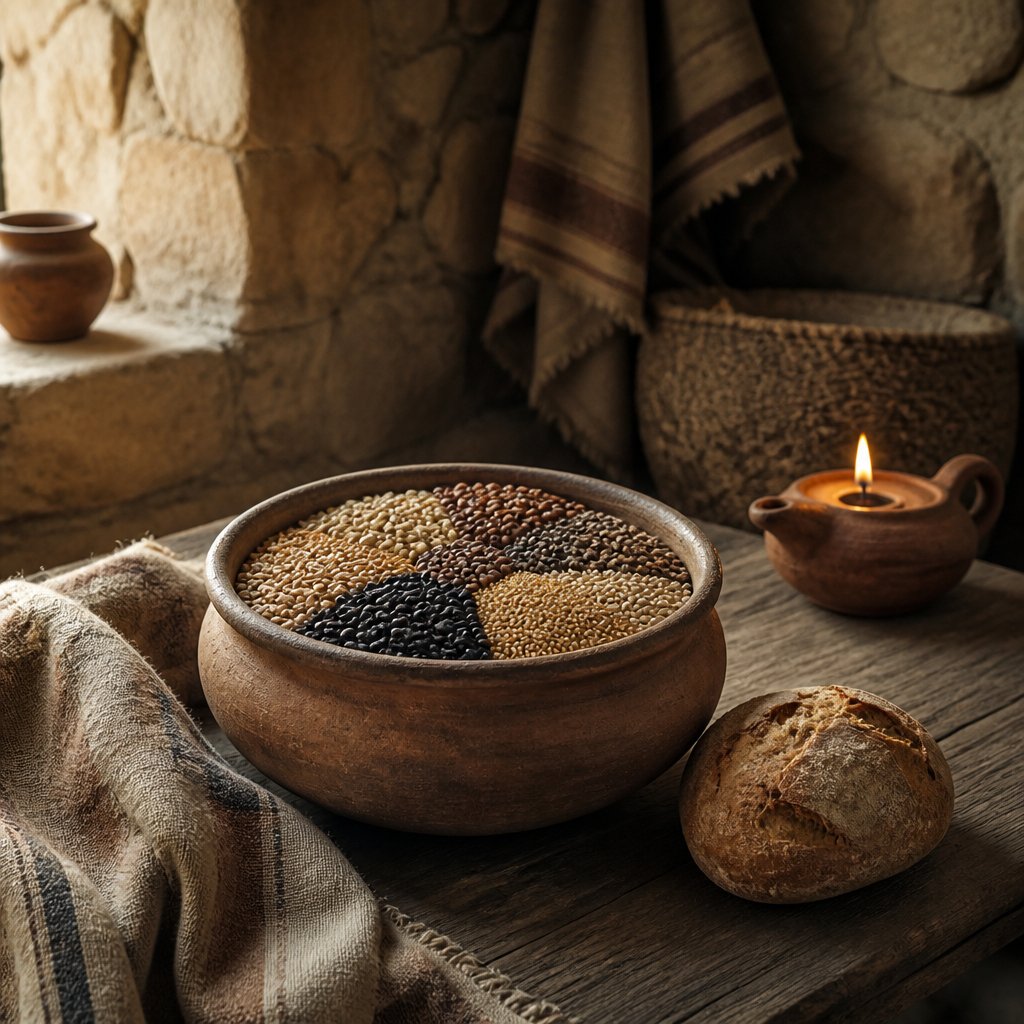
Ezekiel 4:9 from the King James Version (KJV) of the Bible reads: "Take thou also unto thee wheat, and barley, and beans, and lentiles, and millet, and fitches, and put them in one vessel, and make thee bread thereof, according to the number of the days that thou shalt lie upon thy side, three hundred and ninety days shalt thou eat thereof."
This verse comes from the prophecy of Ezekiel, who lived during the time of the Babylonian exile. The Babylonians had besieged Jerusalem in 597 BC, and Ezekiel, among other Israelites, was taken into captivity and exiled to Babylon. It was during this time that he received visions and prophecies from the Lord, which he was tasked with sharing with the people of Israel.
In this particular verse, the Lord instructs Ezekiel to gather a specific combination of grains and legumes – wheat, barley, beans, lentils, millet, and fitches – and mix them together to make bread. This bread was to be Ezekiel's sustenance during a symbolic act he was to perform as part of his prophetic ministry. The act involved Ezekiel lying on his side for 390 days, representing the years of Israel's punishment for their disobedience to God.
One of the key themes in this verse is obedience to God's commands, even when they seem unusual or difficult. Ezekiel was obedient to the Lord's instructions, even though they required significant sacrifice and endurance on his part. This demonstrates the prophet's faithfulness and willingness to carry out the Lord's will, regardless of how challenging it might be.
Another important theme is the symbolism of the grains and legumes themselves. Each of these ingredients has its own significance and can be seen as representing various aspects of life and faith. Wheat, for example, is often associated with nourishment and sustenance, while barley may symbolize endurance and resilience. Beans and lentils are known for their protein content and could represent strength and growth. Millet and fitches are lesser-known grains, but their inclusion in this verse underscores the idea of diversity and abundance in God's provision.
The act of mixing these ingredients together to make bread also speaks to the unity and interconnectedness of God's people. Just as each grain and legume contributes to the overall composition of the bread, so too do individuals contribute to the broader community of faith. This points to the importance of collaboration and mutual support within the body of believers.
Furthermore, the use of bread as a staple food throughout the Bible holds profound symbolism. In the New Testament, Jesus referred to himself as the "bread of life" (John 6:35), highlighting the spiritual nourishment and sustenance that he provides. This connection between bread and spiritual fulfillment resonates with the larger narrative of Ezekiel's prophecy, emphasizing the need for God's people to rely on him for their sustenance and strength.
Finally, the duration of Ezekiel's symbolic act – 390 days – corresponds to the number of years that the Israelites would experience divine punishment. This period of time serves as a reminder of the consequences of disobedience and the importance of seeking reconciliation with God. It also underscores the prophetic nature of Ezekiel's ministry, as he was tasked with sharing a message of warning and hope for the future.
In conclusion, Ezekiel 4:9 carries rich symbolism and themes that speak to the obedience, provision, unity, and spiritual sustenance of God's people. This verse serves as a powerful reminder of the profound significance of God's instructions and the ways in which he provides for his children, even in the midst of challenging circumstances. It also highlights the transformative and redemptive nature of God's plan for his people, ultimately pointing towards the hope of restoration and reconciliation.
Get our apps


Artwork for Ezekiel 4:9
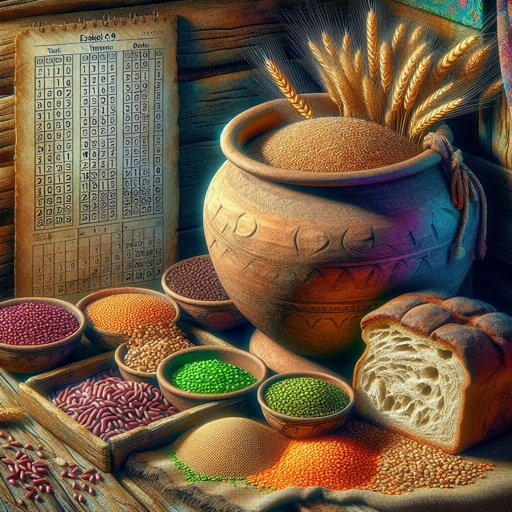
Ezekiel 4:9 - "¶ Take thou also unto thee wheat, and barley, and beans, and lentiles, and millet, and fitches, and put them in one vessel, and make thee bread thereof, according to the number of the days that thou shalt lie upon thy side, three hundred and ninety days shalt thou eat thereof."
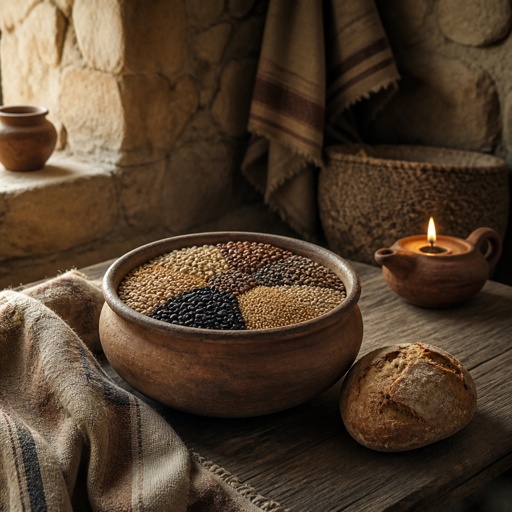
"¶ Take thou also unto thee wheat, and barley, and beans, and lentiles, and millet, and fitches, and put them in one vessel, and make thee bread thereof, according to the number of the days that thou shalt lie upon thy side, three hundred and ninety days shalt thou eat thereof." - Ezekiel 4:9

Ezekiel 9:4 - "And the LORD said unto him, Go through the midst of the city, through the midst of Jerusalem, and set a mark upon the foreheads of the men that sigh and that cry for all the abominations that be done in the midst thereof."

Ezekiel 33:3-9

Ezekiel 47:1-9, 12

Ezekiel 34:3–4

Ezekiel 4:1-3

Ezekiel 1:4-28

Ezekiel 34:9 - "Therefore, O ye shepherds, hear the word of the LORD;"

Ezekiel 1:4-28 – The vision of the four living creatures and the wheels.

Ezekiel 8:9 - "And he said unto me, Go in, and behold the wicked abominations that they do here."

Ezekiel 13:4 - "O Israel, thy prophets are like the foxes in the deserts."

Ezekiel 11:4 - "¶ Therefore prophesy against them, prophesy, O son of man."

Ezekiel 42:9 - "And from under these chambers was the entry on the east side, as one goeth into them from the utter court."

Ezekiel 2:9 - "And when I looked, behold, an hand was sent unto me; and, lo, a roll of a book was therein;"

Ezekiel 9:9 - "Then said he unto me, The iniquity of the house of Israel and Judah is exceeding great, and the land is full of blood, and the city full of perverseness: for they say, The LORD hath forsaken the earth, and the LORD seeth not."

Ezekiel 8:4 - "And, behold, the glory of the God of Israel was there, according to the vision that I saw in the plain."

Ezekiel 36:9 - "For, behold, I am for you, and I will turn unto you, and ye shall be tilled and sown:"

Ezekiel 12:9 - "Son of man, hath not the house of Israel, the rebellious house, said unto thee, What doest thou?"

Ezekiel 40:9 - "Then measured he the porch of the gate, eight cubits; and the posts thereof, two cubits; and the porch of the gate was inward."

Ezekiel 21:9 - "Son of man, prophesy, and say, Thus saith the LORD; Say, A sword, a sword is sharpened, and also furbished:"

Ezekiel 4:17 - "That they may want bread and water, and be astonied one with another, and consume away for their iniquity."

Ezekiel 43:4 - "And the glory of the LORD came into the house by the way of the gate whose prospect is toward the east."

Ezekiel 27:4 - "Thy borders are in the midst of the seas, thy builders have perfected thy beauty."

Ezekiel 48:4 - "And by the border of Naphtali, from the east side unto the west side, a portion for Manasseh."

Ezekiel 1:9 - "Their wings were joined one to another; they turned not when they went; they went every one straight forward."

Ezekiel 24:9 - "Therefore thus saith the Lord GOD; Woe to the bloody city! I will even make the pile for fire great."

Ezekiel 11:9 - "And I will bring you out of the midst thereof, and deliver you into the hands of strangers, and will execute judgments among you."

Ezekiel 1:4-28 – The vision of the four living creatures and the wheels.

Ezekiel 1:4-28 – The vision of the four living creatures and the wheels.