What does Genesis 30:36 mean?
“And he set three days’ journey betwixt himself and Jacob: and Jacob fed the rest of Laban’s flocks.” — Genesis 30:36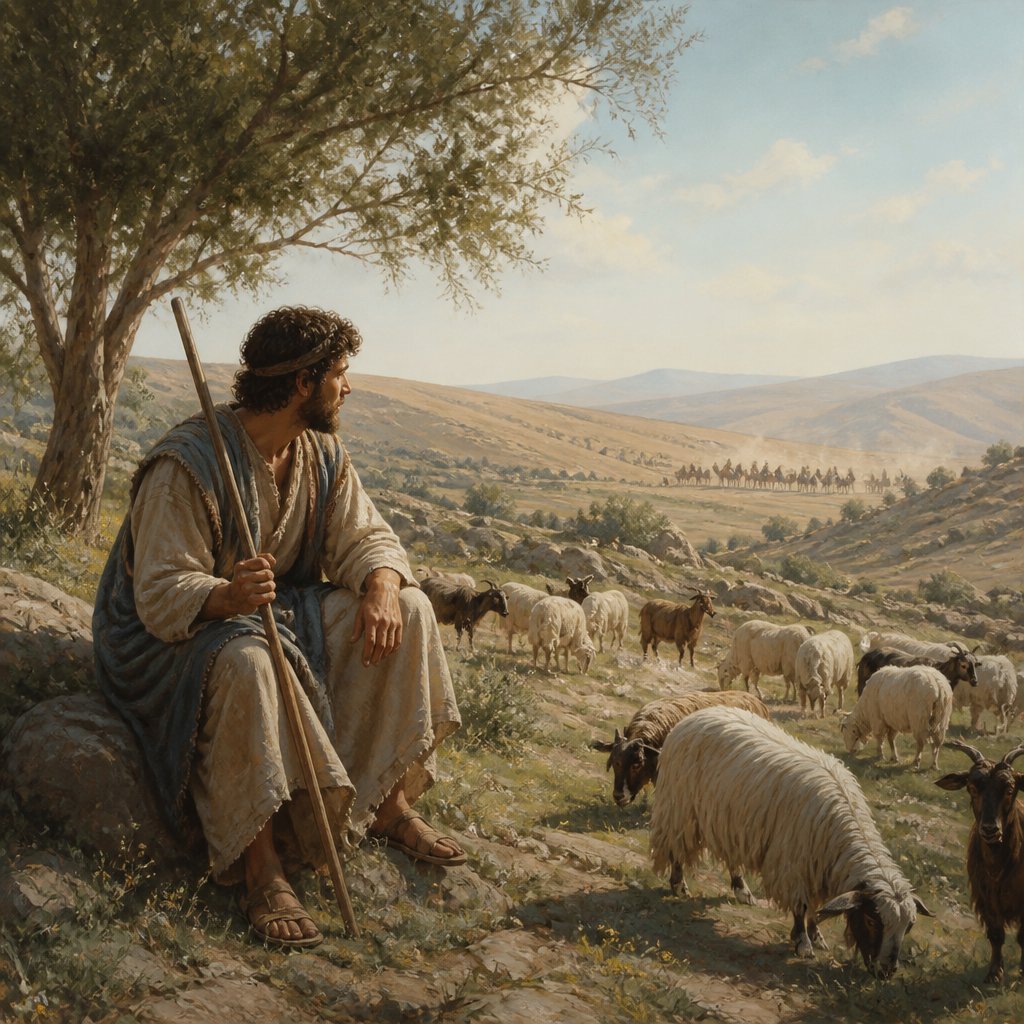
Genesis 30:36 (KJV) reads, "And he set three days' journey betwixt himself and Jacob: and Jacob fed the rest of Laban's flocks."
This particular verse is part of the story of Jacob's time working for his uncle Laban. At this point in the narrative, Jacob is attempting to negotiate with Laban regarding his wages and the livestock he would receive. Laban has been taking advantage of Jacob, changing the terms of their agreement numerous times in order to benefit himself. Thus, Jacob devises a plan to increase the number of speckled and spotted livestock in his flock, in order to improve his own position and reduce Laban's control over him.
In this verse, Laban agrees to Jacob's idea, and they set a distance of three days' journey between Jacob's flocks and Laban's to prevent interbreeding. This distance allowed Jacob to keep the strongest and healthiest animals for himself, while the weaker ones would remain in Laban's care. This plan allowed Jacob to increase his wealth and gain independence from Laban.
One of the prominent themes in this verse is the theme of manipulation and deceit. Both Jacob and Laban engage in deceitful practices, each trying to gain an advantage over the other. This reflects the broader theme of moral ambiguity in the book of Genesis, where individuals often engage in dishonest behavior in order to achieve their own goals.
Another theme that can be drawn from this verse is the theme of perseverance and resourcefulness. Despite facing numerous challenges and setbacks, Jacob remains determined to improve his situation and provide for his family. This perseverance is a common thread throughout the biblical narrative, as individuals are often called upon to endure hardship and exhibit resilience in the face of adversity.
The context of this verse is important to consider when examining its deeper meaning. At this point in the story, Jacob has already endured significant hardship, having been deceived by Laban into marrying Leah instead of Rachel, whom he loved. He has also worked for Laban for many years without fair compensation. Thus, Jacob's actions can be seen as a response to the injustices he has suffered, as he seeks to secure his own future and provide for his family.
Symbolism can also be found in this verse, particularly in the distance of three days' journey that is set between Jacob's flocks and Laban's. The number three is frequently associated with divine completeness and wholeness in the Bible, and it often signifies a sense of unity or harmony. In this context, the three days' journey can be seen as a symbol of the separation between Jacob and Laban, representing their divergent paths and the division that exists between them.
Overall, Genesis 30:36 (KJV) provides valuable insights into the themes of manipulation, perseverance, and resilience. It also offers an example of how individuals in the biblical narrative navigate challenging circumstances and seek to secure their own well-being. Through a deeper exploration of this verse, readers can gain a better understanding of the complexities of human behavior and the ways in which individuals strive to overcome adversity.
Get our apps


Artwork for Genesis 30:36

Genesis 30:36 - "And he set three days' journey betwixt himself and Jacob: and Jacob fed the rest of Laban's flocks."
"And he set three days' journey betwixt himself and Jacob: and Jacob fed the rest of Laban's flocks." - Genesis 30:36

Genesis 36:30 - "Duke Dishon, duke Ezer, duke Dishan: these are the dukes that came of Hori, among their dukes in the land of Seir."
"Duke Dishon, duke Ezer, duke Dishan: these are the dukes that came of Hori, among their dukes in the land of Seir." - Genesis 36:30

Genesis 36:36 - "And Hadad died, and Samlah of Masrekah reigned in his stead."

Genesis 24:36

Genesis 19-36

Job 36:30 - "Behold, he spreadeth his light upon it, and covereth the bottom of the sea."

Genesis 36:28 - "The children of Dishan are these; Uz, and Aran."

"And Hadad died, and Samlah of Masrekah reigned in his stead." - Genesis 36:36

Genesis 36:27 - "The children of Ezer are these; Bilhan, and Zaavan, and Akan."

Genesis 36:3 - "And Bashemath Ishmael's daughter, sister of Nebajoth."

Genesis 36:19 - "These are the sons of Esau, who is Edom, and these are their dukes."

Genesis 36:1 - "Now these are the generations of Esau, who is Edom."

Genesis 36:26 - "And these are the children of Dishon; Hemdan, and Eshban, and Ithran, and Cheran."

Genesis 36:42 - "Duke Kenaz, duke Teman, duke Mibzar,"

Genesis 36:9 - "¶ And these are the generations of Esau the father of the Edomites in mount Seir:"

Exodus 36:30 - "And there were eight boards; and their sockets were sixteen sockets of silver, under every board two sockets."

Genesis 36:41 - "Duke Aholibamah, duke Elah, duke Pinon,"

Genesis 19-30

Genesis 24-30

Genesis 18-30

Genesis 21-30

Genesis 36:8 - "Thus dwelt Esau in mount Seir: Esau is Edom."

Genesis 19:36 - "Thus were both the daughters of Lot with child by their father."

Ezekiel 36:30 - "And I will multiply the fruit of the tree, and the increase of the field, that ye shall receive no more reproach of famine among the heathen."

Genesis 36:25 - "And the children of Anah were these; Dishon, and Aholibamah the daughter of Anah."

Genesis 36:4 - "And Adah bare to Esau Eliphaz; and Bashemath bare Reuel;"

Genesis 36:11 - "And the sons of Eliphaz were Teman, Omar, Zepho, and Gatam, and Kenaz."

Genesis 36:23 - "And the children of Shobal were these; Alvan, and Manahath, and Ebal, Shepho, and Onam."