What does Genesis 31:47 mean?
"And Laban called it Jegarsahadutha: but Jacob called it Galeed." - Genesis 31:47
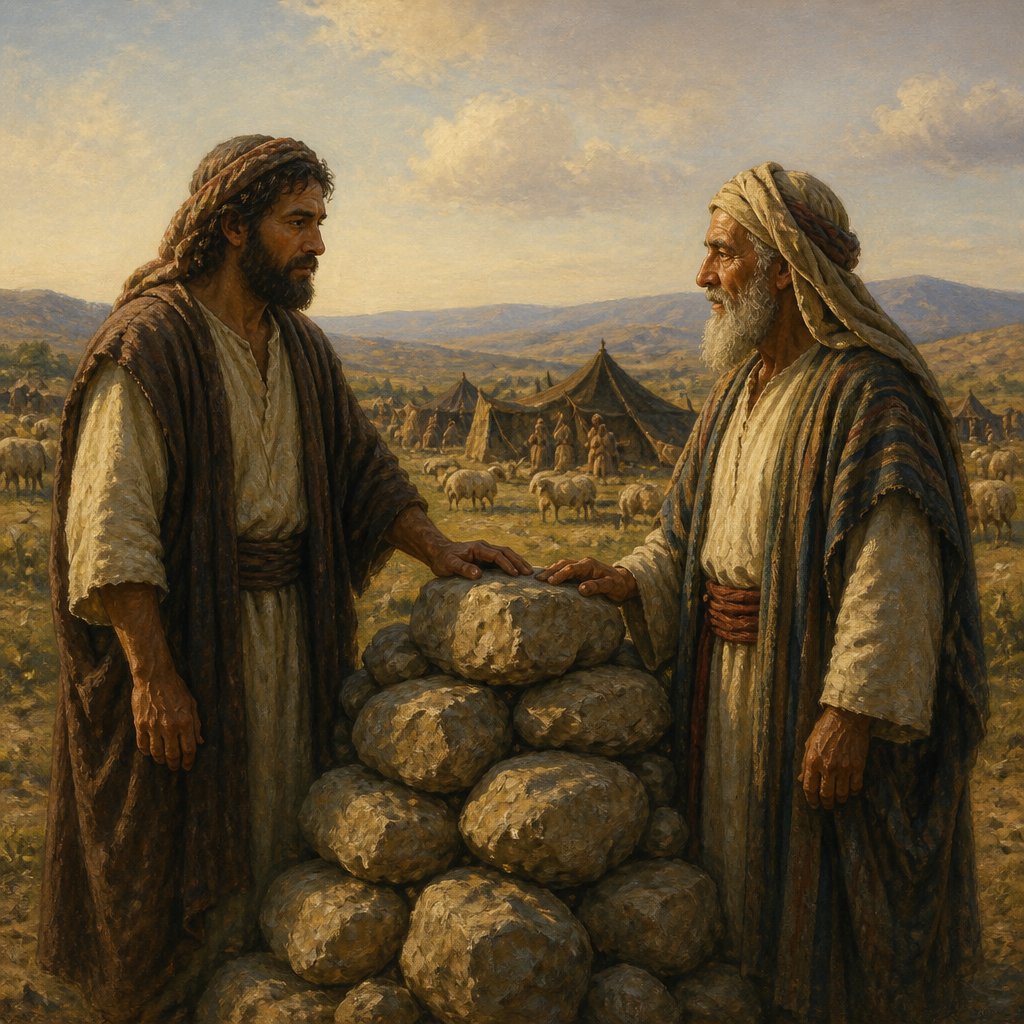
Genesis 31:47 (KJV) says, "And Laban called it Jegarsahadutha: but Jacob called it Galeed."
This simple verse holds deeper meanings and serves as a reflection of the themes of identity, conflict, and reconciliation within the context of the story of Jacob and Laban. To fully understand the significance of this verse, it is essential to consider its broader context within the Book of Genesis.
The verse occurs within the context of Jacob's departure from his uncle Laban's household. Laban had deceived Jacob into marrying his daughters Leah and Rachel, and had also mistreated Jacob by changing his wages multiple times. As a result, Jacob decided to leave Laban's household and return to his homeland. However, before leaving, Jacob and Laban made a covenant, symbolized by a heap of stones, as a witness between them that they would not pass the boundary to do harm to one another. It was during this act of making a covenant that Laban named the heap of stones "Jegarsahadutha," while Jacob called it "Galeed," as seen in Genesis 31:47.
The naming of the heap of stones by both Laban and Jacob holds symbolic significance. In ancient times, the act of naming a place or object was a way of establishing one's connection or claim to it, as well as a way of memorializing important events. In this case, the naming reflects the contrasting perspectives and experiences of Laban and Jacob. Laban, representing the deceiver and oppressor, named the heap of stones "Jegarsahadutha," which means "witness heap" in Aramaic, in an attempt to emphasize the covenant made between them. On the other hand, Jacob, who had suffered at the hands of Laban, named it "Galeed," which means "witness heap" in Hebrew, to also emphasize the covenant but from his own perspective and language.
The act of naming the heap of stones represents the existential reality of Jacob and Laban's relationship. Despite the covenant made between them, their perspectives and experiences of the same event are vastly different. Laban's naming reflects his attempt to create a positive remembrance of the covenant, while Jacob's naming reflects his own experience of suffering and oppression at the hands of Laban.
This verse also highlights the themes of identity and conflict. Jacob's naming of the heap of stones is an assertion of his identity and his experience. By choosing a name in his own language, Jacob is reclaiming his own agency and asserting his own perspective in the face of oppression. This act is a testament to Jacob's journey of self-discovery and finding his voice in the midst of conflict.
Furthermore, the naming of the heap of stones serves as a symbol of reconciliation. Despite the conflict and mistreatment between Jacob and Laban, the act of making a covenant and naming the heap of stones together represents a moment of reconciliation and peace between them. It marks a turning point in their relationship, as they agree to set boundaries and move forward without causing harm to each other.
In conclusion, Genesis 31:47 holds profound significance within the broader context of the story of Jacob and Laban. The act of naming the heap of stones reflects themes of identity, conflict, and reconciliation, as well as the contrasting perspectives and experiences of the characters. It serves as a reminder of the complex human experiences and the potential for reconciliation and peace even in the midst of conflict.
Have questions about Genesis 31:47?
Dive deeper into this scripture with Bible Chat — an AI-powered tool for exploring God's Word through conversation. Ask questions, get context, and grow in your understanding of the Bible.
Get Our Apps


Genesis 31:47 Artwork

Genesis 31:47 - "And Laban called it Jegarsahadutha: but Jacob called it Galeed."

"And Laban called it Jegarsahadutha: but Jacob called it Galeed." - Genesis 31:47

Genesis 47:31 - "And he said, Swear unto me. And he sware unto him. And Israel bowed himself upon the bed's head."

Genesis 24-47
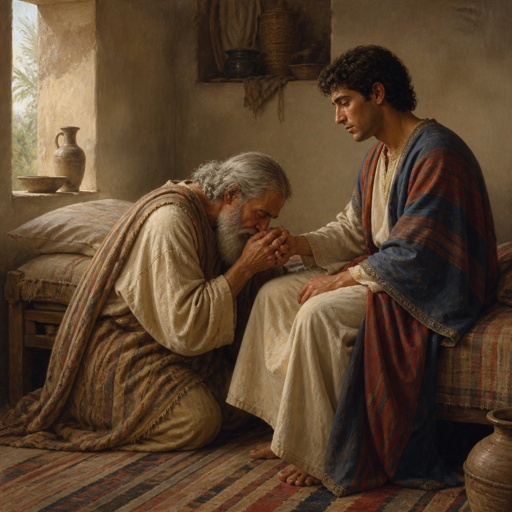
"And he said, Swear unto me. And he sware unto him. And Israel bowed himself upon the bed's head." - Genesis 47:31

Genesis 41:47 - "And in the seven plenteous years the earth brought forth by handfuls."

Genesis 47:10 - "And Jacob blessed Pharaoh, and went out from before Pharaoh."

Genesis 47:8 - "And Pharaoh said unto Jacob, How old art thou?"

Genesis 47:2 - "And he took some of his brethren, even five men, and presented them unto Pharaoh."

Genesis 47:12 - "And Joseph nourished his father, and his brethren, and all his father's household, with bread, according to their families."

Genesis 47:16 - "And Joseph said, Give your cattle; and I will give you for your cattle, if money fail."

Genesis 47:27 - "¶ And Israel dwelt in the land of Egypt, in the country of Goshen; and they had possessions therein, and grew, and multiplied exceedingly."

Genesis 47:7 - "And Joseph brought in Jacob his father, and set him before Pharaoh: and Jacob blessed Pharaoh."

Genesis 47:5 - "And Pharaoh spake unto Joseph, saying, Thy father and thy brethren are come unto thee:"

Genesis 47:28 - "And Jacob lived in the land of Egypt seventeen years: so the whole age of Jacob was an hundred forty and seven years."

Genesis 47:21 - "And as for the people, he removed them to cities from one end of the borders of Egypt even to the other end thereof."

Genesis 47:13 - "¶ And there was no bread in all the land; for the famine was very sore, so that the land of Egypt and all the land of Canaan fainted by reason of the famine."

Genesis 21-31

Genesis 18-31

Genesis 31:35

Genesis 19-31

Genesis 24-31

Genesis 47:25 - "And they said, Thou hast saved our lives: let us find grace in the sight of my lord, and we will be Pharaoh's servants."

Numbers 31:47 - "Even of the children of Israel's half, Moses took one portion of fifty, both of man and of beast, and gave them unto the Levites, which kept the charge of the tabernacle of the LORD; as the LORD commanded Moses."

"And in the seven plenteous years the earth brought forth by handfuls." - Genesis 41:47

Genesis 47:14 - "And Joseph gathered up all the money that was found in the land of Egypt, and in the land of Canaan, for the corn which they bought: and Joseph brought the money into Pharaoh's house."

Genesis 47:11 - "¶ And Joseph placed his father and his brethren, and gave them a possession in the land of Egypt, in the best of the land, in the land of Rameses, as Pharaoh had commanded."

"And Jacob blessed Pharaoh, and went out from before Pharaoh." - Genesis 47:10

Genesis 47:3 - "And Pharaoh said unto his brethren, What is your occupation? And they said unto Pharaoh, Thy servants are shepherds, both we, and also our fathers."

"And Pharaoh said unto Jacob, How old art thou?" - Genesis 47:8