What does Genesis 31:31 mean?
“And Jacob answered and said to Laban, Because I was afraid: for I said, Peradventure thou wouldest take by force thy daughters from me.” — Genesis 31:31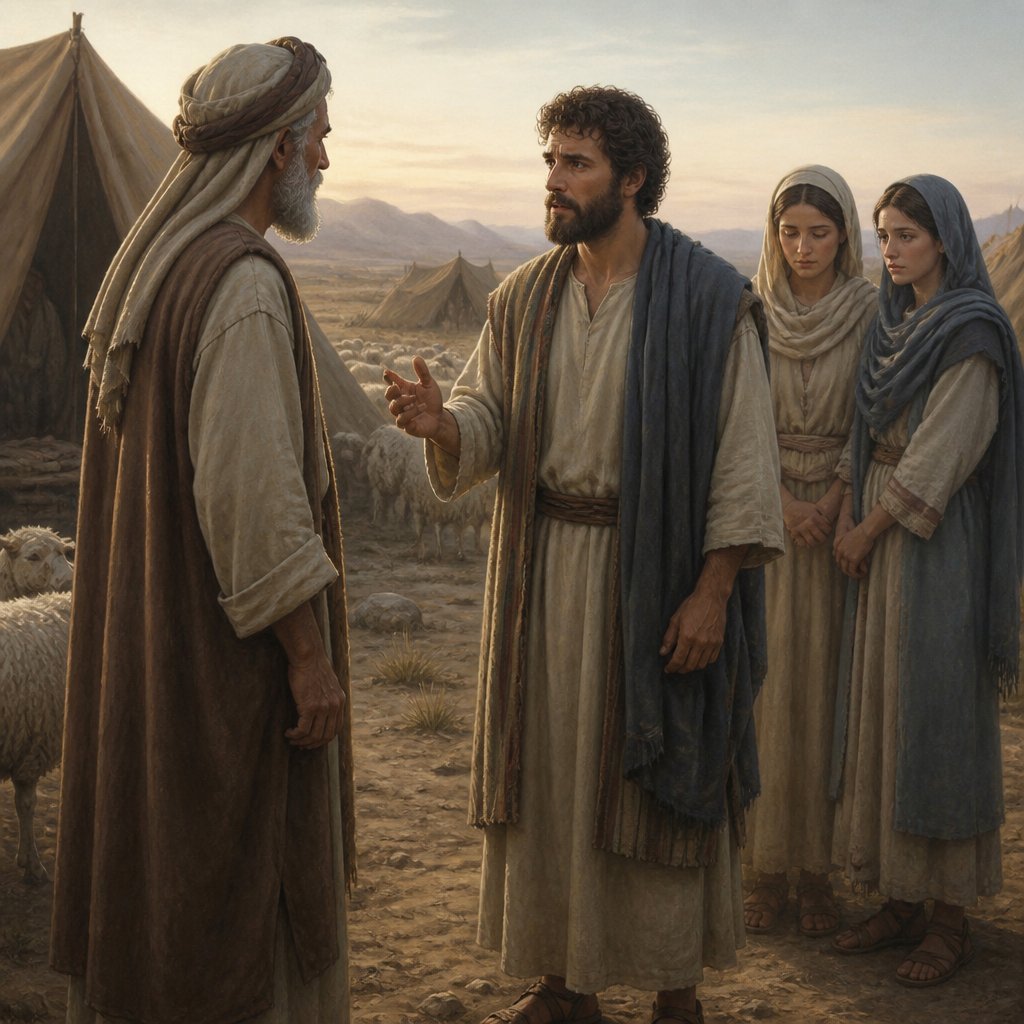
The Bible verse Genesis 31:31 from the King James Version (KJV) reads, "And Jacob answered and said to Laban, Because I was afraid: for I said, Peradventure thou wouldest take by force thy daughters from me."
This verse comes from the story of Jacob and Laban in the book of Genesis. To fully understand the meaning and commentary of this verse, it is important to examine the context and themes surrounding it.
The story of Jacob and Laban is one of deceit, manipulation, and ultimately, redemption. Jacob, the grandson of Abraham, had fled from his home after deceiving his father and brother. He sought refuge with Laban, his uncle, who offered him a place to stay. However, Laban proved to be just as deceitful as Jacob, tricking him into marrying his older daughter Leah before allowing him to marry Rachel, whom Jacob loved.
As the story unfolds, Jacob became a shepherd for Laban and eventually accumulated a large flock of sheep and goats. Laban and his sons became envious of Jacob's success and attempted to take advantage of him. This brings us to the specific verse in question, where Jacob answers Laban's accusation of stealing his idols by explaining his fear of Laban taking his daughters from him by force.
The theme of fear is prevalent throughout this story, and it is no different in this verse. Jacob's fear of losing his wives and children is a driving force behind his actions. His fear of Laban's deception and maltreatment is a reflection of his own past experiences, having been deceived by his own family. It also speaks to the broader theme of the fear of the unknown and the challenges of navigating difficult relationships.
This verse also sheds light on the power dynamics at play in the story. Laban, as the patriarch and head of the household, holds authority over Jacob and his family. Jacob's fear of Laban taking his daughters from him by force exposes the vulnerability and powerlessness he feels in this situation. It is a reminder of the unequal power structures that existed in ancient patriarchal societies and the struggles faced by those who were subjected to them.
Symbolism can also be found in this verse. Jacob's fear can be seen as a symbol of the broader human experience. Fear is a universal emotion that has the power to drive people to make choices they otherwise would not. It is a reminder of the human condition and the complexities of navigating challenging relationships and circumstances.
In conclusion, Genesis 31:31 offers a glimpse into the complex dynamics at play in the story of Jacob and Laban. It speaks to the themes of fear, power, and vulnerability, and serves as a reminder of the human experience and the challenges of navigating difficult relationships. As with many biblical stories, it also offers lessons and insights that are relevant to the human experience today.
Get our apps


Artwork for Genesis 31:31

Genesis 31:31 - "And Jacob answered and said to Laban, Because I was afraid: for I said, Peradventure thou wouldest take by force thy daughters from me."
"And Jacob answered and said to Laban, Because I was afraid: for I said, Peradventure thou wouldest take by force thy daughters from me." - Genesis 31:31

Genesis 21-31

Genesis 18-31

Genesis 31:35

Genesis 19-31

Genesis 24-31

Genesis 31:22 - "And it was told Laban on the third day that Jacob was fled."

Genesis 31:45 - "And Jacob took a stone, and set it up for a pillar."

Genesis 31:47 - "And Laban called it Jegarsahadutha: but Jacob called it Galeed."

Genesis 34:31 - "And they said, Should he deal with our sister as with an harlot?"

Genesis 25:31 - "And Jacob said, Sell me this day thy birthright."

Genesis 31:2 - "And Jacob beheld the countenance of Laban, and, behold, it was not toward him as before."

Genesis 31:4 - "And Jacob sent and called Rachel and Leah to the field unto his flock,"

Genesis 37:31 - "And they took Joseph's coat, and killed a kid of the goats, and dipped the coat in the blood;"

Genesis 42:31 - "And we said unto him, We are true men; we are no spies:"
Genesis 10:31 - "These are the sons of Shem, after their families, after their tongues, in their lands, after their nations."

Genesis 21:31 - "Wherefore he called that place Beer-sheba; because there they sware both of them."

Genesis 41:31 - "And the plenty shall not be known in the land by reason of that famine following; for it shall be very grievous."

Genesis 31:17 - "¶ Then Jacob rose up, and set his sons and his wives upon camels;"

Genesis 31:6 - "And ye know that with all my power I have served your father."

Genesis 31:9 - "Thus God hath taken away the cattle of your father, and given them to me."

Genesis 5:31 - "And all the days of Lamech were seven hundred seventy and seven years: and he died."

Genesis 31:20 - "And Jacob stole away unawares to Laban the Syrian, in that he told him not that he fled."

Genesis 36:31 - "¶ And these are the kings that reigned in the land of Edom, before there reigned any king over the children of Israel."

Genesis 43:31 - "And he washed his face, and went out, and refrained himself, and said, Set on bread."

Genesis 29:31 - "¶ And when the LORD saw that Leah was hated, he opened her womb: but Rachel was barren."

Genesis 31:48 - "And Laban said, This heap is a witness between me and thee this day. Therefore was the name of it called Galeed;"

Genesis 31:19 - "And Laban went to shear his sheep: and Rachel had stolen the images that were her father's."

Genesis 31:3 - "And the LORD said unto Jacob, Return unto the land of thy fathers, and to thy kindred; and I will be with thee."