What does Genesis 31:9 mean?
“Thus God hath taken away the cattle of your father, and given them to me.” — Genesis 31:9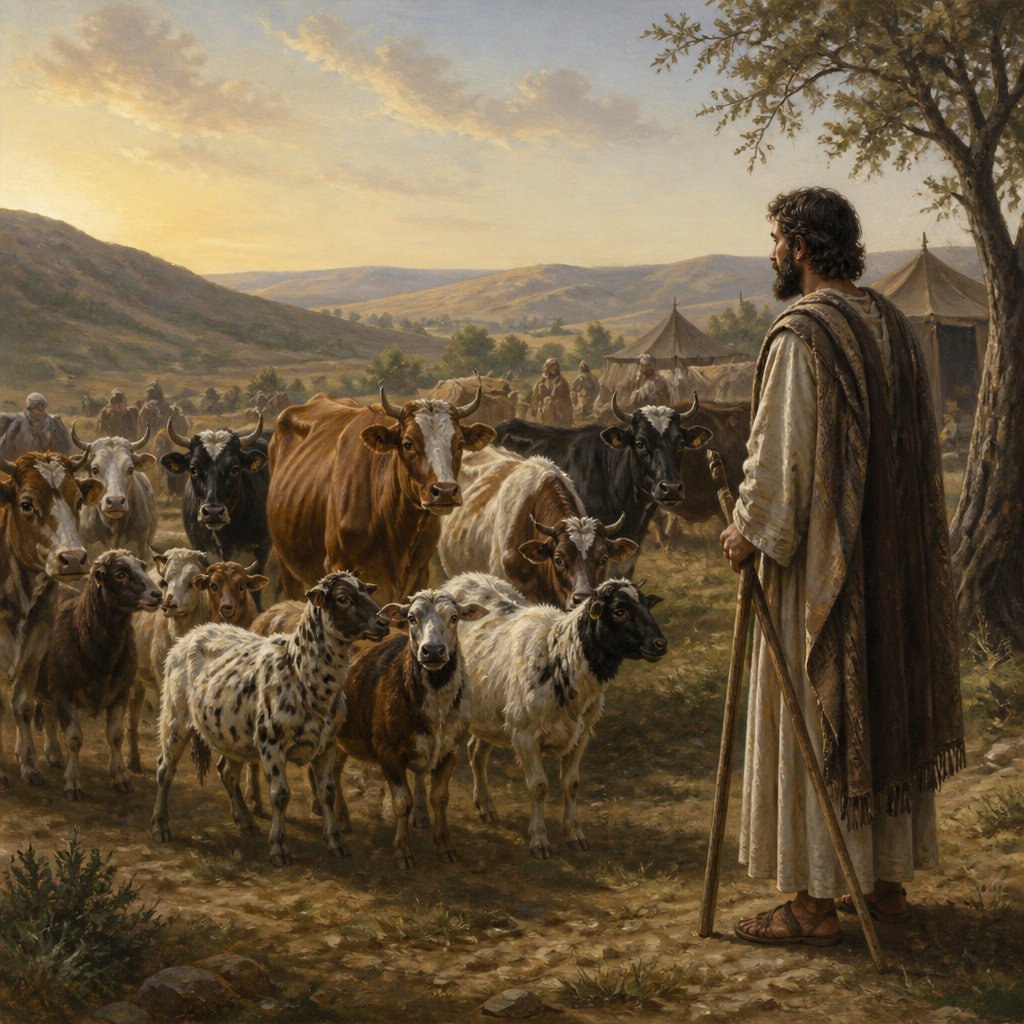
Genesis 31:9 in the King James Version reads, "Thus God hath taken away the cattle of your father, and given them to me." This verse comes from the story of Jacob and Laban, two men who were connected through family and work. The verse is part of a larger narrative in which Jacob, feeling mistreated by his father-in-law, Laban, decides to leave and take his family and possessions with him.
Jacob's statement in this verse reflects his belief that God has played a role in the transfer of wealth from Laban to himself. At first glance, this verse may seem to be a simple account of Jacob's perception of the situation. However, upon deeper analysis, it becomes clear that this verse, like the entire story of Jacob and Laban, is rich with complex themes, symbolism, and significance.
One of the major themes in this verse is the idea of divine intervention in human affairs. Jacob attributes the change in ownership of the cattle to God, indicating his belief that God is directly involved in the distribution of wealth and resources. This theme can be seen as a reflection of the broader biblical concept of God's sovereignty and his role in guiding the lives of individuals and nations.
The verse also touches on the themes of justice and retribution. Jacob's statement implies that the transfer of the cattle from Laban to himself is a form of justice for the mistreatment he has experienced at the hands of his father-in-law. This theme of justice can be seen as reflective of the biblical idea of divine justice and the belief that God ultimately rights all wrongs and rewards the faithful.
The context of this verse is important for understanding its significance. In the preceding chapters of Genesis, Jacob has spent many years working for Laban, only to feel deceived and mistreated by him. Jacob's decision to leave and take his family and possessions with him is a significant turning point in the narrative, as it marks his departure from the land of his father-in-law and his return to his own homeland. In this context, Jacob's statement in Genesis 31:9 can be seen as a bold declaration of his belief that he is justified in taking the cattle with him and that God is on his side in this decision.
The symbolism in this verse is also worth examining. The cattle mentioned in the verse can be seen as symbolic of material wealth and prosperity. By attributing the transfer of the cattle to God, Jacob is expressing his belief that God is the ultimate source of wealth and that he is the one who determines its distribution. This symbolism ties in with the broader biblical theme of the importance of placing one's trust in God rather than in worldly possessions.
In conclusion, Genesis 31:9 is a verse that is rich with meaning and significance. It touches on important themes such as divine intervention, justice, and the symbolism of material wealth. When placed in the context of the larger story of Jacob and Laban, it becomes clear that this verse is a pivotal moment in the narrative, reflecting Jacob's belief in God's guidance and sovereignty. It also serves as a reminder of the broader biblical themes of the importance of trusting in God and seeking justice.
Get our apps


Artwork for Genesis 31:9

Genesis 31:9 - "Thus God hath taken away the cattle of your father, and given them to me."
"Thus God hath taken away the cattle of your father, and given them to me." - Genesis 31:9

Genesis 21-31

Genesis 18-31

Genesis 31:35

Genesis 19-31

Genesis 24-31

Genesis 31:22 - "And it was told Laban on the third day that Jacob was fled."

Genesis 31:45 - "And Jacob took a stone, and set it up for a pillar."

Genesis 31:47 - "And Laban called it Jegarsahadutha: but Jacob called it Galeed."

Genesis 31:31 - "And Jacob answered and said to Laban, Because I was afraid: for I said, Peradventure thou wouldest take by force thy daughters from me."

Genesis 34:31 - "And they said, Should he deal with our sister as with an harlot?"

Genesis 25:31 - "And Jacob said, Sell me this day thy birthright."

Genesis 31:2 - "And Jacob beheld the countenance of Laban, and, behold, it was not toward him as before."

Genesis 31:4 - "And Jacob sent and called Rachel and Leah to the field unto his flock,"

Genesis 37:31 - "And they took Joseph's coat, and killed a kid of the goats, and dipped the coat in the blood;"

Genesis 42:31 - "And we said unto him, We are true men; we are no spies:"
Genesis 10:31 - "These are the sons of Shem, after their families, after their tongues, in their lands, after their nations."

Genesis 21:31 - "Wherefore he called that place Beer-sheba; because there they sware both of them."

Genesis 41:31 - "And the plenty shall not be known in the land by reason of that famine following; for it shall be very grievous."

Genesis 31:17 - "¶ Then Jacob rose up, and set his sons and his wives upon camels;"

Genesis 31:6 - "And ye know that with all my power I have served your father."

2 Chronicles 31:9 - "Then Hezekiah questioned with the priests and the Levites concerning the heaps."

Exodus 9:31 - "And the flax and the barley was smitten: for the barley was in the ear, and the flax was bolled."

Genesis 5:31 - "And all the days of Lamech were seven hundred seventy and seven years: and he died."

Genesis 31:20 - "And Jacob stole away unawares to Laban the Syrian, in that he told him not that he fled."

Genesis 36:31 - "¶ And these are the kings that reigned in the land of Edom, before there reigned any king over the children of Israel."

Genesis 43:31 - "And he washed his face, and went out, and refrained himself, and said, Set on bread."

Genesis 29:31 - "¶ And when the LORD saw that Leah was hated, he opened her womb: but Rachel was barren."

Matthew 9:31 - "But they, when they were departed, spread abroad his fame in all that country."