What does Genesis 32:7 mean?
"Then Jacob was greatly afraid and distressed: and he divided the people that was with him, and the flocks, and herds, and the camels, into two bands;" - Genesis 32:7
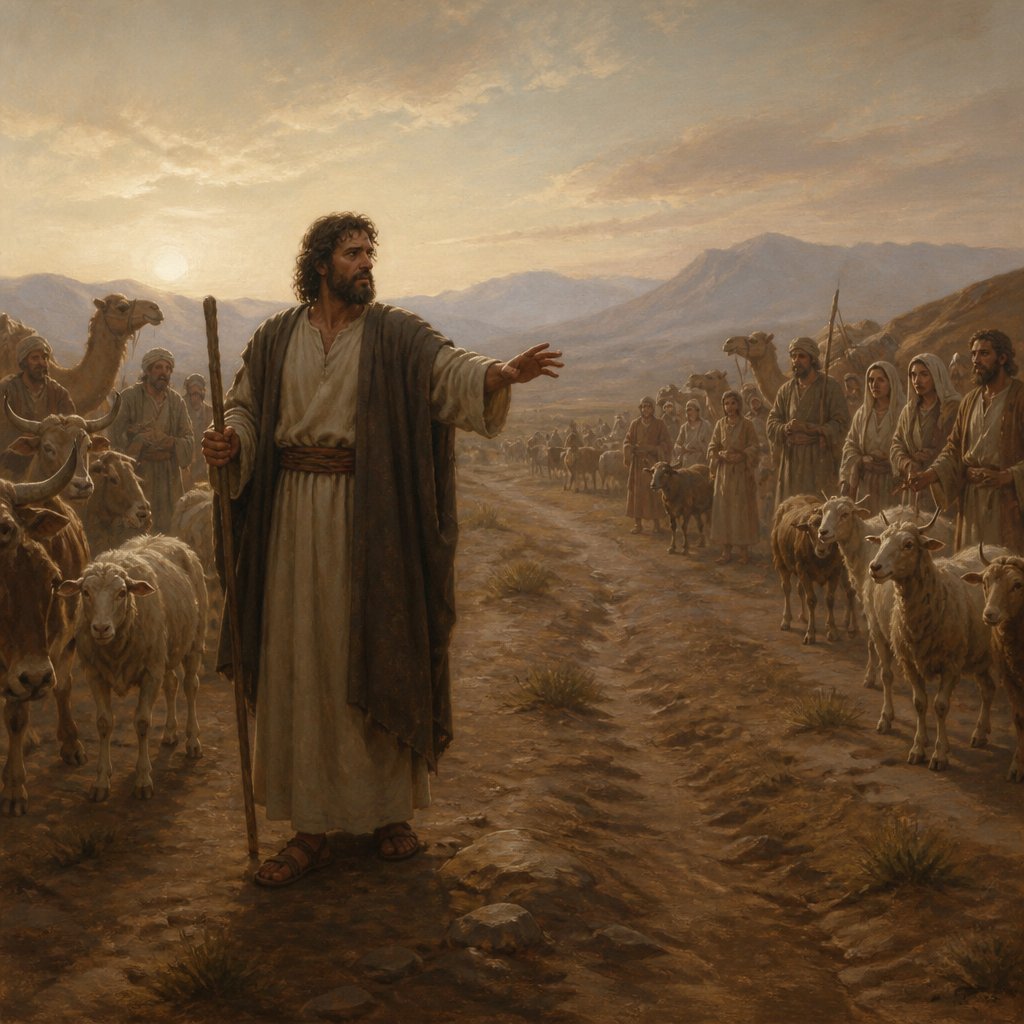
Genesis 32:7 (KJV) reads, "Then Jacob was greatly afraid and distressed: and he divided the people that was with him, and the flocks, and herds, and the camels, into two bands"
This verse comes from the book of Genesis, which is the first book of the Bible and is attributed to Moses, who is believed to have written it around 1450-1410 B.C. The book of Genesis is crucial in providing the foundation for the rest of the Bible, as it contains the accounts of the creation, the fall of man, the flood, and the patriarchs Abraham, Isaac, and Jacob.
In this particular verse, Jacob is in the midst of a significant moment in his life. He is about to come face to face with his brother Esau, whom he had deceived and from whom he had fled many years before. This encounter filled Jacob with fear and distress, as he did not know how his brother would react to his return. In his fear, Jacob took the precaution of dividing his people and possessions into two groups, perhaps as a way to mitigate potential losses in case of an encounter with his brother.
The fear and distress that Jacob experienced in this verse are relatable to many people. They serve as a reminder that even those who are chosen by God and have a special calling on their lives can experience fear and doubt. Jacob's actions also highlight the importance of being prepared and taking practical measures, even as we trust in God's faithfulness and protection.
This verse is part of a larger narrative that spans from Genesis 32:1 to Genesis 33:17. In this narrative, Jacob is returning to Canaan after spending twenty years in Haran with his uncle Laban. He has acquired great wealth during his time away, and he is now faced with the prospect of reuniting with his brother Esau, from whom he fled after deceiving him and taking his birthright.
The themes present in this verse include fear, distress, preparation, and the potential for reconciliation. These themes are woven throughout the larger narrative of Jacob's life and continue to remain relevant in the lives of believers today. Many people can relate to the feeling of fear and distress when facing uncertain or potentially dangerous situations. Jacob's decision to divide his people and possessions reflects a sense of practical wisdom and preparation, even as he puts his trust in God's faithfulness.
Symbolism also plays a significant role in this verse. The division of Jacob's people into two bands is symbolic of the way Jacob is dividing up his life. He is preparing himself for the possibility of loss and is taking steps to protect what is most precious to him. However, this division also serves as a reminder that reconciliation with his brother is possible. By dividing his possessions, Jacob is demonstrating his willingness to make amends with Esau and to offer him a peace offering.
Throughout the Bible, the number two is often symbolic of division, contrast, or opposition. In this context, the decision to divide his people into two bands could be seen as a reflection of the internal conflict that Jacob is facing. He is torn between fear and hope, between the desire for self-preservation and the hope for reconciliation. This internal struggle is one that many people can relate to, as we often find ourselves torn between conflicting emotions and desires.
In conclusion, Genesis 32:7 (KJV) is a powerful verse that captures a significant moment in the life of Jacob. His fear and distress, along with his decision to divide his people and possessions, offer valuable insights into the human experience and the complexities of relationships. This verse reminds believers that it is normal to experience fear and uncertainty, but it also encourages us to take practical measures while trusting in God's faithfulness. The symbolism present in this verse adds depth and complexity to the narrative, enriching our understanding of Jacob's inner turmoil and the potential for reconciliation with his brother.
Have questions about Genesis 32:7?
Dive deeper into this scripture with Bible Chat — an AI-powered tool for exploring God's Word through conversation. Ask questions, get context, and grow in your understanding of the Bible.
Get Our Apps


Genesis 32:7 Artwork

Genesis 32:7 - "Then Jacob was greatly afraid and distressed: and he divided the people that was with him, and the flocks, and herds, and the camels, into two bands;"
"Then Jacob was greatly afraid and distressed: and he divided the people that was with him, and the flocks, and herds, and the camels, into two bands;" - Genesis 32:7

Genesis 19-32

Genesis 27:32

Genesis 25-32

Genesis 18-32

Genesis 24-32
Genesis 21-32

psalm 32:7

Genesis 49:32 - "The purchase of the field and of the cave that is therein was from the children of Heth."

Genesis 32:1 - "And Jacob went on his way, and the angels of God met him."

Genesis 32:32 - "Therefore the children of Israel eat not of the sinew which shrank, which is upon the hollow of the thigh, unto this day: because he touched the hollow of Jacob's thigh in the sinew that shrank."

Genesis 36:32 - "And Bela the son of Beor reigned in Edom: and the name of his city was Dinhabah."

Genesis 32:24 - "¶ And Jacob was left alone; and there wrestled a man with him until the breaking of the day."

Genesis 11:32 - "And the days of Terah were two hundred and five years: and Terah died in Haran."

Genesis 32:27 - "And he said unto him, What is thy name? And he said, Jacob."

Genesis 5:32 - "And Noah was five hundred years old: and Noah begat Shem, Ham, and Japheth."

Genesis 32:21 - "So went the present over before him: and himself lodged that night in the company."

Genesis 32:23 - "And he took them, and sent them over the brook, and sent over that he had."

Nehemiah 7:32 - "The men of Beth-el and Ai, an hundred twenty and three."

Numbers 7:32 - "One golden spoon of ten shekels, full of incense:"

Genesis 32:14 - "Two hundred she goats, and twenty he goats, two hundred ewes, and twenty rams,"

Genesis 10:32 - "These are the families of the sons of Noah, after their generations, in their nations: and by these were the nations divided in the earth after the flood."

Genesis 32:8 - "And said, If Esau come to the one company, and smite it, then the other company which is left shall escape."

1 Chronicles 7:32 - "And Heber begat Japhlet, and Shomer, and Hotham, and Shua their sister."

Genesis 41:32 - "And for that the dream was doubled unto Pharaoh twice; it is because the thing is established by God, and God will shortly bring it to pass."

Genesis 25:32 - "And Esau said, Behold, I am at the point to die: and what profit shall this birthright do to me?"

Genesis 32:13 - "¶ And he lodged there that same night; and took of that which came to his hand a present for Esau his brother;"

Genesis 46:32 - "And the men are shepherds, for their trade hath been to feed cattle; and they have brought their flocks, and their herds, and all that they have."

Genesis 32:15 - "Thirty milch camels with their colts, forty kine, and ten bulls, twenty she asses, and ten foals."