What does Isaiah 39:1 mean?
“At that time Merodach-baladan, the son of Baladan, king of Babylon, sent letters and a present to Hezekiah: for he had heard that he had been sick, and was recovered.” — Isaiah 39:1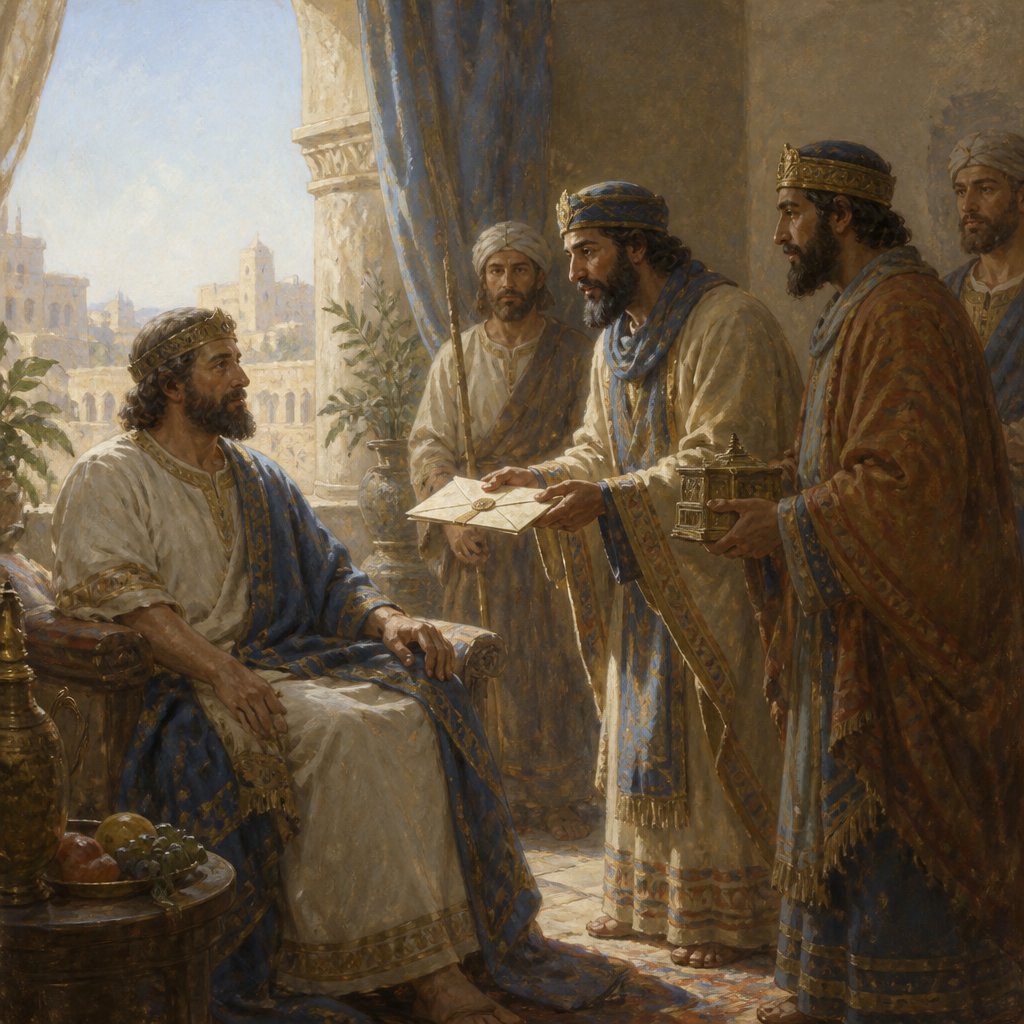
The verse Isaiah 39:1 in the King James Version of the Bible reads, "At that time Merodach-baladan, the son of Baladan, king of Babylon, sent letters and a present to Hezekiah: for he had heard that he had been sick, and was recovered." This verse appears in the book of Isaiah, which is a prophetic book in the Old Testament of the Bible. It is important to understand the historical and cultural context of this verse in order to fully appreciate its meaning and implications.
The book of Isaiah was written by the prophet Isaiah, who served during the 8th century BCE in the kingdom of Judah. His prophetic ministry occurred during a tumultuous period in the history of the Israelites, characterized by political instability, military conflict, and the threat of foreign invasions. The verse in question takes place during the reign of King Hezekiah, who was known for his faithfulness to God and his efforts to reform the religious practices of the kingdom.
In this verse, we are introduced to Merodach-baladan, the son of Baladan, king of Babylon. Babylon was a powerful empire in the ancient Near East, and its influence and ambitions often clashed with those of the Israelites. The sending of letters and a present to Hezekiah by Merodach-baladan signifies a diplomatic gesture, indicating a desire for friendly relations between Babylon and Judah. The reason for this gesture was the news of Hezekiah's illness and subsequent recovery. It is important to note that the Babylonians were keen observers of geopolitical developments in the region, and they sought to cultivate alliances or exploit weaknesses in neighboring kingdoms for their own benefit.
From a historical perspective, this verse reflects the complex political dynamics of the ancient Near East, where smaller kingdoms like Judah had to navigate the power struggles between larger empires such as Babylon and Assyria. It also sheds light on Hezekiah's reign and the challenges he faced in maintaining the independence and security of his kingdom.
However, the significance of this verse goes beyond its historical context. It holds broader theological and spiritual implications that resonate throughout the biblical narrative. One overarching theme is the sovereignty of God in human affairs. The encounter between Hezekiah and Merodach-baladan serves as a reminder of the intricate ways in which God orchestrates the events of history, using even the actions of foreign rulers to accomplish His purposes.
Furthermore, this verse invites reflection on the nature of worldly power and the wisdom of placing trust in human alliances. Hezekiah's reception of the Babylonian envoys and his decision to show them the treasures of his kingdom eventually leads to the prophet Isaiah's rebuke and a prophetic warning of future calamity for Judah at the hands of the Babylonians. This serves as a cautionary tale about the dangers of relying on political maneuvering and military alliances at the expense of faithfulness to God.
Symbolically, the visit of Merodach-baladan can be seen as a test of Hezekiah's spiritual discernment and loyalty to God. It raises the question of whether he will seek security and validation from worldly powers or place his trust in the Lord alone. The implications of this dilemma reverberate throughout the Bible, as the tension between faith and worldly enticements is a recurring theme in the lives of God's people.
In conclusion, Isaiah 39:1 offers a rich tapestry of historical, theological, and moral themes. It provides a window into the political realities of ancient Near Eastern kingdoms and the spiritual challenges faced by their rulers. It prompts readers to consider the complexities of human power and the enduring relevance of placing trust in God's providential care. As such, this verse continues to speak to believers today, urging them to seek God's wisdom and guidance in the midst of worldly pressures and temptations.
Get our apps


Artwork for Isaiah 39:1

Isaiah 39:1 - "At that time Merodach-baladan, the son of Baladan, king of Babylon, sent letters and a present to Hezekiah: for he had heard that he had been sick, and was recovered."

"At that time Merodach-baladan, the son of Baladan, king of Babylon, sent letters and a present to Hezekiah: for he had heard that he had been sick, and was recovered." - Isaiah 39:1

Isaiah 39:5 - "Then said Isaiah to Hezekiah, Hear the word of the LORD of hosts:"

"Then said Isaiah to Hezekiah, Hear the word of the LORD of hosts:" - Isaiah 39:5

Isaiah 39:8 - "Then said Hezekiah to Isaiah, Good is the word of the LORD which thou hast spoken. He said moreover, For there shall be peace and truth in my days."

Isaiah 39:3 - "¶ Then came Isaiah the prophet unto king Hezekiah, and said unto him, What said these men? and from whence came they unto thee? And Hezekiah said, They are come from a far country unto me, even from Babylon."

Luke 1:39

Luke 5:39

Isaiah 39:7 - "And of thy sons that shall issue from thee, which thou shalt beget, shall they take away; and they shall be eunuchs in the palace of the king of Babylon."

1 Corinthians 14:39-40

Luke 1:39 - 45

1 Chronicles 1:39 - "And the sons of Lotan; Hori, and Homam: and Timna was Lotan's sister."

Isaiah 39:4 - "Then said he, What have they seen in thine house? And Hezekiah answered, All that is in mine house have they seen: there is nothing among my treasures that I have not shewed them."

Isaiah 39:6 - "Behold, the days come, that all that is in thine house, and that which thy fathers have laid up in store until this day, shall be carried to Babylon: nothing shall be left, saith the LORD."

1 Chronicles 7:39 - "And the sons of Ulla; Arah, and Haniel, and Rezia."

1 Kings 11:39 - "And I will for this afflict the seed of David, but not for ever."

1 Chronicles 2:39 - "And Azariah begat Helez, and Helez begat Eleasah,"

1 Corinthians 14:39 - "Wherefore, brethren, covet to prophesy, and forbid not to speak with tongues."

Scene from book of numbers 14:39-45

"Then said Hezekiah to Isaiah, Good is the word of the LORD which thou hast spoken. He said moreover, For there shall be peace and truth in my days." - Isaiah 39:8

1 Chronicles 11:39 - "Zelek the Ammonite, Naharai the Berothite, the armourbearer of Joab the son of Zeruiah,"

Mark 1:39 - "And he preached in their synagogues throughout all Galilee, and cast out devils."

Luke 1:39 - "And Mary arose in those days, and went into the hill country with haste, into a city of Juda;"

1 Samuel 20:39 - "But the lad knew not any thing: only Jonathan and David knew the matter."

1 Chronicles 12:39 - "And there they were with David three days, eating and drinking: for their brethren had prepared for them."

1 Chronicles 16:39 - "And Zadok the priest, and his brethren the priests, before the tabernacle of the LORD in the high place that was at Gibeon,"

1 Chronicles 4:39 - "¶ And they went to the entrance of Gedor, even unto the east side of the valley, to seek pasture for their flocks."

"And the sons of Lotan; Hori, and Homam: and Timna was Lotan's sister." - 1 Chronicles 1:39

1 Chronicles 8:39 - "And the sons of Eshek his brother were, Ulam his firstborn, Jehush the second, and Eliphelet the third."

Numbers 1:39 - "Those that were numbered of them, even of the tribe of Dan, were threescore and two thousand and seven hundred."