What does Isaiah 63:9 mean?
“In all their affliction he was afflicted, and the angel of his presence saved them: in his love and in his pity he redeemed them; and he bare them, and carried them all the days of old.” — Isaiah 63:9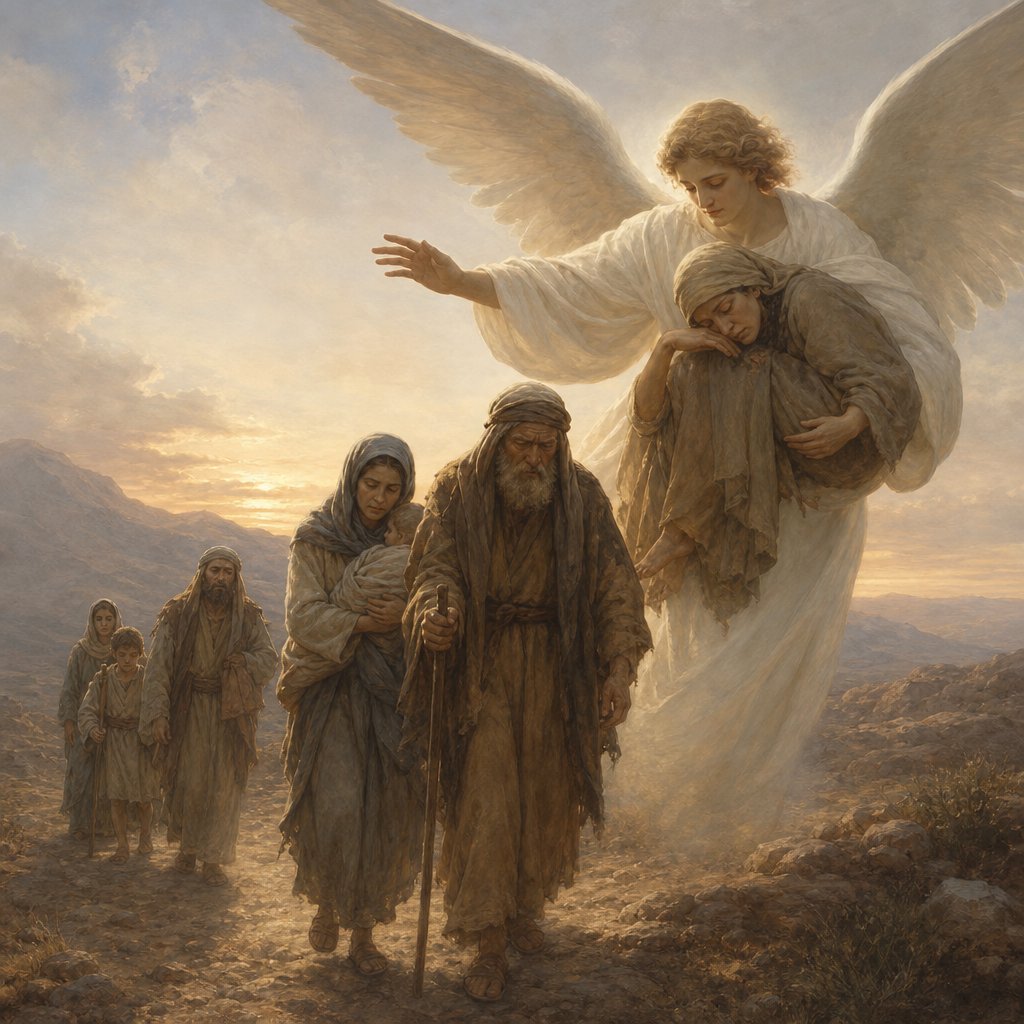
Isaiah 63:9 in the KJV reads, “In all their affliction he was afflicted, and the angel of his presence saved them: in his love and in his pity he redeemed them; and he bare them, and carried them all the days of old.” It stands as a concentrated remembrance of how the LORD dealt with Israel in the days of the Exodus and wilderness, and it is placed in Isaiah as a confession that looks backward in order to make sense of the present crisis and to plead for mercy. The surrounding passage (Isaiah 63:7–14) is a rehearsing of “the lovingkindnesses of the LORD,” a deliberate act of recalling God’s former acts of salvation so that faith can speak in a time when the nation feels forsaken. Just before this, Isaiah 63:1–6 presents the LORD as the divine warrior coming from Edom with garments stained from judgment; immediately after, Isaiah 63:10 turns to Israel’s grievous response: “But they rebelled, and vexed his holy Spirit.” Verse 9 therefore sits at the hinge between God’s saving compassion and Israel’s later rebellion, emphasizing both the depth of God’s mercy and the tragedy of human unfaithfulness.
The first clause, “In all their affliction he was afflicted,” declares divine compassion in the plainest terms. The verse does not portray a distant deity who merely issues decrees; it portrays the covenant God as identifying with the suffering of his people. Their troubles are not indifferent events to him. In the memory of Israel’s story, this resonates with the oppression in Egypt, the cries of the enslaved, and the hardships of the wilderness. The wording gives the sense that when his people were pressed down, he did not stand apart as a spectator, but took their distress as his own. That idea becomes a foundation for prayer: if God once regarded their pain as his pain, then he can be appealed to again as One whose heart is moved by the affliction of those he calls his own.
Next comes, “and the angel of his presence saved them.” The expression “angel of his presence” is rich with symbolism. In KJV language, an “angel” is a messenger, but here the messenger is defined by “his presence,” meaning the nearness and personal involvement of the LORD himself. The phrase suggests that the deliverance of Israel was not merely an impersonal providence; it was God drawing near in a saving way. In Exodus imagery, God’s presence is associated with leading, guarding, and manifesting himself among his people. The “angel of his presence” therefore functions as a sign that salvation is not simply an act God performs at a distance; it is his presence entering the danger, guiding through it, and overcoming it. The verse is not merely recounting that help came, but that help came as the LORD’s own nearness, a presence that rescues.
Then Isaiah says, “in his love and in his pity he redeemed them.” “Redeemed” in KJV carries the sense of deliverance by reclaiming, as a kinsman-redeemer would rescue and restore what belongs to him. It is covenant language: God’s relationship to Israel is not that of a hired protector but of One who claims them as his own. The motives are named as “love” and “pity,” which together show both steadfast affection and tender compassion. Love speaks of covenant loyalty and chosen commitment; pity speaks of mercy toward weakness and misery. Redemption is thus not described as a bargain Israel earned, but as an act arising from God’s own heart. This is especially significant in the context of Isaiah, where the people’s sins and failures are repeatedly exposed; the prophet’s memory of redemption insists that the deepest reason for salvation lies not in Israel’s worthiness but in God’s lovingkindness.
The final clause gathers the imagery into a picture of sustained care: “and he bare them, and carried them all the days of old.” The language evokes a fatherly or shepherd-like tenderness, even the way one might carry a child who cannot walk. It portrays not only a single dramatic rescue but ongoing support through time. “Bare” suggests lifting a burden; “carried” suggests continued conveyance and preservation. “All the days of old” anchors it in Israel’s foundational history, especially the long stretch of wilderness wandering when survival itself testified to divine care. The verse thus teaches that God’s redemption was not merely an exit from Egypt but a continual bearing up of a people who would otherwise collapse under their own frailty and the harshness of their journey.
Within Isaiah 63’s broader movement, verse 9 functions as an argument built from remembrance. The prophet recounts what God was like toward “them” in earlier days: compassionate in affliction, present to save, loving and pitiful in redemption, patient and sustaining over time. But this memory is not sentimental; it is morally charged, because the next verse speaks of rebellion and the vexing of “his holy Spirit.” That juxtaposition highlights the gravity of sin: it is not merely breaking rules but repaying compassion with resistance. At the same time, it deepens the appeal for mercy later in the chapter, because the people who pray are leaning on God’s revealed character. If he saved in love and pity before, then his own name and nature become the ground of hope even after failure.
The significance of Isaiah 63:9, using KJV terms, is that it portrays redemption as personal presence and shared affliction, not abstract rescue; it roots salvation in “love” and “pity,” not in merit; and it frames God’s historical dealings with Israel as sustained carrying, not momentary intervention. The verse is therefore a window into the covenant heart of God as Isaiah presents him: a Redeemer who draws near, who is moved by the distress of his people, who saves by his presence, and who supports over long seasons—truths recalled precisely because the present hour needs that ancient mercy to be remembered and sought again.
Get our apps


Artwork for Isaiah 63:9

"In all their affliction he was afflicted, and the angel of his presence saved them: in his love and in his pity he redeemed them; and he bare them, and carried them all the days of old." - Isaiah 63:9

Isaiah 63:9 - "In all their affliction he was afflicted, and the angel of his presence saved them: in his love and in his pity he redeemed them; and he bare them, and carried them all the days of old."

Isaiah 63:9 In all their affliction He was afflicted, And the Angel of His Presence saved them; In His love and in His pity He redeemed them; And He bore them and carried them All the days of old.

"In all their affliction he was afflicted, and the angel of his presence saved them: in his love and in his pity he redeemed them; and he bare them, and carried them all the days of old." - Isaiah 63:9
"In all their affliction he was afflicted, and the angel of his presence saved them: in his love and in his pity he redeemed them; and he bare them, and carried them all the days of old." - Isaiah 63:9

Isaiah 63:13 - "That led them through the deep, as an horse in the wilderness, that they should not stumble?"

Isaiah 63:4 - "For the day of vengeance is in mine heart, and the year of my redeemed is come."

Isaiah 63:8 - "For he said, Surely they are my people, children that will not lie: so he was their Saviour."

Isaiah 63:2 - "Wherefore art thou red in thine apparel, and thy garments like him that treadeth in the winefat?"

Isaiah 63:19 - "We are thine: thou never barest rule over them; they were not called by thy name."

Psalms 63:9 - "But those that seek my soul, to destroy it, shall go into the lower parts of the earth."

Isaiah 63:10 - "¶ But they rebelled, and vexed his holy Spirit: therefore he was turned to be their enemy, and he fought against them."

Isaiah 63:18 - "The people of thy holiness have possessed it but a little while: our adversaries have trodden down thy sanctuary."

Isaiah 63:12 - "That led them by the right hand of Moses with his glorious arm, dividing the water before them, to make himself an everlasting name?"

Isaiah 63:6 - "And I will tread down the people in mine anger, and make them drunk in my fury, and I will bring down their strength to the earth."

"For the day of vengeance is in mine heart, and the year of my redeemed is come." - Isaiah 63:4

"That led them through the deep, as an horse in the wilderness, that they should not stumble?" - Isaiah 63:13

Isaiah 63:14 - "As a beast goeth down into the valley, the Spirit of the LORD caused him to rest: so didst thou lead thy people, to make thyself a glorious name."

Isaiah 63:1 - "Who is this that cometh from Edom, with dyed garments from Bozrah? this that is glorious in his apparel, travelling in the greatness of his strength? I that speak in righteousness, mighty to save."

"Who is this that cometh from Edom, with dyed garments from Bozrah? this that is glorious in his apparel, travelling in the greatness of his strength? I that speak in righteousness, mighty to save." - Isaiah 63:1

Isaiah 63:5 - "And I looked, and there was none to help; and I wondered that there was none to uphold: therefore mine own arm brought salvation unto me; and my fury, it upheld me."

Isaiah 63:2 Why is Your apparel red, And Your garments like one who treads in the winepress?

"For he said, Surely they are my people, children that will not lie: so he was their Saviour." - Isaiah 63:8

Isaiah 63:17 - "¶ O LORD, why hast thou made us to err from thy ways, and hardened our heart from thy fear? Return for thy servants' sake, the tribes of thine inheritance."

Isaiah 63:16 - "Doubtless thou art our father, though Abraham be ignorant of us, and Israel acknowledge us not: thou, O LORD, art our father, our redeemer; thy name is from everlasting."

Isaiah 63:15 - "¶ Look down from heaven, and behold from the habitation of thy holiness and of thy glory: where is thy zeal and thy strength, the sounding of thy bowels and of thy mercies toward me? are they restrained?"

"Wherefore art thou red in thine apparel, and thy garments like him that treadeth in the winefat?" - Isaiah 63:2

Isaiah 63:10 But they rebelled and grieved His Holy Spirit; So He turned Himself against them as an enemy, And He fought against them.

"But those that seek my soul, to destroy it, shall go into the lower parts of the earth." - Psalms 63:9

Isaiah 63:11 - "Then he remembered the days of old, Moses, and his people, saying, Where is he that brought them up out of the sea with the shepherd of his flock? where is he that put his holy Spirit within him?"