What does James 1:17 mean?
“Every good gift and every perfect gift is from above, and cometh down from the Father of lights, with whom is no variableness, neither shadow of turning.” — James 1:17
James 1:17 in the KJV reads, “Every good gift and every perfect gift is from above, and cometh down from the Father of lights, with whom is no variableness, neither shadow of turning.” In the flow of James 1, this sentence functions like a clear boundary stone between two different sources: what arises out of fallen desire and what descends from God. Immediately before it James insists that God is not the author of evil temptation: “Let no man say when he is tempted, I am tempted of God: for God cannot be tempted with evil, neither tempteth he any man” (James 1:13). He then explains that temptation’s engine is not heavenward but inward, when “every man is tempted, when he is drawn away of his own lust, and enticed” (James 1:14), and that this path matures into ruin: “lust… bringeth forth sin: and sin… bringeth forth death” (James 1:15). Into that dark chain of cause and effect James inserts a corrective: “Do not err, my beloved brethren” (James 1:16). James 1:17 is the substance of that correction. If sin and death have a human-originating trajectory, then goodness has a divine-originating trajectory. What is truly good does not climb up from us to God as though we manufactured it; it “is from above,” and “cometh down.”
The verse’s first emphasis is on God as the source of all true beneficence: “Every good gift and every perfect gift is from above.” In James, “good” and “perfect” are not presented as accidental qualities that sometimes attach to gifts; they describe the character of what God gives in contrast to the destructive “gift” of lust that ends in death. The repetition of “gift” presses the thought that God’s dealings with his people are fundamentally giving, not exploiting; he is not a deceiver who lures by temptation, but a Father who supplies what is good. James is also speaking pastorally to believers who are enduring “temptations” in the sense of trials (James 1:2). In that pressure, it is easy to misread circumstances and imagine God as capricious, withholding, or harsh. James 1:17 insists that behind and above the believer’s shifting experiences there stands a steady Giver, and that whatever is genuinely “good” and “perfect” in a believer’s life bears the mark of its origin: it comes “down” from God.
The language “from above” and “cometh down” is a deliberate vertical symbolism. It portrays God as transcendent and sovereign, the One who initiates blessing. It also quietly humbles human pride. If the best gifts descend, then they are not earned as wages, nor seized as prey, nor produced as self-made virtue; they are received. This fits the larger movement of the chapter, which later says of God, “Of his own will begat he us with the word of truth” (James 1:18). The new birth itself is presented as something God does, springing from “his own will.” James 1:17 prepares for that by establishing the consistent pattern of God’s action: God gives, and what he gives is good.
James then names God as “the Father of lights.” This title carries rich biblical resonance. “Lights” evokes the heavenly luminaries—the sun, moon, and stars—set in the heavens, which in Scripture are often associated with God’s creative power and ordering wisdom. Calling God their “Father” identifies him not only as their maker but as the origin of their shining. Light in Scripture regularly symbolizes purity, truth, and life; it exposes what is hidden and guides the path. By choosing this title here, James is not merely being poetic. He is reinforcing the moral argument of the paragraph: the God who is “Father of lights” is not the source of darkness. Temptation that leads to sin and death belongs to another realm; God’s realm is light, and his gifts bear light’s character—goodness, clarity, and life-giving purpose.
The next clause presses the most pointed theological claim of the verse: “with whom is no variableness, neither shadow of turning.” James contrasts God’s unchanging nature with the instability that characterizes both human desire and the created lights themselves. The heavenly lights visibly “turn” and cast “shadows.” The sun’s position shifts; days lengthen and shorten; shadows move across the earth. Yet God, though he is called the Father of those lights, does not share their mutability. The phrase “no variableness” asserts that God does not alter in his character, intentions, or goodness. The phrase “neither shadow of turning” uses the imagery of shifting light and shade to deny even the slightest trace of fluctuation in God—no passing dimness, no momentary eclipse, no change that would make him sometimes generous and sometimes malicious. In context, this directly answers the temptation to “err” by blaming God for one’s temptation or imagining that God’s posture toward his children changes with circumstances. James anchors the believer’s confidence not in the believer’s steadiness, but in God’s.
That unchanging goodness is especially significant in a chapter preoccupied with instability. Earlier James describes “a double minded man” as “unstable in all his ways” (James 1:8). Human beings shift; desires surge and fade; circumstances alter; emotions fluctuate; even the rich man’s outward prosperity is portrayed as passing away like a flower (James 1:10–11). Against all of that, James 1:17 sets God as the fixed point. If God does not vary, then faith has a stable object, and endurance in trial is not wishful thinking but a rational trust in the consistent Father who gives what is good.
Taken together, the verse teaches that God is the consistent source of all that is truly beneficial, that his giving is not sporadic or moody but flows from his unchanging nature, and that the believer must not confuse the inward origin of temptation with the heavenly origin of goodness. It also prepares the reader to receive the next statement—“Of his own will begat he us with the word of truth” (James 1:18)—as the supreme example of a “good” and “perfect” gift: God’s saving act, initiated from above, rooted in his will, and characterized by light and truth rather than shadow and turning. In prose, James 1:17 stands as a lighthouse in the chapter: when trials, temptations, and inner conflicts threaten to distort one’s view of God, it insists that God remains what he has always been—the Father of lights, the unchanging Giver, from whom every good and perfect gift comes down.
Get our apps


Artwork for James 1:17

James 1:17

James 1:17

James 1:17

James 1:17

James 1:17

James 1:17-22
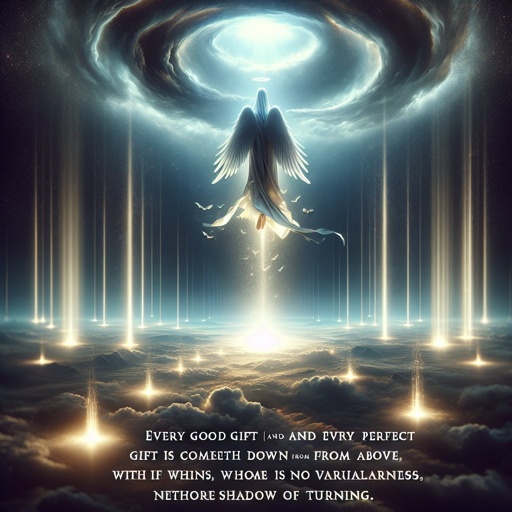
James 1:17 - "Every good gift and every perfect gift is from above, and cometh down from the Father of lights, with whom is no variableness, neither shadow of turning."

"Every good gift and every perfect gift is from above, and cometh down from the Father of lights, with whom is no variableness, neither shadow of turning." - James 1:17
James 1:17-18 Every good and perfect gift is from above, coming down from the Father of the heavenly lights, who does not change like shifting shadows. He chose to give us birth through the word of truth, that we might be a kind of firstfruits of all he created.
James 1:17-18 Every good and perfect gift is from above, coming down from the Father of the heavenly lights, who does not change like shifting shadows. He chose to give us birth through the word of truth, that we might be a kind of firstfruits of all he created.

"Every good gift and every perfect gift is from above, and cometh down from the Father of lights, with whom is no variableness, neither shadow of turning." - James 1:17

"Every good gift and every perfect gift is from above, and cometh down from the Father of lights, with whom is no variableness, neither shadow of turning." - James 1:17

JAMES 4:17

Matthew 17:1 - "And after six days Jesus taketh Peter, James, and John his brother, and bringeth them up into an high mountain apart,"

Mark 3:17 - "And James the son of Zebedee, and John the brother of James; and he surnamed them Boanerges, which is, The sons of thunder:"

James 1:7 - "For let not that man think that he shall receive any thing of the Lord."

James 4:17 - "Therefore to him that knoweth to do good, and doeth it not, to him it is sin."

James 2:17 - "Even so faith, if it hath not works, is dead, being alone."

1 Esdras 1:17 (KJVA) 17 Thus were the things that belonged to the sacrifices of the Lord accomplished in that day, that they might hold the passover,

James 1:1 - "James, a servant of God and of the Lord Jesus Christ, to the twelve tribes which are scattered abroad, greeting."
"For let not that man think that he shall receive any thing of the Lord." - James 1:7

James

Matthew 17:1-3: After six days Jesus took with him Peter, James and John the brother of James, and led them up a high mountain by themselves. 2 There he was transfigured before them. His face shone like the sun, and his clothes became as white as the light. 3 Just then there appeared before them Moses and Elijah, talking with Jesus.

Matthew 17:1-3: After six days Jesus took with him Peter, James and John the brother of James, and led them up a high mountain by themselves. 2 There he was transfigured before them. His face shone like the sun, and his clothes became as white as the light. 3 Just then there appeared before them Moses and Elijah, talking with Jesus.

Matthew 17:1-3: After six days Jesus took with him Peter, James and John the brother of James, and led them up a high mountain by themselves. 2 There he was transfigured before them. His face shone like the sun, and his clothes became as white as the light. 3 Just then there appeared before them Moses and Elijah, talking with Jesus.

"And James the son of Zebedee, and John the brother of James; and he surnamed them Boanerges, which is, The sons of thunder:" - Mark 3:17

James 1: 2-4

James 1:2-4

James 1:22

James 1:19