What does James 5:13 mean?
“Is any among you afflicted? let him pray. Is any merry? let him sing psalms.” — James 5:13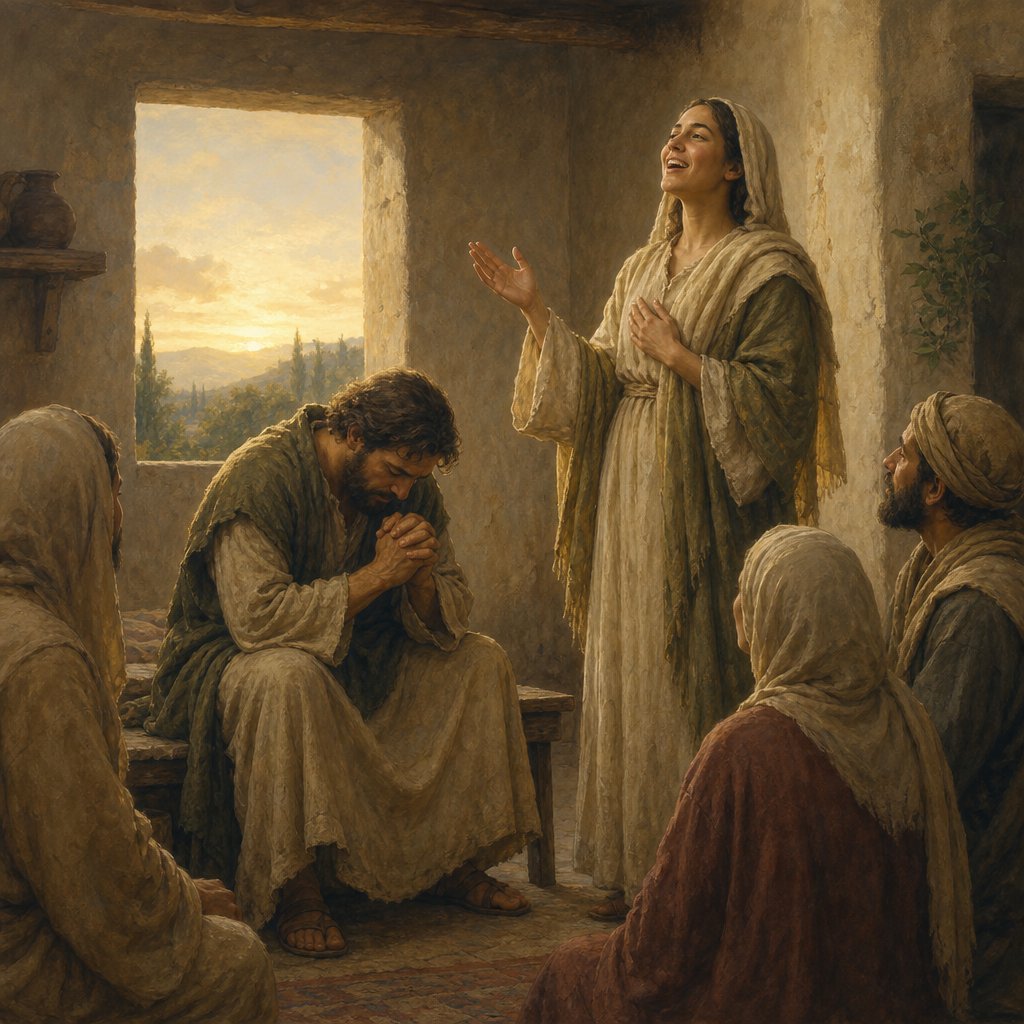
“Is any among you afflicted? let him pray. Is any merry? let him sing psalms.” (James 5:13, KJV)
In this verse James gathers the whole range of ordinary human experience into two plain conditions—affliction and cheer—and he assigns to each a fitting, Godward response. He is not offering a vague encouragement to “be spiritual,” but giving pastoral direction for how a believing community is to interpret life as it actually comes: when trouble presses, the first motion of the soul is to be prayerful; when gladness rises, the first motion of the soul is to be worshipful. James is teaching that the believer’s reflex, whether in sorrow or in joy, ought to turn toward God rather than inward into despair or outward into forgetfulness.
The immediate context is James’s closing exhortations. Just before this, he has spoken of patience in suffering, of the coming of the Lord, of the prophets as examples of enduring affliction, and of Job as a witness to God’s compassion and mercy. That atmosphere matters. James has been addressing real pressure: oppression, sickness, weariness, the temptation to speak rashly or to lose heart. Against that background, “Is any among you afflicted?” is not merely a theoretical question. It is the voice of a shepherd to scattered believers who know what hardship is. The remedy he gives is not first a change of circumstances but a change of direction: “let him pray.” Affliction is treated as a summons into communion with God. Prayer becomes the language of dependence, the acknowledgment that God remains sovereign, present, and able even when the believer is weak.
The second half of the verse balances the first. James does not only provide counsel for the dark day; he also provides counsel for the bright day. “Is any merry?” is an equally spiritual question. Cheerfulness can be as spiritually dangerous as suffering, because joy can loosen the heart’s vigilance and lead to self-congratulation or to living as though God were unnecessary. James therefore teaches that merriness is not to be wasted on empty noise but gathered up into praise: “let him sing psalms.” In other words, joy is to be sanctified. The happy believer is not merely to feel glad, but to interpret gladness as a gift and to answer it with thanksgiving.
The themes running through the verse are simplicity, wholeness, and God-centeredness. James is deliberately practical. He does not separate the “religious” from the “real.” The afflicted do not graduate out of prayer because life hurts; that is precisely when prayer is most fitting. The merry do not set worship aside because life is pleasant; that is precisely when worship guards the heart from pride and forgetfulness. Together these two commands insist that every season has a holy response. The believer’s life is meant to be a continual turning: prayer in pain, praise in pleasure.
There is also a quiet communal emphasis in the words “among you.” James speaks to the church as a body, implying that within the same fellowship some will be afflicted while others are merry. The verse therefore carries a subtle call to mutual understanding and spiritual maturity. In a living congregation, sorrow and song coexist. When one suffers, prayer should rise; when another rejoices, psalms should be heard. The health of the community is measured in part by whether both responses are present and sincere.
Symbolically, the two actions—prayer and psalm—cover the vertical dimension of life. Prayer is need spoken toward God; psalms are gratitude sung toward God. Prayer often rises from emptiness; psalms often overflow from fullness. Yet both are forms of worship, both are acts of faith, and both confess that God is the true horizon of the believer’s experience. In affliction, prayer refuses the symbolism of abandonment; it asserts that suffering is not proof that God is absent. In merriness, singing psalms refuses the symbolism of self-sufficiency; it asserts that joy is not proof that God is unnecessary.
The choice of “psalms” is especially meaningful in KJV language. James does not merely say, “let him sing,” as though any expression will do. He says, “let him sing psalms,” directing joy into the scriptural vocabulary of praise. The Psalms are filled with the whole range of human emotion—lament, confession, longing, triumph, thanksgiving—and so they teach the believer to rejoice with reverence and truth. Even when the heart is light, the psalm keeps worship anchored in God’s character and works, not merely in passing moods. It also implies that the believer’s song is not entertainment but testimony; it is joy shaped by the word of God.
The significance of James 5:13, then, is its insistence that God is to be approached in every condition and that spiritual life is not suspended by circumstance. Affliction is not an excuse for silence toward heaven but a reason to pray. Merriness is not an excuse to drift into forgetfulness but a reason to sing psalms. James places the whole believer under a holy discipline: whatever comes, respond in a way that keeps the heart turned toward the Lord. In that sense the verse is a small map for daily faithfulness, teaching that the Christian’s first instinct—whether in tears or in laughter—should be communion with God.
Get our apps


Artwork for James 5:13

James 5:13 - "Is any among you afflicted? let him pray. Is any merry? let him sing psalms."
"Is any among you afflicted? let him pray. Is any merry? let him sing psalms." - James 5:13

James 5:13-16 - "Is anyone among you suffering? Let him pray. Is anyone cheerful? Let him sing psalms. Is anyone among you sick? Let him call for the elders of the church, and let them pray over him, anointing him with oil in the name of the Lord. And the prayer of faith will save the sick, and the Lord will raise him up. And if he has committed sins, he will be forgiven. Confess your trespasses to one another, and pray for one another, that you may be healed. The effective, fervent prayer of a righteous man avails much."

"Is anyone among you suffering? Let him pray. Is anyone cheerful? Let him sing psalms. Is anyone among you sick? Let him call for the elders of the church, and let them pray over him, anointing him with oil in the name of the Lord. And the prayer of faith will save the sick, and the Lord will raise him up. And if he has committed sins, he will be forgiven. Confess your trespasses to one another, and pray for one another, that you may be healed. The effective, fervent prayer of a righteous man avails much." - James 5:13-16

Mark 5:37 - "And he suffered no man to follow him, save Peter, and James, and John the brother of James."

James 5:16

James 5:16

James 5:16

James 5:16

James 1:2-13

James 1:2-13

Acts 1:13 - "And when they were come in, they went up into an upper room, where abode both Peter, and James, and John, and Andrew, Philip, and Thomas, Bartholomew, and Matthew, James the son of Alphaeus, and Simon Zelotes, and Judas the brother of James."
James 21:5-120

James 1:5-20

James 5:14-15

James 5:7 – "Be patient, then, brothers and sisters, until the Lord’s coming."

James 5:7 – "Be patient, then, brothers and sisters, until the Lord’s coming."

James 5:2 - "Your riches are corrupted, and your garments are motheaten."

James 5:5 - "Ye have lived in pleasure on the earth, and been wanton; ye have nourished your hearts, as in a day of slaughter."

James 5:6 - "Ye have condemned and killed the just; and he doth not resist you."

"And he suffered no man to follow him, save Peter, and James, and John the brother of James." - Mark 5:37

James 5:8 - "Be ye also patient; stablish your hearts: for the coming of the Lord draweth nigh."

James 5:19 - "Brethren, if any of you do err from the truth, and one convert him;"

Matthew 13:55 - "Is not this the carpenter's son? is not his mother called Mary? and his brethren, James, and Joses, and Simon, and Judas?"

Acts 15:13 - "¶ And after they had held their peace, James answered, saying, Men and brethren, hearken unto me:"

James 4:5 - "Do ye think that the scripture saith in vain, The spirit that dwelleth in us lusteth to envy?"

James 5:18 - "And he prayed again, and the heaven gave rain, and the earth brought forth her fruit."

James 2:13 - "For he shall have judgment without mercy, that hath shewed no mercy; and mercy rejoiceth against judgment."

James 5:1 - "Go to now, ye rich men, weep and howl for your miseries that shall come upon you."

James 5:9 - "Grudge not one against another, brethren, lest ye be condemned: behold, the judge standeth before the door."