What does Jeremiah 13:7 mean?
"Then I went to Euphrates, and digged, and took the girdle from the place where I had hid it: and, behold, the girdle was marred, it was profitable for nothing." - Jeremiah 13:7
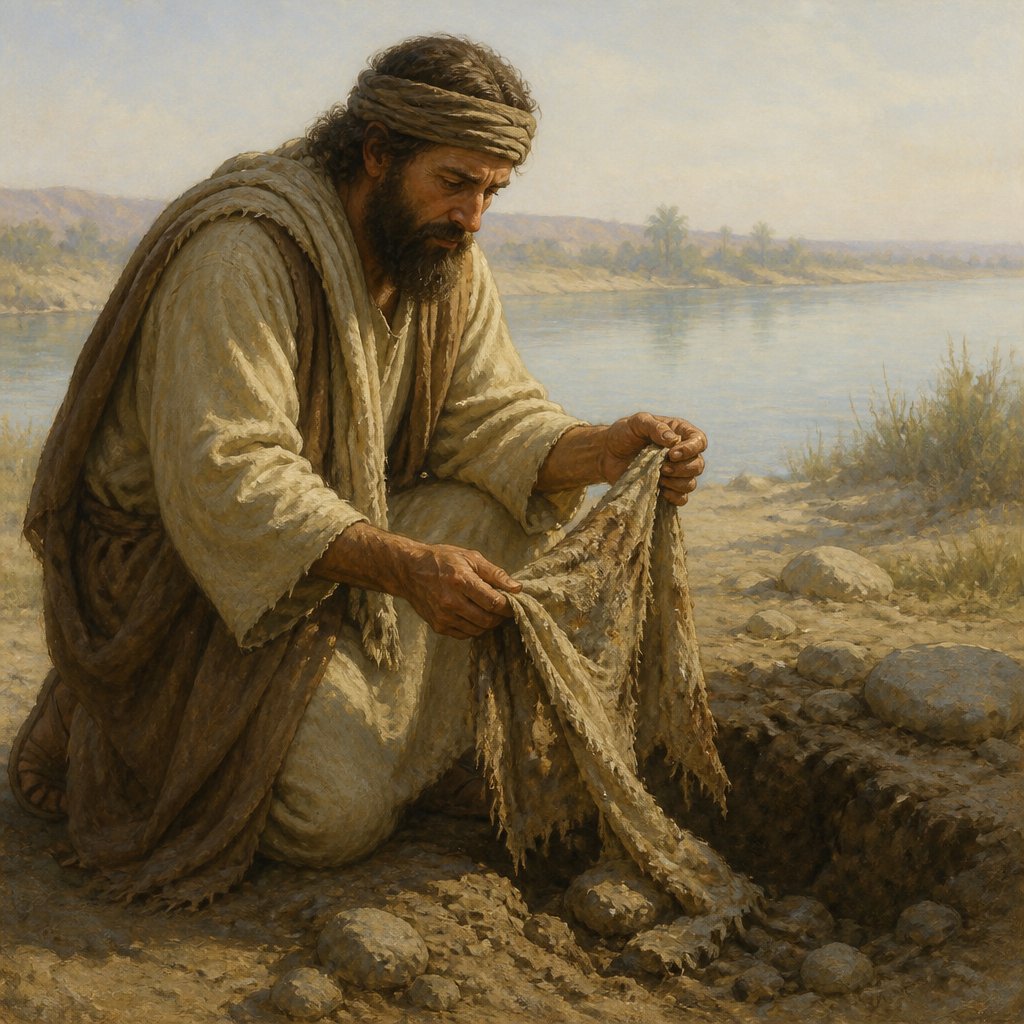
The verse Jeremiah 13:7 from the King James Version of the Bible reads: "Then I went to Euphrates, and digged, and took the girdle from the place where I had hid it: and, behold, the girdle was marred, it was profitable for nothing." This verse is part of a larger passage in which God uses the prophet Jeremiah to convey a powerful message to the people of Judah.
The context of this verse is important for gaining a deeper understanding of its meaning. In this passage, Jeremiah is told by God to take a linen girdle and hide it in a cleft of the rock near the Euphrates River. After some time, God instructs Jeremiah to retrieve the girdle. However, when he does so, he finds that it has become ruined and is no longer profitable.
The broader context of the book of Jeremiah provides insight into the significance of this message. The prophet Jeremiah was called by God to deliver a message of judgment and warning to the people of Judah. The nation had turned away from God and embraced idolatry, immorality, and social injustice. As a result, God was preparing to bring judgment upon them in the form of the Babylonian exile.
The symbolism of the ruined girdle in Jeremiah 13:7 is a powerful metaphor for the spiritual condition of the people of Judah. The girdle, which was originally a symbol of strength and support, had become worthless and ruined. This serves as a representation of the people's spiritual decay and moral corruption. Despite being chosen and set apart by God, they had become marred and unprofitable, just like the girdle.
The significance of the Euphrates River in this verse is also noteworthy. The Euphrates was a well-known and significant river in the ancient Near East, and it often carried symbolic connotations in Hebrew prophecy. In this context, it can be seen as a reminder of the historical events related to the Babylonian exile, which were soon to come upon Judah. The river serves as a geographical and historical marker, emphasizing the certainty of God's judgment upon the nation.
Another important theme in this verse is the concept of obedience and disobedience. The people of Judah had been given clear instructions from God, but they had chosen to disobey and walk in their own ways. The ruined girdle serves as a visual demonstration of the consequences of their disobedience. It shows that when God's commands are disregarded, there are grave consequences.
Additionally, this passage can also be seen as a reflection of God's faithfulness and the unchanging nature of His character. Despite the people's unfaithfulness, God remained steadfast in His commitment to them. Through Jeremiah, He continued to reach out to the people, calling them to repentance and offering them the opportunity to turn back to Him.
In conclusion, Jeremiah 13:7 is a powerful and vivid illustration of the spiritual condition of the people of Judah and the impending judgment that awaited them. It serves as a warning against disobedience and a reminder of the consequences of turning away from God. The ruined girdle at the Euphrates River symbolizes the people's spiritual decay and the unchanging nature of God's character. Ultimately, this verse carries a timeless message about the importance of obedience, repentance, and the faithfulness of God.
Have questions about Jeremiah 13:7?
Dive deeper into this scripture with Bible Chat — an AI-powered tool for exploring God's Word through conversation. Ask questions, get context, and grow in your understanding of the Bible.
Get Our Apps


Jeremiah 13:7 Artwork

Jeremiah 13:7 - "Then I went to Euphrates, and digged, and took the girdle from the place where I had hid it: and, behold, the girdle was marred, it was profitable for nothing."
"Then I went to Euphrates, and digged, and took the girdle from the place where I had hid it: and, behold, the girdle was marred, it was profitable for nothing." - Jeremiah 13:7

Jeremiah 7:13 - "And now, because ye have done all these works, saith the LORD, and I spake unto you, rising up early and speaking, but ye heard not; and I called you, but ye answered not;"

Jeremiah 38:13 - "So they drew up Jeremiah with cords, and took him up out of the dungeon: and Jeremiah remained in the court of the prison."

Jeremiah 29:11-13

Jeremiah 29:11-13

Jeremiah 29:11-13

Jeremiah 29:11-13

Jeremiah 7:1 - "The word that came to Jeremiah from the LORD, saying,"

Jeremiah 13:23

Jeremiah 42:7 - "¶ And it came to pass after ten days, that the word of the LORD came unto Jeremiah."

Jeremiah 38:1–13

Jeremiah 46:13 - "¶ The word that the LORD spake to Jeremiah the prophet, how Nebuchadrezzar king of Babylon should come and smite the land of Egypt."

Jeremiah 26:7 - "So the priests and the prophets and all the people heard Jeremiah speaking these words in the house of the LORD."

1 Chronicles 12:13 - "Jeremiah the tenth, Machbanai the eleventh."

Jeremiah 17:7-8

Jeremiah 17:7-8

Jeremiah 17:7-8

Jeremiah 17:7-8

Jeremiah 13:8 - "Then the word of the LORD came unto me, saying,"

Jeremiah 32:13 - "¶ And I charged Baruch before them, saying,"

"The word that came to Jeremiah from the LORD, saying," - Jeremiah 7:1

Jeremiah 7:7 - "Then will I cause you to dwell in this place, in the land that I gave to your fathers, for ever and ever."

Matthew 7:13-14

Matthew 7:13-14

Matthew 7:13-14

Matthew 7:13-14

Matthew 7:13-14

Matthew 7:13-14

Matthew 7:13-14