What does Job 25:3 mean?
“Is there any number of his armies? and upon whom doth not his light arise?” — Job 25:3
Job 25:3 from the King James Version (KJV) of the Bible reads: "Is there any number of his armies? and upon whom doth not his light arise?"
This verse is part of a conversation amongst Job and his friends, in which they are discussing the power and majesty of God. The friend speaking here is Bildad, who is attempting to remind Job of the limitless nature of God's power and the futility of attempting to understand it with human reasoning.
The verse opens with the question, "Is there any number of his armies?" This serves as a rhetorical question, with the implied answer being that there is no number that can be assigned to God's armies. This speaks to the vastness and incomprehensibility of God's power. The idea of armies also brings to mind the notion of God as a warrior, which is a common theme throughout the Bible. In this context, it serves to emphasize the strength and might of God.
The verse then continues, "and upon whom doth not his light arise?" This phrase speaks to the pervasiveness of God's presence and influence. Light is often used as a symbol of truth, righteousness, and enlightenment in the Bible. In this context, it suggests that God's guidance and influence are available to all, shining upon every corner of the earth and reaching every individual.
In the larger context of the Book of Job, this verse is part of a series of speeches in which Job and his friends grapple with the nature of suffering and the concept of divine justice. Bildad is attempting to remind Job of the vastness and power of God in order to encourage him to submit himself to God's will and trust in his wisdom, even in the midst of his suffering. The verse serves as a reminder of the sovereignty and omnipotence of God, and the insufficiency of human understanding in the face of such grandeur.
The themes present in this verse are the omnipotence and omnipresence of God, as well as the limitations of human understanding. The imagery of armies and light serve as symbols of God's power and guidance, respectively. These themes and symbols are recurring throughout the Bible, and serve to emphasize the transcendence and immanence of God, as well as the humility and reverence with which humans should approach him.
In conclusion, Job 25:3 serves as a powerful reminder of the vastness and incomprehensibility of God's power and presence. It is a call to humility and submission in the face of the divine, and a recognition of the limitations of human understanding. The images of armies and light serve to emphasize the strength and guidance of God, and the pervasiveness of his influence. This verse is a potent reflection on the nature of God and the relationship between humans and the divine, and it continues to resonate with readers as a profound meditation on the awe-inspiring majesty of God.
Get our apps


Artwork for Job 25:3

Job 25:3 - "Is there any number of his armies? and upon whom doth not his light arise?"

"Is there any number of his armies? and upon whom doth not his light arise?" - Job 25:3

Job 3:25 - "For the thing which I greatly feared is come upon me, and that which I was afraid of is come unto me."

Job 39:13-25

Job 25:1 - "Then answered Bildad the Shuhite, and said,"

Job 3:2 - "And Job spake, and said,"

"For the thing which I greatly feared is come upon me, and that which I was afraid of is come unto me." - Job 3:25

Job 40:3 - "¶ Then Job answered the LORD, and said,"

Job 28:25 - "To make the weight for the winds; and he weigheth the waters by measure."

Job 21:25 - "And another dieth in the bitterness of his soul, and never eateth with pleasure."

Job 30:25 - "Did not I weep for him that was in trouble? was not my soul grieved for the poor?"

Job 25:5 - "Behold even to the moon, and it shineth not; yea, the stars are not pure in his sight."

Job 36:25 - "Every man may see it; man may behold it afar off."

Job 6:25 - "How forcible are right words! but what doth your arguing reprove?"

Job 3:1 - "After this opened Job his mouth, and cursed his day."

Job 25:2 - "Dominion and fear are with him, he maketh peace in his high places."

Job 25:6 - "How much less man, that is a worm? and the son of man, which is a worm?"

Job 38:25 - "Who hath divided a watercourse for the overflowing of waters, or a way for the lightning of thunder;"
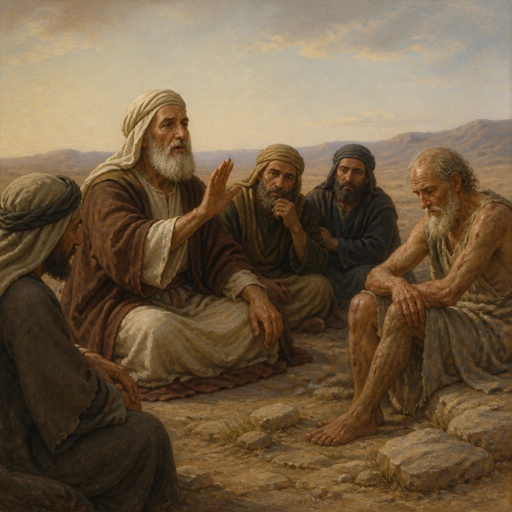
"Then answered Bildad the Shuhite, and said," - Job 25:1

"And Job spake, and said," - Job 3:2

Job 34:25 - "Therefore he knoweth their works, and he overturneth them in the night, so that they are destroyed."

Job 9:25 - "Now my days are swifter than a post: they flee away, they see no good."

Job 22:25 - "Yea, the Almighty shall be thy defence, and thou shalt have plenty of silver."

"¶ Then Job answered the LORD, and said," - Job 40:3

Job 15:25 - "For he stretcheth out his hand against God, and strengtheneth himself against the Almighty."

Job 25:4 - "How then can man be justified with God? or how can he be clean that is born of a woman?"

Job 13:25 - "Wilt thou break a leaf driven to and fro? and wilt thou pursue the dry stubble?"

Job 41:25 - "When he raiseth up himself, the mighty are afraid: by reason of breakings they purify themselves."

Job 39:19-25 – "Do you give the horse its strength or clothe its neck with a flowing mane?"

Job 24:25 - "And if it be not so now, who will make me a liar, and make my speech nothing worth?"