What does Job 32:1 mean?
“So these three men ceased to answer Job, because he was righteous in his own eyes.” — Job 32:1
The verse Job 32:1 in the King James Version (KJV) of the Bible reads, "So these three men ceased to answer Job, because he was righteous in his own eyes." This verse comes at a crucial point in the book of Job, when Job's three friends, Eliphaz, Bildad, and Zophar, have finished their rounds of attempting to console Job in his suffering and have been unable to convince Job to admit to any wrongdoing or sin that might have caused his suffering.
The book of Job is a complex and multifaceted work, dealing with the issues of human suffering, God's justice, and the nature of faith. The verse in question marks a turning point in the narrative, as it sets the stage for the entrance of a new character, Elihu, who will offer his own perspective on Job's situation.
In the context of the broader narrative, the three friends of Job represent conventional wisdom and traditional religious beliefs. They adhere to the idea that suffering is a punishment for sin, and they urge Job to confess to any wrongdoing in order to receive God's forgiveness and restoration. However, despite their repeated attempts to convince Job to admit to sin, Job maintains his innocence and refuses to give in to their demands. This verse signifies the end of their attempts to argue with Job, as they recognize that Job is steadfast in his belief in his own righteousness.
The theme of righteousness and self-perception is central to this verse. Job's friends are unable to persuade him to see himself as a sinner, and they ultimately give up their attempts to argue with him. Job, on the other hand, remains firm in his conviction that he has not committed any grave sin that would warrant the suffering he is experiencing. This raises questions about the nature of righteousness, whether it is self-deception or a genuine understanding of one's own innocence.
The entrance of Elihu, the character who speaks after this verse, brings a new perspective on the situation. Elihu is described as young and thus represents a fresh and perhaps unconventional viewpoint. He offers a critique of both Job and his friends, pointing out their errors and misjudgments. Ultimately, it is clear that the issues at play in the book of Job are far more complex than a simple matter of sin and punishment. The verse sets the stage for a deeper exploration of these themes and the introduction of a new voice to the conversation.
In addition to its thematic significance, the verse can also be seen as a symbol of the limits of human understanding and the complexity of the human experience. Job's friends, despite their earnest efforts, are unable to comprehend the depth of Job's suffering and the complexity of his relationship with God. Job, for his part, is resolute in his belief in his own innocence, despite the evidence to the contrary. This serves to highlight the ways in which human perceptions and judgments can be limited and flawed.
In conclusion, the verse Job 32:1 in the King James Version of the Bible marks a crucial point in the narrative of the book of Job. It signals the end of the attempts of Job's friends to convince him of his sinfulness and righteousness and sets the stage for the entrance of a new character with a fresh perspective. The verse raises deep questions about the nature of righteousness, the limits of human understanding, and the complexities of human suffering. It serves as a symbol of the intricacies of the human experience and the multifaceted nature of faith and belief.
Get our apps


Artwork for Job 32:1

Job 32:1 - "So these three men ceased to answer Job, because he was righteous in his own eyes."

"So these three men ceased to answer Job, because he was righteous in his own eyes." - Job 32:1

Job 32:12 - "Yea, I attended unto you, and, behold, there was none of you that convinced Job, or that answered his words:"

Job 32:4 - "Now Elihu had waited till Job had spoken, because they were elder than he."

Job 32:3 - "Also against his three friends was his wrath kindled, because they had found no answer, and yet had condemned Job."

Job 32:15 - "They were amazed, they answered no more: they left off speaking."

Job 32:8 - "But there is a spirit in man: and the inspiration of the Almighty giveth them understanding."

Job 21:32 - "Yet shall he be brought to the grave, and shall remain in the tomb."

Job 36:32 - "With clouds he covereth the light; and commandeth it not to shine by the cloud that cometh betwixt."

Job 15:32 - "It shall be accomplished before his time, and his branch shall not be green."

Job 32:9 - "Great men are not always wise: neither do the aged understand judgment."

Job 31:32 - "The stranger did not lodge in the street: but I opened my doors to the traveller."

Job 32:18 - "For I am full of matter, the spirit within me constraineth me."

Job 32:16 - "When I had waited, (for they spake not, but stood still, and answered no more;)"

Job 32:2 - "Then was kindled the wrath of Elihu the son of Barachel the Buzite, of the kindred of Ram: against Job was his wrath kindled, because he justified himself rather than God."

Job 32:20 - "I will speak, that I may be refreshed: I will open my lips and answer."

Job 32:7 - "I said, Days should speak, and multitude of years should teach wisdom."

Job 32:10 - "Therefore I said, Hearken to me; I also will shew mine opinion."

Job 32:5 - "When Elihu saw that there was no answer in the mouth of these three men, then his wrath was kindled."

Job 41:32 - "He maketh a path to shine after him; one would think the deep to be hoary."

Job 32:17 - "I said, I will answer also my part, I also will shew mine opinion."

Job 32:19 - "Behold, my belly is as wine which hath no vent; it is ready to burst like new bottles."

Job 33:32 - "If thou hast any thing to say, answer me: speak, for I desire to justify thee."

Job 38:32 - "Canst thou bring forth Mazzaroth in his season? or canst thou guide Arcturus with his sons?"

Job 34:32 - "That which I see not teach thou me: if I have done iniquity, I will do no more."

Job 9:32 - "For he is not a man, as I am, that I should answer him, and we should come together in judgment."

Job 32:22 - "For I know not to give flattering titles; in so doing my maker would soon take me away."

Job 32:14 - "Now he hath not directed his words against me: neither will I answer him with your speeches."

Job 32:13 - "Lest ye should say, We have found out wisdom: God thrusteth him down, not man."
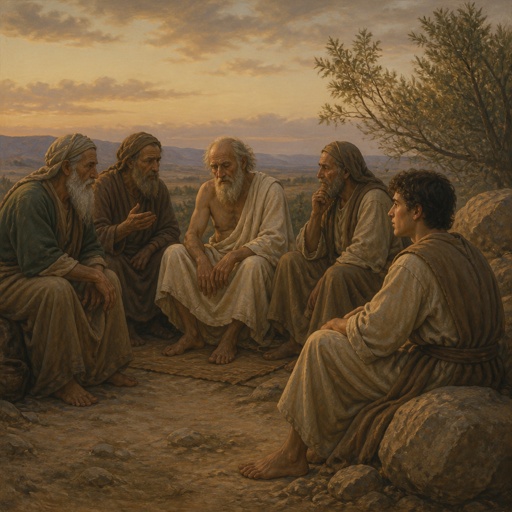
"Now Elihu had waited till Job had spoken, because they were elder than he." - Job 32:4