What does Job 41:20 mean?
“Out of his nostrils goeth smoke, as out of a seething pot or caldron.” — Job 41:20
Job 41:20 in the King James Version of the Bible reads, "Out of his nostrils goeth smoke, as out of a seething pot or caldron." This verse is part of a passage in the Book of Job describing the fearsome sea creature known as Leviathan.
The Book of Job is a complex and enigmatic text, and the Leviathan is a symbol of chaos, destruction, and the untamable power of the natural world. In this particular verse, the imagery of smoke coming out of the creature's nostrils is meant to evoke a sense of awe and dread. The comparison to a seething pot or caldron suggests a violent and turbulent force, capable of great destruction.
The Leviathan is a recurring figure in ancient Near Eastern mythology, and it is often used as a symbol of chaos and evil in the Bible. In Jewish tradition, Leviathan is a sea monster representing the primordial forces of chaos, and its appearance in the Book of Job underscores the power of God to create and control even the most fearsome and uncontrollable elements of the natural world.
The imagery of smoke coming from the creature's nostrils also evokes the idea of fire and brimstone, a common motif in biblical descriptions of divine wrath and judgment. The smoke is a visual manifestation of the Leviathan's power and ferocity, and it serves as a warning to those who would challenge the authority of God.
In a broader thematic sense, the verse can be seen as a meditation on the limits of human knowledge and understanding. The Leviathan is a creature of myth and legend, beyond the scope of human comprehension. By describing its fearsome attributes in vivid and evocative language, the Book of Job invites readers to contemplate the awesome and mysterious nature of creation.
This verse also serves as a reminder of the fundamental power imbalance between humanity and the natural world. The Leviathan is a symbol of the untamable forces of nature, and its portrayal in the Book of Job is a testament to the idea that there are some things in the world that will always remain beyond human control.
Interpreting the verse in its broader context, we can see that it is part of a larger conversation about the nature of suffering and the inscrutable ways of God. The Book of Job tells the story of a righteous man who is tested by seemingly endless trials and tribulations. The Leviathan is invoked as a symbol of the incomprehensible power and wisdom of God, and the verse serves as a reminder that there are forces at work in the world that are beyond human understanding.
In conclusion, Job 41:20 is a rich and evocative verse that contains deep layers of meaning and symbolism. It serves as a reminder of the awesome power and mystery of the natural world, and it invites readers to contemplate the limits of human knowledge and the inscrutable ways of God. The imagery of the smoke coming from the Leviathan's nostrils is a powerful and vivid evocation of the creature's fearsome nature, and it serves as a potent symbol of the untamable forces of chaos and destruction that exist in the world.
Get our apps


Artwork for Job 41:20
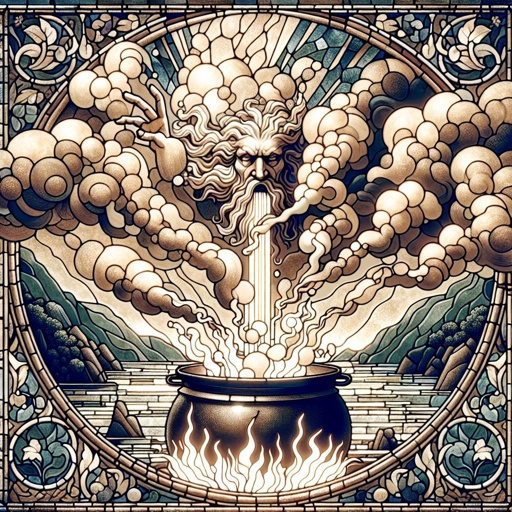
Job 41:20 - "Out of his nostrils goeth smoke, as out of a seething pot or caldron." respectful, symbolic bible verse art

"Out of his nostrils goeth smoke, as out of a seething pot or caldron." - Job 41:20

"Out of his mouth go burning lamps, and sparks of fire leap out. Out of his nostrils goeth smoke, as out of a seething pot or caldron." - Job 41:19-20

Ezekiel 20:41

Ezekiel 20:41

Ezekiel 20:41

Ezekiel 20:41

Ezekiel 20:41

Ezekiel 20:41

Job 41:22 - "In his neck remaineth strength, and sorrow is turned into joy before him."

Job 41:17 - "They are joined one to another, they stick together, that they cannot be sundered."

Job 41:29 - "Darts are counted as stubble: he laugheth at the shaking of a spear."

Job 41:27 - "He esteemeth iron as straw, and brass as rotten wood."

Job 41:33 - "Upon earth there is not his like, who is made without fear."

Job 41:8 - "Lay thine hand upon him, remember the battle, do no more."

Job 41:23 - "The flakes of his flesh are joined together: they are firm in themselves; they cannot be moved."

Job 41:16 - "One is so near to another, that no air can come between them."

Job 41:24 - "His heart is as firm as a stone; yea, as hard as a piece of the nether millstone."

Job 41:15 - "His scales are his pride, shut up together as with a close seal."

Job 41:28 - "The arrow cannot make him flee: slingstones are turned with him into stubble."

Job 41:21 - "His breath kindleth coals, and a flame goeth out of his mouth."

Job 41:26 - "The sword of him that layeth at him cannot hold: the spear, the dart, nor the habergeon."

Job 41:4 - "Will he make a covenant with thee? wilt thou take him for a servant for ever?"

Job 41:18 - "By his neesings a light doth shine, and his eyes are like the eyelids of the morning."

Job 41:19 - "Out of his mouth go burning lamps, and sparks of fire leap out."

Job 41:6 - "Shall the companions make a banquet of him? shall they part him among the merchants?"

Job 41:9 - "Behold, the hope of him is in vain: shall not one be cast down even at the sight of him?"

Job 41:5 - "Wilt thou play with him as with a bird? or wilt thou bind him for thy maidens?"

Job 41:25 - "When he raiseth up himself, the mighty are afraid: by reason of breakings they purify themselves."

Job 41:32 - "He maketh a path to shine after him; one would think the deep to be hoary."