What does Job 8:18 mean?
“If he destroy him from his place, then it shall deny him, saying, I have not seen thee.” — Job 8:18
Job 8:18 in the King James Version of the Bible reads, "If he destroy him from his place, then it shall deny him, saying, I have not seen thee." This verse is part of a larger conversation between Job and his friends, who are attempting to provide explanations for Job's suffering.
In order to fully understand the meaning of this verse, it is necessary to delve into the context of the book of Job as a whole. The book of Job is a complex and thought-provoking exploration of the nature of suffering and the human experience. The central character, Job, is a righteous and devout man who experiences a series of unimaginable tragedies, including the loss of his children, his wealth, and his health. As Job grapples with the enormity of his suffering, he is joined by three friends who attempt to offer explanations for his misfortune.
The speaker in Job 8:18 is Bildad, one of Job's friends who is attempting to convince Job that his suffering is a result of his own sin. In this particular verse, Bildad is suggesting that if a wicked person is removed from their place of power or influence, then their former allies and supporters will disavow any knowledge of them. This assertion is meant to illustrate Bildad's belief that the punishment for wickedness is inevitable and total abandonment.
The verse also serves to highlight the theme of the transient nature of human power and influence. Bildad is pointing out that, in the end, even those who were once in a position to support and protect the wicked will disavow any connection to them. This serves as a warning to Job, implying that even his former allies and friends may turn against him if he continues to be steadfast in his claims of innocence.
Additionally, this verse can be seen as a reflection of the larger theme of the justice of God. Bildad is making the case that the wicked will ultimately face judgment and punishment, regardless of any support or protection they may have had in the past. This theme is central to the book of Job, as Job grapples with the question of why the righteous suffer and the wicked prosper. Bildad's words in Job 8:18 serve to underscore the idea that God's justice will ultimately prevail, even if it may not be readily apparent in the present moment.
Symbolically, the destruction of the wicked from their place can be seen as a metaphor for the upheaval and downfall of those who have built their lives on a foundation of lies, deceit, and wickedness. The denial of their existence by those who once supported them serves as a stark reminder of the consequences of their actions and the fleeting nature of worldly power.
In conclusion, Job 8:18 in the King James Version of the Bible offers a glimpse into the complex and nuanced themes of the book of Job. This verse, part of a larger conversation between Job and his friends, serves to highlight the themes of the transient nature of human power and influence, the justice of God, and the consequences of wickedness. It also serves as a reminder of the inevitable judgment and punishment that the wicked will face. Overall, this verse adds to the richness and depth of the book of Job, inviting readers to grapple with profound questions about the nature of suffering and the human experience.
Get our apps


Artwork for Job 8:18
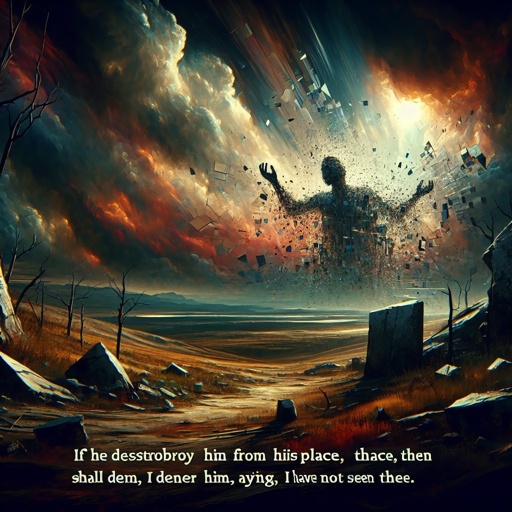
Job 8:18 - "If he destroy him from his place, then it shall deny him, saying, I have not seen thee."

"If he destroy him from his place, then it shall deny him, saying, I have not seen thee." - Job 8:18

Job 18:8 - "For he is cast into a net by his own feet, and he walketh upon a snare."

"For he is cast into a net by his own feet, and he walketh upon a snare." - Job 18:8

Job 18:18 - "He shall be driven from light into darkness, and chased out of the world."

Job 18-19

Job 18:1 - "Then answered Bildad the Shuhite, and said,"

Job 1:8

Job 8:8 - "For enquire, I pray thee, of the former age, and prepare thyself to the search of their fathers:"

Job 3:18 - "There the prisoners rest together; they hear not the voice of the oppressor."

Job 18:10 - "The snare is laid for him in the ground, and a trap for him in the way."

Job 6:18 - "The paths of their way are turned aside; they go to nothing, and perish."

Job 21:18 - "They are as stubble before the wind, and as chaff that the storm carrieth away."

Job 12:18 - "He looseth the bond of kings, and girdeth their loins with a girdle."

Job 18:21 - "Surely such are the dwellings of the wicked, and this is the place of him that knoweth not God."

Job 8:1 - "Then answered Bildad the Shuhite, and said,"

Job 18:3 - "Wherefore are we counted as beasts, and reputed vile in your sight?"

Job 27:18 - "He buildeth his house as a moth, and as a booth that the keeper maketh."

Job 37:8 - "Then the beasts go into dens, and remain in their places."

Job 38:18 - "Hast thou perceived the breadth of the earth? declare if thou knowest it all."

Job 9:18 - "He will not suffer me to take my breath, but filleth me with bitterness."

Job 18:12 - "His strength shall be hungerbitten, and destruction shall be ready at his side."

Job 36:8 - "And if they be bound in fetters, and be holden in cords of affliction;"

Job 15:18 - "Which wise men have told from their fathers, and have not hid it:"

Job 28:18 - "No mention shall be made of coral, or of pearls: for the price of wisdom is above rubies."

Job 34:18 - "Is it fit to say to a king, Thou art wicked? and to princes, Ye are ungodly?"

Job 32:18 - "For I am full of matter, the spirit within me constraineth me."

"He shall be driven from light into darkness, and chased out of the world." - Job 18:18

Job 41:18 - "By his neesings a light doth shine, and his eyes are like the eyelids of the morning."

Job 40:18 - "His bones are as strong pieces of brass; his bones are like bars of iron."