What does John 13:26 mean?
"Jesus answered, He it is, to whom I shall give a sop, when I have dipped it. And when he had dipped the sop, he gave it to Judas Iscariot, the son of Simon." - John 13:26
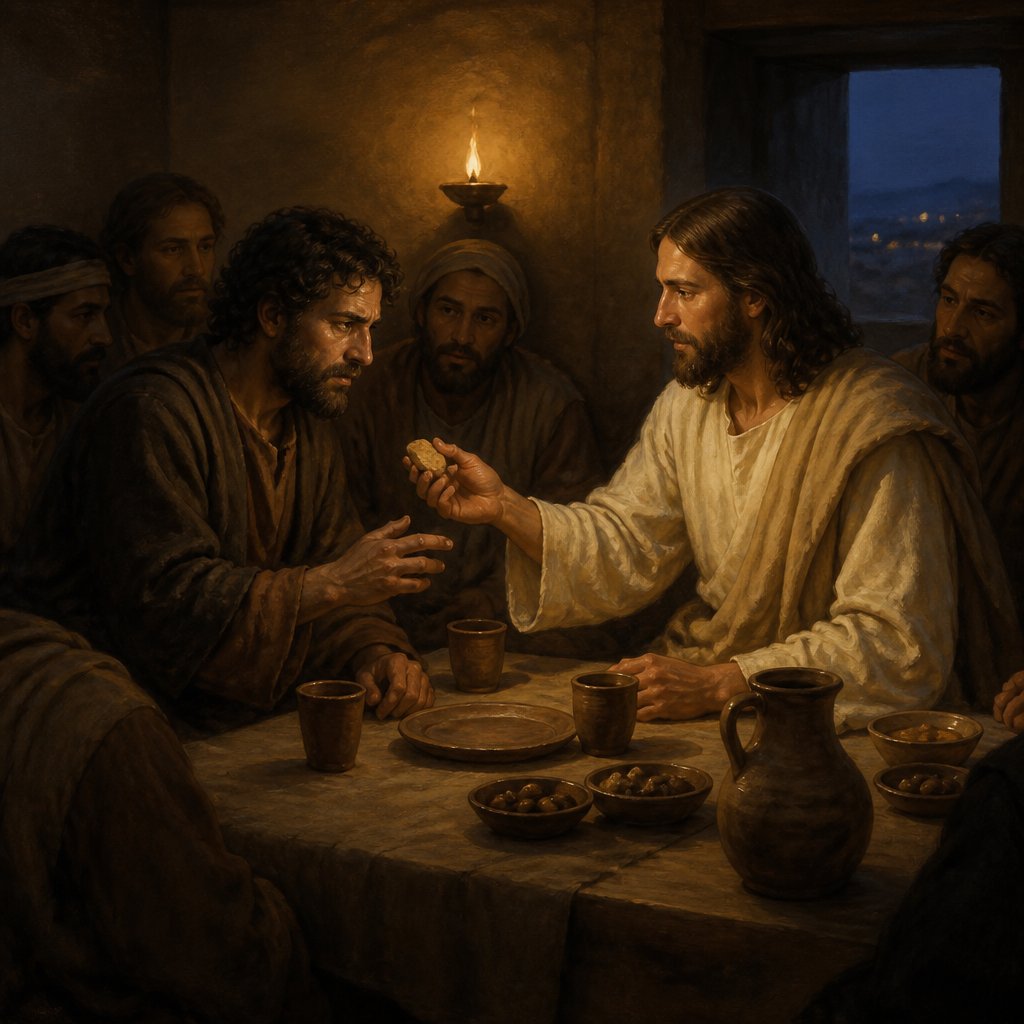
John 13:26 (KJV): Jesus answered, He it is, to whom I shall give a sop, when I have dipped it. And when he had dipped the sop, he gave it to Judas Iscariot, the son of Simon.
This verse comes from the New Testament in the Gospel of John, which is the fourth book of the Bible. This particular passage takes place during the Last Supper, a significant event in Christianity where Jesus shared a final meal with his disciples before his crucifixion.
In this verse, Jesus is indicating that he will give a piece of bread dipped in sauce (referred to as a "sop") to the one who will betray him, foreshadowing Judas Iscariot's betrayal. This event signifies a pivotal moment in the narrative of Jesus' crucifixion and serves as a point of tension and drama in the larger story of Jesus' life and ministry.
This verse carries profound symbolism and themes that are central to Christian theology. The act of sharing a meal and offering bread to a guest has deep cultural and spiritual significance in the biblical context. Throughout the Bible, the act of sharing a meal, or breaking bread, is often associated with communion, fellowship, and hospitality. In the Christian tradition, the Last Supper is remembered and commemorated through the sacrament of Holy Communion, where believers partake in the bread and wine as symbols of Jesus' body and blood.
The specific act of Jesus giving the sop to Judas Iscariot is significant not only as a foreshadowing of his betrayal but also as a demonstration of Jesus' love and compassion, even towards his betrayer. This act underscores the themes of forgiveness and unconditional love that are central to Jesus' teachings. It serves as a powerful example of Jesus' willingness to extend grace and mercy even in the face of betrayal and deceit.
Furthermore, this verse also speaks to the theme of divine providence and the fulfillment of prophecy. In the larger narrative of Jesus' life, his betrayal by Judas Iscariot was foretold in the Scriptures, and this act of giving the sop serves as a fulfillment of that prophecy. It highlights the sovereignty of God and the unfolding of his divine plan, even in the midst of human choices and actions.
The context of this verse within the larger passage of the Last Supper also contributes to its significance. The Last Supper is a deeply symbolic and meaningful event in the Christian tradition, as it represents the institution of the Eucharist and the establishment of a new covenant through Jesus' sacrifice.
In conclusion, John 13:26 is a verse rich in symbolism, themes, and theological significance. It illuminates important aspects of Christian faith, including the themes of communion, forgiveness, divine providence, and the unfolding of prophecy. This verse serves as a poignant reminder of Jesus' selfless love and his willingness to extend grace even in the face of betrayal, ultimately pointing towards the redemptive message at the heart of the Christian gospel.
Have questions about John 13:26?
Dive deeper into this scripture with Bible Chat — an AI-powered tool for exploring God's Word through conversation. Ask questions, get context, and grow in your understanding of the Bible.
Get Our Apps


John 13:26 Artwork

John 13:26 - "Jesus answered, He it is, to whom I shall give a sop, when I have dipped it. And when he had dipped the sop, he gave it to Judas Iscariot, the son of Simon."
"Jesus answered, He it is, to whom I shall give a sop, when I have dipped it. And when he had dipped the sop, he gave it to Judas Iscariot, the son of Simon." - John 13:26

John 15:26 NLT

John 19:26-27

John 1:26 - "John answered them, saying, I baptize with water: but there standeth one among you, whom ye know not;"

John 13

John 11:26 - "And whosoever liveth and believeth in me shall never die. Believest thou this?"

John 13:13 - "Ye call me Master and Lord: and ye say well; for so I am."

John 13:4-9

JOHN 6:11-13

John 20:11-13

John 4:26 - "Jesus saith unto her, I that speak unto thee am he."

John 10:26 - "But ye believe not, because ye are not of my sheep, as I said unto you."

1 John 2:26 - "These things have I written unto you concerning them that seduce you."

John 3:26 - "And they came unto John, and said unto him, Rabbi, he that was with thee beyond Jordan, to whom thou barest witness, behold, the same baptizeth, and all men come to him."

Numbers 26:13 - "Of Zerah, the family of the Zarhites: of Shaul, the family of the Shaulites."

1 John 4:13

John 13:31-35

Matthew 21:26 - "But if we shall say, Of men; we fear the people; for all hold John as a prophet."

John 9:26 - "Then said they to him again, What did he to thee? how opened he thine eyes?"

John 5:26 - "For as the Father hath life in himself; so hath he given to the Son to have life in himself;"

Proverbs 26:13 - "The slothful man saith, There is a lion in the way; a lion is in the streets."

John 9:13 - "¶ They brought to the Pharisees him that aforetime was blind."

John 7:26 - "But, lo, he speaketh boldly, and they say nothing unto him. Do the rulers know indeed that this is the very Christ?"

Mark 13:26 - "And then shall they see the Son of man coming in the clouds with great power and glory."

John 2:13 - "¶ And the Jews' passover was at hand, and Jesus went up to Jerusalem,"

John 10:13 - "The hireling fleeth, because he is an hireling, and careth not for the sheep."

Matthew 11:13 - "For all the prophets and the law prophesied until John."

John 16:26 - "At that day ye shall ask in my name: and I say not unto you, that I will pray the Father for you:"

Matthew 13:26 - "But when the blade was sprung up, and brought forth fruit, then appeared the tares also."