What does John 13:34-35 mean?
“A new commandment I give unto you, That ye love one another; as I have loved you, that ye also love one another. By this shall all men know that ye are my disciples, if ye have love one to another.” — John 13:34-35
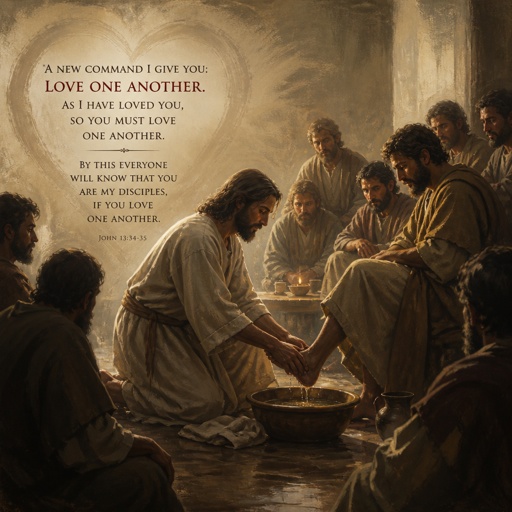
John 13:34–35 in the King James Version reads, “A new commandment I give unto you, That ye love one another; as I have loved you, that ye also love one another. By this shall all men know that ye are my disciples, if ye have love one to another.” These words are spoken by Jesus in the intimate setting of His final meal with His disciples, just after He has risen from supper, laid aside His garments, and washed their feet. The timing is crucial: the shadow of the cross is already falling across the room. Judas has been identified in action if not by full comprehension, and has gone out into the night. Jesus then begins to speak more plainly about His departure: “Little children, yet a little while I am with you.” In that moment of impending separation, when the disciples are about to face confusion, scattering, and fear, Jesus does not give them a complicated rulebook. He gives them a defining command that will hold them together when He is no longer visibly present among them.
The phrase “A new commandment” does not mean that love itself had never been commanded before, because the Scriptures already taught love of neighbor. The newness lies in the measure and pattern: “as I have loved you.” Jesus makes His own love the standard, not the changing standards of human affection. His love is not merely emotional warmth; it is deliberate, sacrificial, cleansing, patient, and steadfast. The footwashing that has just occurred functions as a living parable of the kind of love He is commanding. The Lord and Master took the lowest place, touched what was unclean, and served those who did not deserve it, including one who would betray Him and others who would soon abandon Him. In that act the symbolism is strong: love in Christ is willing to stoop, willing to bear inconvenience, willing to cleanse and restore, and willing to keep serving even when it is not returned. When Jesus says, “as I have loved you,” He gathers that whole meaning into a single measure. He is pointing beyond the basin and towel to the cross itself, where His love will reach its fullest expression. The commandment is therefore not simply to admire His love, but to reproduce it in community.
The words “That ye love one another” focus the command on the life of the disciples together. Jesus is forming a people, not only calling individuals. He is preparing them for the time when their unity will be strained by persecution, internal weakness, and the absence of His physical presence. The love He commands is the bond of the new community He is creating. It is not presented as optional spirituality for advanced believers; it is given as a commandment, meaning it is an obligation grounded in His authority. Yet it is also a gift, because the command is inseparable from His example and from the life He gives. He does not ask them to generate an impossible love from themselves; He calls them to live out what they have received from Him.
In verse 35 Jesus adds the consequence and the sign: “By this shall all men know that ye are my disciples, if ye have love one to another.” The identity of Christ’s followers will not primarily be proven by outward markers, social power, or impressive speech, but by the visible reality of love within the fellowship. “By this” indicates a test that can be observed. “All men” widens the horizon to the watching world. The disciples are not only to love privately, but in a way that becomes public evidence. Love becomes the distinguishing mark, not as a vague sentiment but as a recognizable pattern of life. It is also significant that Jesus does not say people will know they are His disciples by their love for the world in general, though that matters elsewhere, but specifically “if ye have love one to another.” The internal life of the Christian community becomes the first and most immediate witness. When believers forgive one another, bear one another’s burdens, serve without seeking rank, and remain faithful to each other under strain, they display something that points beyond ordinary human social ties. It is meant to make observers conclude not merely that they are kind people, but that they belong to Jesus.
This also reveals a deeper theme: discipleship is relational before it is performative. To be Christ’s disciple is to be shaped into the likeness of Christ, and the most direct arena where that likeness shows itself is in how His people treat each other. The commandment is “new” because it is rooted in the new reality Jesus is bringing through His death and resurrection, a community formed around His self-giving love. The measure “as I have loved you” sets the bar at Christ Himself, and that means Christian love is cruciform in nature: it has the shape of the cross, choosing humility over status, service over self-protection, and faithfulness over convenience. In the context of John 13, where Jesus speaks of His glorification and imminent departure, this love is also the way His presence continues among them. He is leaving in one sense, but His life is meant to be seen in them.
The significance of John 13:34–35, then, is that Jesus names the defining ethic and the identifying sign of His people at the very moment they are about to lose the visible comfort of His company. He gives them a command that is simple enough to remember in crisis and deep enough to occupy them for a lifetime. It is not merely a moral exhortation; it is a revelation of what His kingdom looks like in human relationships. The world is meant to recognize Him through the love His disciples have “one to another,” a love measured by His own, demonstrated in humble service, and ultimately anchored in the sacrifice He is about to make.
Get our apps


Artwork for John 13:34-35
John 13: 34-35

John 13:34-35 - "A new command I give you: Love one another. As I have loved you, so you must love one another. By this everyone will know that you are my disciples, if you love one another."

John 13:34-35 Jesus tells his disciples, "Let me give you a new command: Love one another. In the same way I loved you, you love one another

"A new command I give you: Love one another. As I have loved you, so you must love one another. By this everyone will know that you are my disciples, if you love one another." - John 13:34-35

John 13:31-35

John 13:34 Love Hope Strength Bless

John 13:34 Love Hope Strength Bless

John 13:34 Love Hope Strength Bless

John 13:34 Love Hope Strength Bless

John 13:35 - "By this shall all men know that ye are my disciples, if ye have love one to another."

3 John 1:3-4 - "For I rejoiced greatly when brethren came and testified of the truth that is in you, just as you walk in the truth. I have no greater joy than to hear that my children walk in truth."

Lucas 20:34-35

John 13:34 - "A new commandment I give unto you, That ye love one another; as I have loved you, that ye also love one another."

1 Samuel 17:34-35

John (11:35) Jesus wept.

"By this shall all men know that ye are my disciples, if ye have love one to another." - John 13:35

2 Corinthians 1:3-4

John (11:35) Jesus wept.

John (11:35) Jesus wept.

John (11:35) Jesus wept.

Job 34:35 - "Job hath spoken without knowledge, and his words were without wisdom."

John (11:35) Jesus wept.

John (11:35) Jesus wept.

John 11:35

John 11:35

John 1:35 - "¶ Again the next day after John stood, and two of his disciples;"

John (11:35) Jesus wept.

John (11:35) Jesus wept.

John (11:35) Jesus wept.

John 11:35 - "Jesus wept."