What does John 14:2 mean?
“In my Father’s house are many mansions: if it were not so, I would have told you. I go to prepare a place for you.” — John 14:2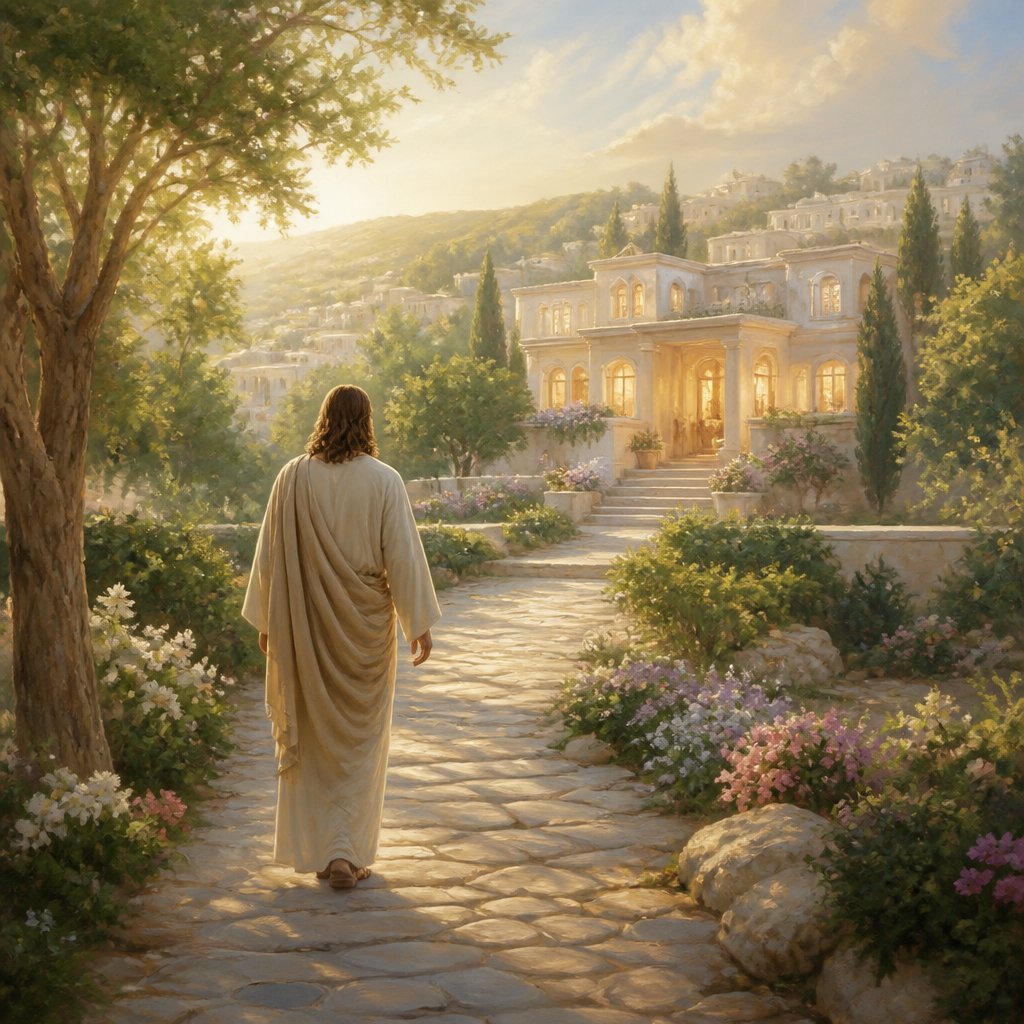
John 14:2 in the King James Version reads, “In my Father’s house are many mansions: if it were not so, I would have told you. I go to prepare a place for you.”
The verse belongs to Jesus’ farewell words to his disciples on the night before his crucifixion. The immediate setting is one of distress and impending loss. Judas has gone out, Peter’s denial has been foretold, and the disciples are troubled because Jesus has spoken plainly of his departure. John 14 opens with the command, “Let not your heart be troubled,” and John 14:2 continues that consolation by giving the disciples a picture large enough to contain their fear: Jesus is leaving, but his leaving is not abandonment. It is purposeful movement toward a destination where they, too, are meant to be.
When Jesus says, “In my Father’s house,” he is not merely describing a location but invoking the idea of home, belonging, and access. “Father” signals intimacy and authority at once: God is not presented as distant, but as the Father of the Son, and by implication the Father to whom the disciples will be brought. “House” carries temple-like overtones as well as household overtones. The temple in Israel was thought of as the house of God, the place where God’s presence was encountered; yet a house is also where a family lives. The phrase gathers both meanings—God’s dwelling and God’s family—so the promise is not simply that heaven exists, but that there is a dwelling with God that welcomes Christ’s people.
The statement “are many mansions” speaks to abundance and permanence. It is not a cramped refuge with limited room, nor a temporary shelter. The word “many” assures the disciples that the promise is not reserved for a narrow few, but extends broadly to those who belong to Christ. The “mansions” imagery communicates settled dwelling places—rooms of lasting residence rather than passing accommodation. The emphasis is less on luxury than on sufficiency, stability, and assured space. Against the disciples’ fear of being left behind, Jesus describes a household in which there is room for all whom he intends to bring.
The clause “if it were not so, I would have told you” underscores Jesus’ trustworthiness and the reliability of his revelation. He is not offering wishful thinking to soothe grief; he appeals to the integrity of his relationship with them. Throughout John’s Gospel, Jesus speaks what he has received from the Father, and here he grounds their hope in his character. The logic is pastoral: if their hope were false, he would not permit them to rest on it. This sentence is meant to quiet the suspicion that death will swallow up everything he has promised. It is also a reminder that Christian hope is not a human projection upward but a truth spoken downward from the One who knows the Father’s dwelling.
The final sentence, “I go to prepare a place for you,” gives the promise its center. Jesus’ “going” in John is layered. It includes his death, his resurrection, and his ascension to the Father. The preparation of a place is therefore not presented as mere construction, but as a redemptive act. The way is prepared by what Jesus is about to do: he will pass through suffering and death and emerge into life, opening access for his people. The preparation is personal and relational: “for you.” The disciples are not merely told that there is a place; they are told that the place is being prepared with them in mind. The phrase ties destiny to the person of Christ. The security of their future rests on where he goes and what he accomplishes, not on their ability to secure a place for themselves.
Symbolically, the “Father’s house” functions as the image of ultimate communion with God, and the “many mansions” functions as the image of welcome, capacity, and enduring residence. Jesus’ departure, which appears to the disciples as loss, is reinterpreted as the necessary path to their inclusion. The verse therefore holds together comfort and Christology: it comforts troubled hearts by revealing who Jesus is and what his mission achieves. It also quietly reshapes the meaning of home. Home is not defined by present circumstances, by Jerusalem, or by the stability of earthly life, but by belonging to the Father through the Son.
In the larger flow of the chapter, John 14:2 prepares for what follows. Jesus will speak of the “way,” the “truth,” and the “life,” and he will say, “no man cometh unto the Father, but by me.” The promise of many dwelling places is not detached from that claim; it is anchored in it. The place is prepared because the Son goes to the Father, and the people are brought because the Son is the way. Thus John 14:2 is significant not only as a tender word at a bedside or a graveside, but as a declaration that Jesus’ impending death is the doorway into the Father’s household, and that the future of his disciples is not uncertainty but a prepared belonging in the presence of God.
Get our apps


Artwork for John 14:2

John 14:2 - "In my Father's house are many mansions: if it were not so, I would have told you. I go to prepare a place for you."

John 14:2 NKJV In My Father's house are many mansions; if it were not so, I would have told you. I go to prepare a place for you.

John 14:2 NKJV In My Father's house are many mansions; if it were not so, I would have told you. I go to prepare a place for you.

John 14:2 NKJV In My Father's house are many mansions; if it were not so, I would have told you. I go to prepare a place for you.

John 14:2-3 - "In my Father's house are many mansions: if it were not so, I would have told you. I go to prepare a place for you. And if I go and prepare a place for you, I will come again, and receive you unto myself; that where I am, there ye may be also."
"In my Father's house are many mansions: if it were not so, I would have told you. I go to prepare a place for you." - John 14:2
!["In my Father’s house are many mansions: if [it were] not [so], I would have told you. I go to prepare a place for you." - John 14:2](https://media.bible.art/a2872745-9769-41bd-bda0-cc4babd2eb35-thumbnail.jpg)
"In my Father’s house are many mansions: if [it were] not [so], I would have told you. I go to prepare a place for you." - John 14:2
![Generate an image of a powerful, dynamic, dramatic, and heartfelt scene inspired by John 14:2-3 NKJV
In My Father's house are many mansions; if it were not so, I would have told you. I go to prepare a place for you. [3] And if I go and prepare a place for you, I will come again and receive you to Myself; that where I am, there you may be also.](https://media.bible.art/8c306fcb-61cd-4dd9-b065-3cb7674d14d2-thumbnail.jpg)
Generate an image of a powerful, dynamic, dramatic, and heartfelt scene inspired by John 14:2-3 NKJV In My Father's house are many mansions; if it were not so, I would have told you. I go to prepare a place for you. [3] And if I go and prepare a place for you, I will come again and receive you to Myself; that where I am, there you may be also.
![Generate an image of a powerful, dynamic, dramatic, and heartfelt scene inspired by John 14:2-3 NKJV
In My Father's house are many mansions; if it were not so, I would have told you. I go to prepare a place for you. [3] And if I go and prepare a place for you, I will come again and receive you to Myself; that where I am, there you may be also.](https://media.bible.art/14a55d77-bb5b-47cd-b881-45963fd50111-thumbnail.jpg)
Generate an image of a powerful, dynamic, dramatic, and heartfelt scene inspired by John 14:2-3 NKJV In My Father's house are many mansions; if it were not so, I would have told you. I go to prepare a place for you. [3] And if I go and prepare a place for you, I will come again and receive you to Myself; that where I am, there you may be also.
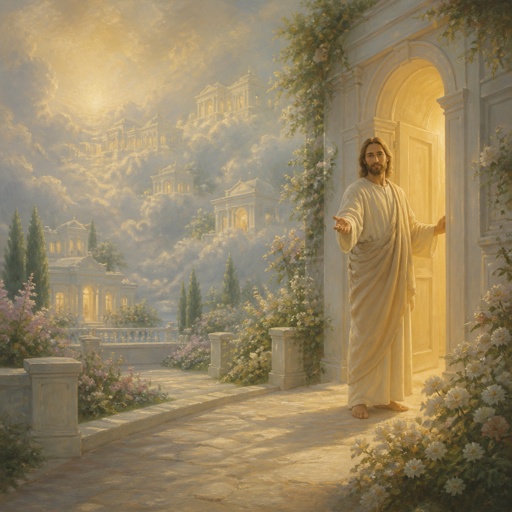
"In my Father's house are many mansions: if it were not so, I would have told you. I go to prepare a place for you. And if I go and prepare a place for you, I will come again, and receive you unto myself; that where I am, there ye may be also." - John 14:2-3

1 John 2:14

1 John 2:14

John 14:1-2

John 2:14 - "And found in the temple those that sold oxen and sheep and doves, and the changers of money sitting:"

Matthew 14:2 - "And said unto his servants, This is John the Baptist; he is risen from the dead; and therefore mighty works do shew forth themselves in him."

John 14

John 14:30

John 3:14

John 14:16

John 14:6

John 14:28

John 20:14

John 14:14 - "If ye shall ask any thing in my name, I will do it."
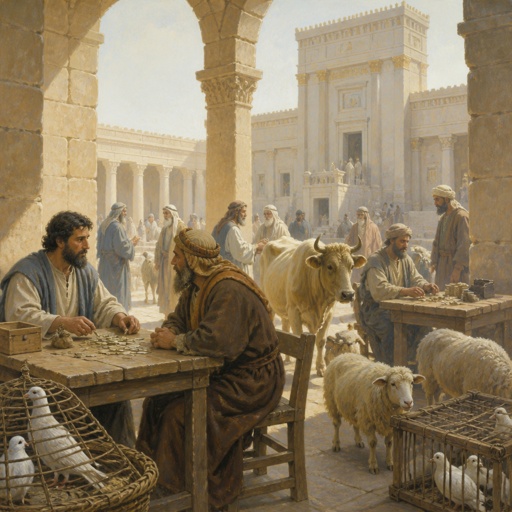
"And found in the temple those that sold oxen and sheep and doves, and the changers of money sitting:" - John 2:14

John 14:15-21

John 14:23-29

John 14:23-29

John 14:23-29

John 14:16-17

Matthew 14:10 - "And he sent, and beheaded John in the prison."