What does John 15:13 mean?
“Greater love hath no man than this, that a man lay down his life for his friends.” — John 15:13
John 15:13 in the King James Version reads, “Greater love hath no man than this, that a man lay down his life for his friends.” In a single sentence Jesus defines the highest measure of love, not as a feeling that rises and falls, but as a deliberate self-giving that is willing to absorb the cost of another person’s good. The verse sets love on the scale of sacrifice: love is “greater” when it is proven by surrendering what is most precious, even “his life.” In the language of the verse, the summit of love is reached where the self is no longer protected at all costs, but offered.
Its immediate context in John 15 is Jesus speaking to his disciples on the night before his crucifixion. He has been teaching them what it means to abide in him, to keep his commandments, and to live in the kind of love that comes from him and reflects him. Just before this verse he says, “This is my commandment, That ye love one another, as I have loved you.” John 15:13 then explains what that love looks like at its fullest strength: “as I have loved you” is not sentimental language but cruciform language, love shaped like the cross. Jesus is not offering a proverb detached from his life; he is interpreting what he is about to do. The next day, as the Gospel narrative unfolds, he will literally “lay down” his life. The verse therefore functions both as instruction and as revelation: instruction to the disciples about the pattern of their love, and revelation of the meaning of his own coming death.
The word “greater” places this love above all lesser expressions of affection and loyalty. Scripture does not deny that there are genuine loves that give time, resources, comfort, protection, and honor, but Jesus names the outer limit, the point beyond which love cannot go in this life. The “life” in the verse is not a token; it is the whole self—breath, blood, future, claims, rights, plans—placed on the altar for another. This makes the verse intensely personal. It insists that love is measured by what it is willing to lose for the beloved, and that the greatest love does not merely share what is convenient but yields what is irreplaceable.
The phrase “lay down” is also symbolic, because it depicts sacrifice as intentional. One may lose life by accident or by necessity, but to “lay down” is to choose. It is the posture of a shepherd who places himself between the flock and the wolf, of a defender who steps into danger so another may go free, of a servant who embraces loss rather than abandon those entrusted to him. In John’s Gospel, Jesus repeatedly speaks of his death as something he gives, not something taken from him. In that light, John 15:13 is not merely describing heroism; it is describing the willing self-offering that is at the heart of Christ’s mission. His death is not presented as a tragic end that love mourns, but as the very act by which divine love is displayed.
“Friends” carries its own weight in the passage. In the world of the first century, friendship could be a bond of loyalty and mutual obligation, but Jesus reshapes the word by drawing the disciples into a relationship grounded in his initiative. Immediately after this verse he says, “Ye are my friends, if ye do whatsoever I command you.” This is not friendship as a casual category; it is a covenantal nearness defined by shared allegiance to him. Yet it is also surprising, because he is speaking to men who will soon scatter in fear. The significance is that his love does not wait for their strength; he calls them “friends” and lays down his life in full knowledge of their weakness. Friendship here is not earned by their perfection but established by his commitment and then expressed in their obedience. The verse thus shows love creating friendship, not merely responding to it.
The themes that converge in this line are the themes of substitution, loyalty, and the reversal of ordinary power. The greatest love is not domination but self-emptying; not taking life but giving it. It sets the pattern for Christian discipleship: the community Jesus forms is to be marked by a love that prefers the other, that shoulders burdens, that endures wrong, that refuses to abandon. It does not require that every believer die physically for another, but it establishes that the true shape of Christian love is cruciform, willing to suffer loss for the sake of another’s life and good. It challenges any love that remains only at the level of words, because it defines love by action and cost.
Within the broader symbolism of John 15, where Jesus speaks of the vine and the branches, this love is the fruit of abiding. A branch bears fruit not by straining but by remaining joined to the vine’s life. Likewise, the capacity to love with this kind of greatness is not portrayed as a mere moral achievement; it flows from union with Christ. The disciples are commanded to love, but they are also being told where such love comes from: from remaining in him, from keeping his commandments, from receiving his love and letting it shape theirs. John 15:13 therefore is not only an ideal but a disclosure of the source and standard of the Christian life—Christ’s own self-giving.
The significance of the verse ultimately rests on who is speaking it. When Jesus says, “Greater love hath no man than this,” he is speaking as the one who will embody the statement to the uttermost. The cross, seen through this saying, is not only the instrument of death but the measure of love. It reveals that God’s love is not distant or theoretical but willing to enter suffering, to bear shame, and to give life so that others may live. John 15:13 becomes, in that sense, a window into the heart of the Gospel: the greatest love is a life laid down, and in Jesus that greatest love is not merely described but accomplished.
Get our apps


Artwork for John 15:13

John 15:13 - "Greater love hath no man than this, that a man lay down his life for his friends."

"Greater love hath no man than this, that a man lay down his life for his friends." - John 15:13

"Greater love hath no man than this, that a man lay down his life for his friends." - John 15:13

John 13:15 - "For I have given you an example, that ye should do as I have done to you."

John 15:12-13 - "My command is this: Love each other as I have loved you. Greater love has no one than this: to lay down one’s life for one’s friends."
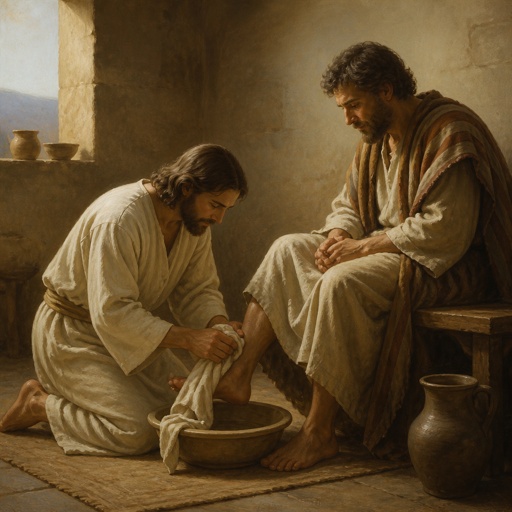
"For I have given you an example, that ye should do as I have done to you." - John 13:15

John 15:7

John 15:7

John 13

John 15:5

John 15:5

John 15 The Vine

John 15:26 NLT

John 14:15-21

John 15:1-8

John 13:13 - "Ye call me Master and Lord: and ye say well; for so I am."

John 13: 34-35

John 15:9-10

John 21:15-19

John 15:9-10

John 13:4-9

JOHN 6:11-13

John 20:11-13

1 John 4:13

John 13:31-35

John 14:15 - "¶ If ye love me, keep my commandments."

Genesis 15:13

John 9:13 - "¶ They brought to the Pharisees him that aforetime was blind."

John 15:23 - "He that hateth me hateth my Father also."

John 8:15 - "Ye judge after the flesh; I judge no man."