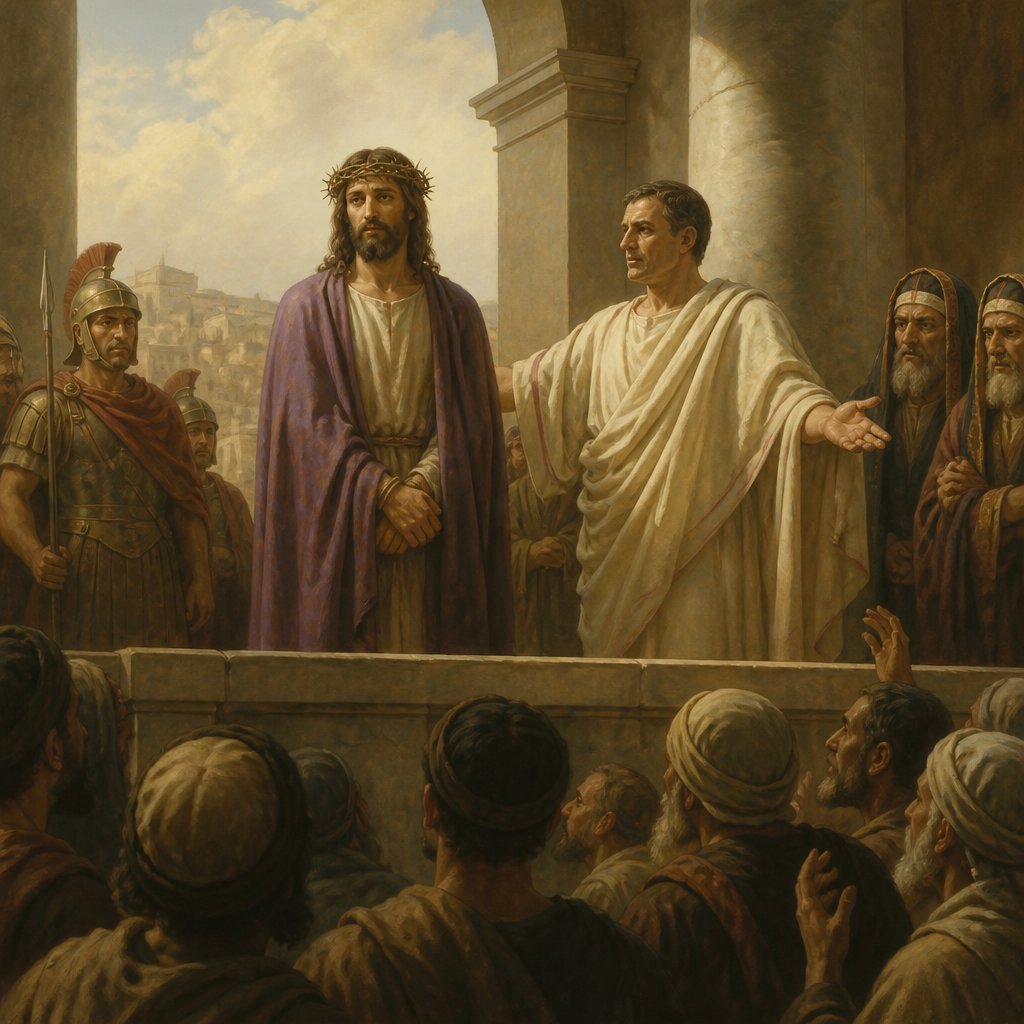
John 19:1-6 (KJV): "Then Pilate therefore took Jesus, and scourged him. And the soldiers platted a crown of thorns, and put it on his head, and they put on him a purple robe, and said, Hail, King of the Jews! and they smote him with their hands. Pilate therefore went forth again, and saith unto them, Behold, I bring him forth to you, that ye may know that I find no fault in him. Then came Jesus forth, wearing the crown of thorns, and the purple robe. And Pilate saith unto them, Behold the man! When the chief priests therefore and officers saw him, they cried out, saying, Crucify him, crucify him. Pilate saith unto them, Take ye him, and crucify him: for I find no fault in him."
The verses in John 19:1-6 depict the final moments leading up to the crucifixion of Jesus Christ. This passage is a crucial part of the gospel narrative, as it shows the profound suffering and humiliation that Jesus endured before his ultimate sacrifice for the sins of humanity.
The first two verses describe the physical and emotional abuse inflicted upon Jesus by the Roman soldiers. Pilate, the Roman governor, orders for Jesus to be scourged, a form of punishment involving flogging and whipping. This brutal act serves as a reminder of the intense physical pain and suffering that Jesus endured on behalf of humanity.
Additionally, the soldiers mock Jesus by crowning him with thorns and dressing him in a purple robe, a color traditionally associated with royalty. By doing so, they cruelly and sarcastically hail him as the "King of the Jews," further taunting his claims of being the Son of God. The act of putting a thorny crown on his head not only inflicts physical pain but also symbolizes the burden of sin and the consequences of human rebellion against God.
Pilate presents the battered and humiliated Jesus to the crowd, stating, "Behold the man!" His words serve as a poignant commentary on the degradation and suffering that Jesus endured, highlighting his humanity and the unjust treatment he received at the hands of the authorities. Pilate, despite finding no fault in Jesus, ultimately succumbs to the pressure from the chief priests and officers and allows for Jesus to be crucified.
This passage presents several themes that are central to the Christian faith. Firstly, it highlights the theme of sacrificial love and atonement. Jesus willingly endured humiliation, suffering, and ultimately death in order to offer redemption and forgiveness for the sins of humanity. His sacrifice serves as a powerful expression of God's unconditional love and mercy towards humanity.
The verses also underscore the theme of injustice and the willingness of those in authority to yield to the demands of the crowd, even at the expense of an innocent life. Pilate's reluctance to condemn Jesus, coupled with the insistence of the religious leaders to have him crucified, reflects the moral and ethical failings of those in power.
Furthermore, the symbolism in this passage is rich and profound. The crown of thorns represents the weight of humanity's sin and the suffering that Jesus endured on the cross. The purple robe, though intended to mock Jesus, also serves as a symbol of his true kingship and sovereignty as the Son of God. Additionally, Pilate's declaration, "Behold the man," invites contemplation on the humanity of Jesus and the compassion and empathy that should be extended towards all who suffer unjustly.
In conclusion, John 19:1-6 offers a poignant and evocative portrayal of the suffering and humiliation of Jesus Christ before his crucifixion. The themes of sacrificial love, injustice, and the symbolism contained within these verses serve as a powerful reminder of the central tenets of the Christian faith and the enduring significance of Christ's sacrifice for humanity.
Get our apps


Artwork for John 19:1-6
"Then Pilate took Jesus and had him flogged. The soldiers twisted together a crown of thorns and put it on his head. They clothed him in a purple robe and went up to him again and again, saying, “Hail, king of the Jews!” And they slapped him in the face. Once more Pilate came out and said to the Jews gathered there, “Look, I am bringing him out to you to let you know that I find no basis for a charge against him.” When Jesus came out wearing the crown of thorns and the purple robe, Pilate said to them, “Here is the man!” As soon as the chief priests and their officials saw him, they shouted, “Crucify! Crucify!” But Pilate answered, “You take him and crucify him. As for me, I find no basis for a charge against him.”" - John 19:1-6

John 19:1-6 - "Then Pilate took Jesus and had him flogged. The soldiers twisted together a crown of thorns and put it on his head. They clothed him in a purple robe and went up to him again and again, saying, “Hail, king of the Jews!” And they slapped him in the face. Once more Pilate came out and said to the Jews gathered there, “Look, I am bringing him out to you to let you know that I find no basis for a charge against him.” When Jesus came out wearing the crown of thorns and the purple robe, Pilate said to them, “Here is the man!” As soon as the chief priests and their officials saw him, they shouted, “Crucify! Crucify!” But Pilate answered, “You take him and crucify him. As for me, I find no basis for a charge against him.”"

John 19:1

John 19:1-3

John 19:1 - "Then Pilate therefore took Jesus, and scourged him."

"Then Pilate therefore took Jesus, and scourged him." - John 19:1

"So when they had rowed about five and twenty or thirty furlongs, they see Jesus walking on the sea, and drawing nigh unto the ship: and they were afraid." - John 6:19

John 1:6 - "¶ There was a man sent from God, whose name was John."

John 21:6

John 1:19 - "¶ And this is the record of John, when the Jews sent priests and Levites from Jerusalem to ask him, Who art thou?"

John 21:6

1 John 4:19 - "We love him, because he first loved us."

1 John 5:19 - "And we know that we are of God, and the whole world lieth in wickedness."

1 Corinthians 6:19

1 Corinthians 6:19

1 Corinthians 6:19

1 Corinthians 6:19

1 Corinthians 6:19

1 Corinthians 6:19

John 6:19 - "So when they had rowed about five and twenty or thirty furlongs, they see Jesus walking on the sea, and drawing nigh unto the ship: and they were afraid."

2 John 1:6 – "And this is love: that we walk in obedience to his commands."

2 John 1:6 – "And this is love: that we walk in obedience to his commands."

1 Corinthians 6:19-20

"¶ There was a man sent from God, whose name was John." - John 1:6

1 John 3:19 - "And hereby we know that we are of the truth, and shall assure our hearts before him."

1 Corinthians 6:19-20

1 Corinthians 6:19-20
1 Corinthians 6:19-20

Apocalipsis 11, 19; 12, 1-6. 10

1 John 1:6 - "If we say that we have fellowship with him, and walk in darkness, we lie, and do not the truth:"