What does John 20:19 mean?
“Then the same day at evening, being the first day of the week, when the doors were shut where the disciples were assembled for fear of the Jews, came Jesus and stood in the midst, and saith unto them, Peace be unto you.” — John 20:19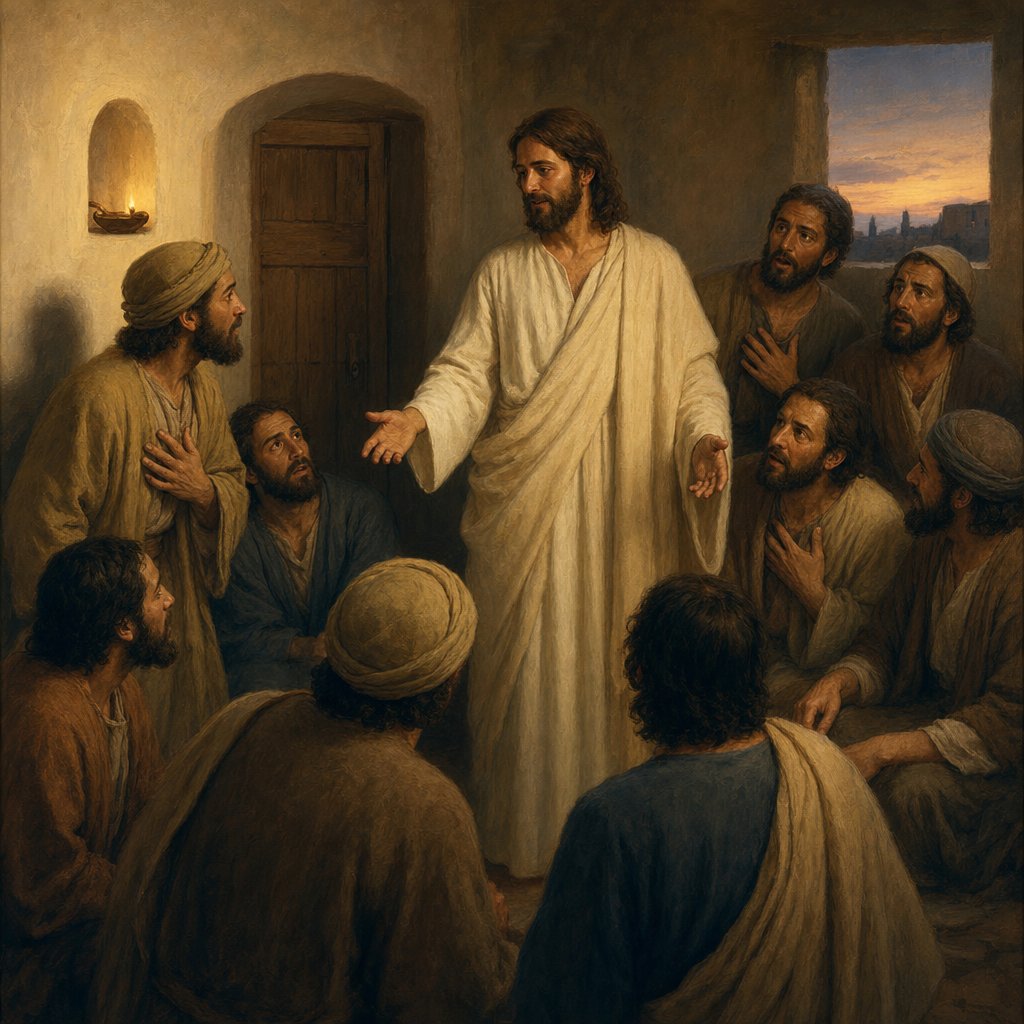
John 20:19 (KJV) reads, “Then the same day at evening, being the first day of the week, when the doors were shut where the disciples were assembled for fear of the Jews, came Jesus and stood in the midst, and saith unto them, Peace be unto you.”
In its immediate context, this verse occurs on the very day the resurrection was discovered. Earlier in John 20, Mary Magdalene finds the sepulchre empty, Peter and John run to see, and Mary encounters the risen Lord. By the time evening comes, the disciples are gathered together, yet their gathering is not marked by confident celebration but by fear. They have heard reports, but they have not yet been steadied by the personal presence of Christ. John’s narrative places this meeting at a hinge-point between the shock of the crucifixion and the settled faith of resurrection testimony. John 20:19 is therefore not merely a scene-setting detail; it is the first corporate appearance of the risen Jesus to his disciples in John’s Gospel, and it shows how the resurrection begins to reshape a fearful community into a commissioned one.
The phrase “the same day at evening, being the first day of the week” carries strong theological weight in John’s storytelling. It anchors the event in time, making clear that the resurrection is not a vague spiritual idea but an acted event in history. Yet the timing also signals new creation themes. The “first day of the week” evokes beginnings, and John’s Gospel has long used creation-like language and patterns. Now, on the first day, the risen Christ appears to gather his people and speak peace into their disorder. The day that began with an empty tomb ends with the living Lord standing among them. The movement from morning discovery to evening presence gives the sense that the resurrection day is filling up with meaning, turning confusion into clarity.
John notes that “the doors were shut where the disciples were assembled for fear of the Jews.” This detail is both practical and symbolic. Practically, the disciples expect danger. Their Master has been executed, and they fear that association with him may bring them the same fate. John’s wording reflects the social reality of hostility and threat as the disciples perceive it. Symbolically, the shut doors represent a community closed in by fear, hiding, withdrawing, attempting to survive by separation. The resurrection does not first meet them as a triumphal spectacle in public; it meets them in a locked room, in their anxiety, where courage has failed. The setting underscores that Christ’s initiative precedes their readiness. They do not open the way to him; he comes to them.
The words “came Jesus and stood in the midst” are among the most significant in the verse. The emphasis is not on their seeking but on his coming. The risen Jesus is active, personal, and present. He “stood in the midst,” not at the margins. In the language of the scene, he takes the center, reconstituting the disciples around himself. The “midst” is the place of fellowship and authority: he is not simply an encouraging memory, nor merely a private vision to an individual disciple, but the living Lord who gathers and anchors the community. That he appears while the doors are shut highlights the transformed reality of resurrection life. John does not pause to explain the mechanics; he simply states the fact: Jesus comes and stands among them. The point is not to satisfy curiosity but to insist that nothing—neither fear, nor barriers, nor human control—can keep the risen Christ from his own.
Then Jesus speaks: “Peace be unto you.” In the KJV, the words are simple and direct, but they carry layers of significance. At the most immediate level, it is reassurance. They are afraid; his first word quiets terror. He does not begin with rebuke for their flight, nor with interrogation, but with peace. This reveals the character of the risen Christ toward his disciples: he comes to restore, not to crush. Yet “peace” here is more than calm feelings. In John’s Gospel, Jesus has already promised peace as a gift distinct from what the world gives. The resurrection is the ground on which that promise becomes tangible. His peace is not the absence of trouble but the presence of reconciliation and the settling of what sin and death had unsettled. The greeting functions like a pronouncement: the crucifixion, which looked like defeat, has not shattered God’s purpose; the resurrection stands as God’s answer, and peace is the result.
There is also symbolism in the contrast between the disciples’ fear and Jesus’ peace. Fear gathers them behind shut doors; peace meets them in the center and opens the future. This verse prepares for what follows in the same chapter, where Jesus shows his hands and his side and the disciples are glad, and where he sends them as the Father sent him. John 20:19 is thus the doorway into the disciples’ transformation: the locked room becomes the first setting of resurrection assurance, and the fearful assembly becomes the seed of a witnessing community. The peace Jesus speaks is not an ending but a beginning, the atmosphere in which the risen Lord will reveal himself, restore his disciples, and set them in motion.
The verse’s significance, then, lies in how it portrays the resurrection as personally restorative and communally formative. The risen Christ enters the place of fear without being hindered, places himself “in the midst” as the center of his people, and speaks peace as the first fruit of his victory. John 20:19 shows that resurrection faith is not born from human bravery or optimism, but from an encounter with the living Jesus who comes to his own and gives them what they cannot produce for themselves: his peace.
Get our apps


Artwork for John 20:19

John 20:19 - "¶ Then the same day at evening, being the first day of the week, when the doors were shut where the disciples were assembled for fear of the Jews, came Jesus and stood in the midst, and saith unto them, Peace be unto you."

John 20:19-20 - "On the evening of that first day of the week, when the disciples were together, with the doors locked for fear of the Jewish leaders, Jesus came and stood among them and said, “Peace be with you!” After he said this, he showed them his hands and side. The disciples were overjoyed when they saw the Lord."

John 20:19-23 - "On the evening of that first day of the week, when the disciples were together, with the doors locked for fear of the Jewish leaders, Jesus came and stood among them and said, “Peace be with you!” After he said this, he showed them his hands and side. The disciples were overjoyed when they saw the Lord. Again Jesus said, “Peace be with you! As the Father has sent me, I am sending you.” And with that he breathed on them and said, “Receive the Holy Spirit. If you forgive anyone’s sins, their sins are forgiven; if you do not forgive them, they are not forgiven.”"
!["Then the same day at evening, being the first [day] of the week, when the doors were shut where the disciples were assembled for fear of the Jews, came Jesus and stood in the midst, and saith unto them, Peace [be] unto you." - John 20:19](https://media.bible.art/b463d4f5-4f20-49a7-ab8e-de6f8959226f-thumbnail.jpg)
"Then the same day at evening, being the first [day] of the week, when the doors were shut where the disciples were assembled for fear of the Jews, came Jesus and stood in the midst, and saith unto them, Peace [be] unto you." - John 20:19
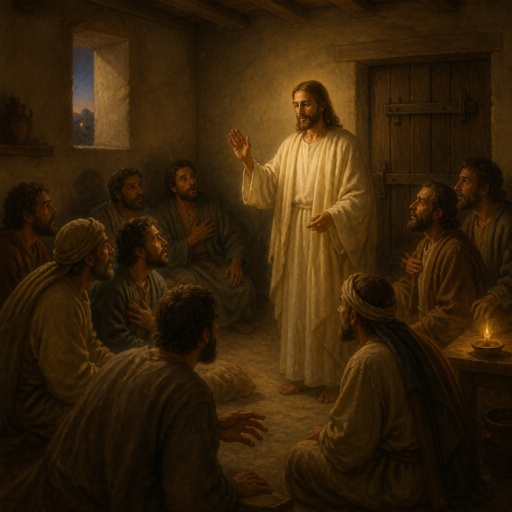
"¶ Then the same day at evening, being the first day of the week, when the doors were shut where the disciples were assembled for fear of the Jews, came Jesus and stood in the midst, and saith unto them, Peace be unto you." - John 20:19
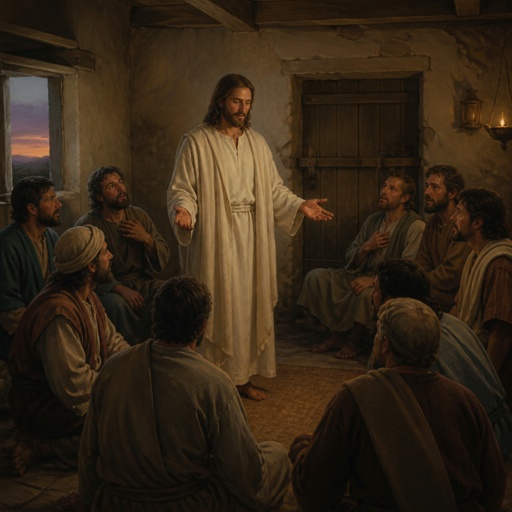
"¶ Then the same day at evening, being the first day of the week, when the doors were shut where the disciples were assembled for fear of the Jews, came Jesus and stood in the midst, and saith unto them, Peace be unto you." - John 20:19
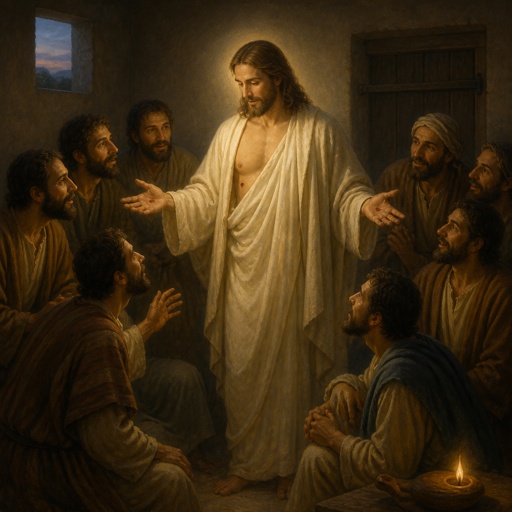
"On the evening of that first day of the week, when the disciples were together, with the doors locked for fear of the Jewish leaders, Jesus came and stood among them and said, “Peace be with you!” After he said this, he showed them his hands and side. The disciples were overjoyed when they saw the Lord." - John 20:19-20
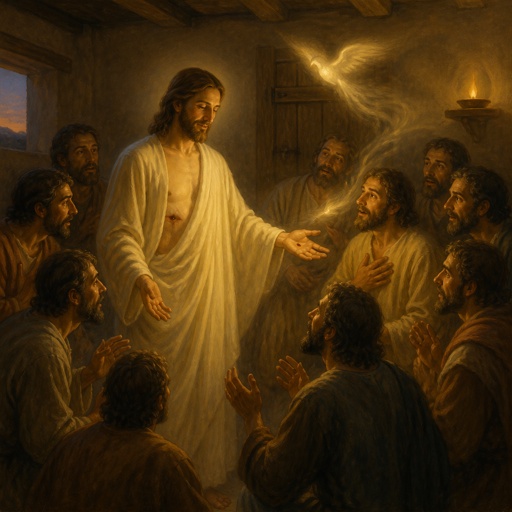
"On the evening of that first day of the week, when the disciples were together, with the doors locked for fear of the Jewish leaders, Jesus came and stood among them and said, “Peace be with you!” After he said this, he showed them his hands and side. The disciples were overjoyed when they saw the Lord. Again Jesus said, “Peace be with you! As the Father has sent me, I am sending you.” And with that he breathed on them and said, “Receive the Holy Spirit. If you forgive anyone’s sins, their sins are forgiven; if you do not forgive them, they are not forgiven.”" - John 20:19-23

John 19:20 - "This title then read many of the Jews: for the place where Jesus was crucified was nigh to the city: and it was written in Hebrew, and Greek, and Latin."

1 John 3:19-20 - "By this we know that we are of the truth, and shall assure our hearts before Him. For if our heart condemns us, God is greater than our heart, and knows all things."

John 3:19-20 - "And this is the condemnation, that light is come into the world, and men loved darkness rather than light, because their deeds were evil. For every one that doeth evil hateth the light, neither cometh to the light, lest his deeds should be reproved."
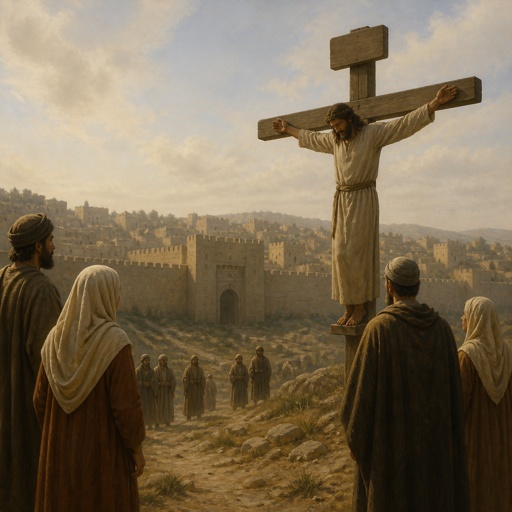
"This title then read many of the Jews: for the place where Jesus was crucified was nigh to the city: and it was written in Hebrew, and Greek, and Latin." - John 19:20

John 19:38

John 19:1

John 20:21

John 20:14

John 20:27

John 20:27

John 19:19 - "¶ And Pilate wrote a title, and put it on the cross. And the writing was, JESUS OF NAZARETH THE KING OF THE JEWS."

John 17.6-19

John 19:1-3

John 19:25-27

John 20:11-12

John 20:11-13

Genesis 19-20

Genesis 20-19

John 20:30-31

John 1:19 - "¶ And this is the record of John, when the Jews sent priests and Levites from Jerusalem to ask him, Who art thou?"

John 19:25-27

John 19:26-27