What does John 2:10 mean?
“And saith unto him, Every man at the beginning doth set forth good wine; and when men have well drunk, then that which is worse: but thou hast kept the good wine until now.” — John 2:10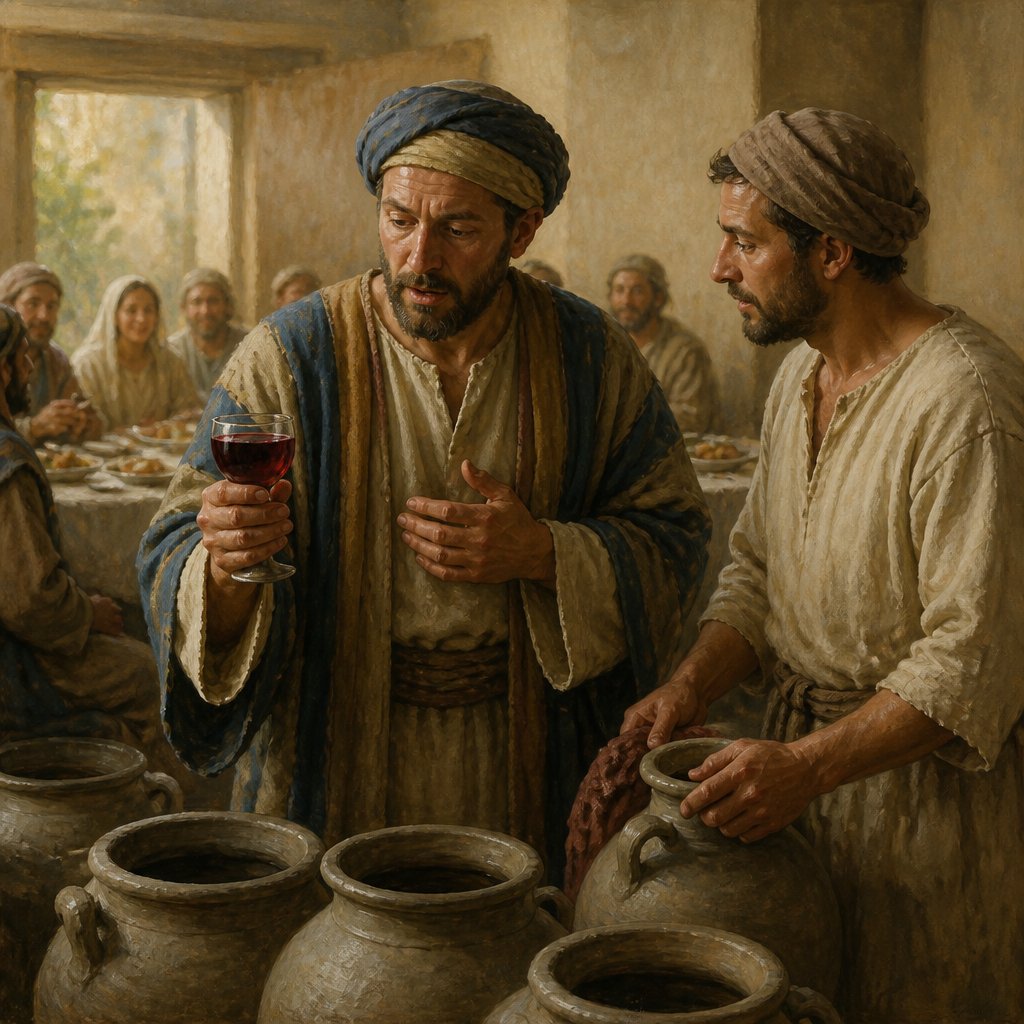
John 2:10 (KJV) - "And saith unto him, Every man at the beginning doth set forth good wine; and when men have well drunk, then that which is worse: but thou hast kept the good wine until now."
This verse is part of the well-known story of the Wedding at Cana, which is found in the Gospel of John. This passage is significant because it marks the first of Jesus' miracles, where he turned water into wine. The verse holds a deeper meaning beyond the literal interpretation of the events at the wedding. It offers valuable insights into Jesus' character, the nature of his ministry, and the symbolism of the wine itself.
Context:
The Wedding at Cana is located at the beginning of Jesus' public ministry. He and his disciples were invited to a wedding celebration in Cana of Galilee, where Mary, Jesus' mother, informed him that the wine had run out. Even though Jesus initially resisted getting involved, at his mother's urging, he instructed the servants to fill six stone water jars with water. When the master of the feast tasted the water that had become wine, he marveled at its quality. This miraculous act revealed Jesus' power and divinity to his disciples and was the beginning of his public ministry.
The Nature of Jesus' Ministry:
This verse reflects the nature of Jesus' ministry, which was marked by a transformative and abundant grace. The master of the feast's surprise at the quality of the wine mirrors the astonishment and delight that people experience when they encounter Jesus' teachings and miracles. While others may offer only what is inferior or temporary, Jesus offers something significantly better and lasting. The good wine symbolizes the new covenant and the spiritual blessings that Jesus brings to those who believe in him. In contrast to the religious leaders of his time, who were focused on legalistic rituals and traditions, Jesus brought joy, abundance, and new life to those who followed him.
Symbolism:
The turning of water into wine carries profound symbolism. Water often symbolizes purification and cleansing in the Bible, representing the old covenant of the law, which was unable to save or transform mankind. By transforming water into wine, Jesus demonstrated his ability to bring about new life and abundance, replacing the old with something superior. The wine symbolizes the new covenant and the spiritual blessings that Jesus brings to those who believe in him. This symbolism is further emphasized in the Last Supper when Jesus used wine to represent his blood, shed for the forgiveness of sins.
More broadly, the wedding feast itself is a symbol of the joyous union between Christ and his church, marked by the abundance of the good wine. This act of turning water into wine also foreshadows the true purpose of Jesus' ministry, which is to bring about a new creation, full of grace and abundant life.
Good Wine Until Now:
The master of the feast's acknowledgment that the good wine had been kept until the end of the celebration is often understood as a foreshadowing of the abundant blessings that would come through Jesus' sacrifice. This implies that the best was yet to come with the arrival of Jesus and the inauguration of the new covenant. The blessings that Jesus brings are not merely better than what has gone before, but they are of an entirely different order. This anticipation of something better is a recurring theme throughout the Gospels and emphasizes the fulfillment and surpassing nature of the new covenant brought by Jesus.
In conclusion, John 2:10 provides rich theological insights into the nature of Jesus' ministry and the symbolism of the wine at the Wedding at Cana. This verse represents Jesus' ability to bring about transformation, abundance, and renewal, as well as foreshadows the superior blessings of the new covenant. It challenges believers to anticipate and embrace the better things that God has in store, reminding them of the surpassing nature of Christ's grace and the abundant life found in him.
Get our apps


Artwork for John 2:10

1 John 2:10 - "He that loveth his brother abideth in the light, and there is none occasion of stumbling in him."

John 2:10 - "And saith unto him, Every man at the beginning doth set forth good wine; and when men have well drunk, then that which is worse: but thou hast kept the good wine until now."

"He that loveth his brother abideth in the light, and there is none occasion of stumbling in him." - 1 John 2:10
"And saith unto him, Every man at the beginning doth set forth good wine; and when men have well drunk, then that which is worse: but thou hast kept the good wine until now." - John 2:10

John 10:2 - "But he that entereth in by the door is the shepherd of the sheep."

"But he that entereth in by the door is the shepherd of the sheep." - John 10:2

Matthew 10:2…Matthew 10:2 These are the names of the twelve apostles: first, Simon (who is called Peter) and his brother Andrew; James son of Zebedee, and his brother John

John 10:10

John 10:10

John 10:10

John 10:10

John 10:10

John 10:10

John 10:10

2 John 1:10 - "If there come any unto you, and bring not this doctrine, receive him not into your house, neither bid him God speed:"

Matthew 10:2 - "Now the names of the twelve apostles are these; The first, Simon, who is called Peter, and Andrew his brother; James the son of Zebedee, and John his brother;"

John 10:41 - "And many resorted unto him, and said, John did no miracle: but all things that John spake of this man were true."

John 10:30
John 9:10

John 10:30

John 10:9

John 10:9

John 10:9

Matthew 10:2-4…Matthew 10:2-4 New International Version 2 These are the names of the twelve apostles: first, Simon (who is called Peter) and his brother Andrew; James son of Zebedee, and his brother John; 3 Philip and Bartholomew; Thomas and Matthew the tax collector; James son of Alphaeus, and Thaddaeus; 4 Simon the Zealot and Judas Iscariot, who betrayed him.

Matthew 10:2-4…Matthew 10:2-4 New International Version 2 These are the names of the twelve apostles: first, Simon (who is called Peter) and his brother Andrew; James son of Zebedee, and his brother John; 3 Philip and Bartholomew; Thomas and Matthew the tax collector; James son of Alphaeus, and Thaddaeus; 4 Simon the Zealot and Judas Iscariot, who betrayed him.

John 10:40 - "And went away again beyond Jordan into the place where John at first baptized; and there he abode."

John 10:42 - "And many believed on him there."

John 15:9-10

John 15:9-10

John 10:22 - "¶ And it was at Jerusalem the feast of the dedication, and it was winter."