What does John 4:14 mean?
“But whosoever drinketh of the water that I shall give him shall never thirst; but the water that I shall give him shall be in him a well of water springing up into everlasting life.” — John 4:14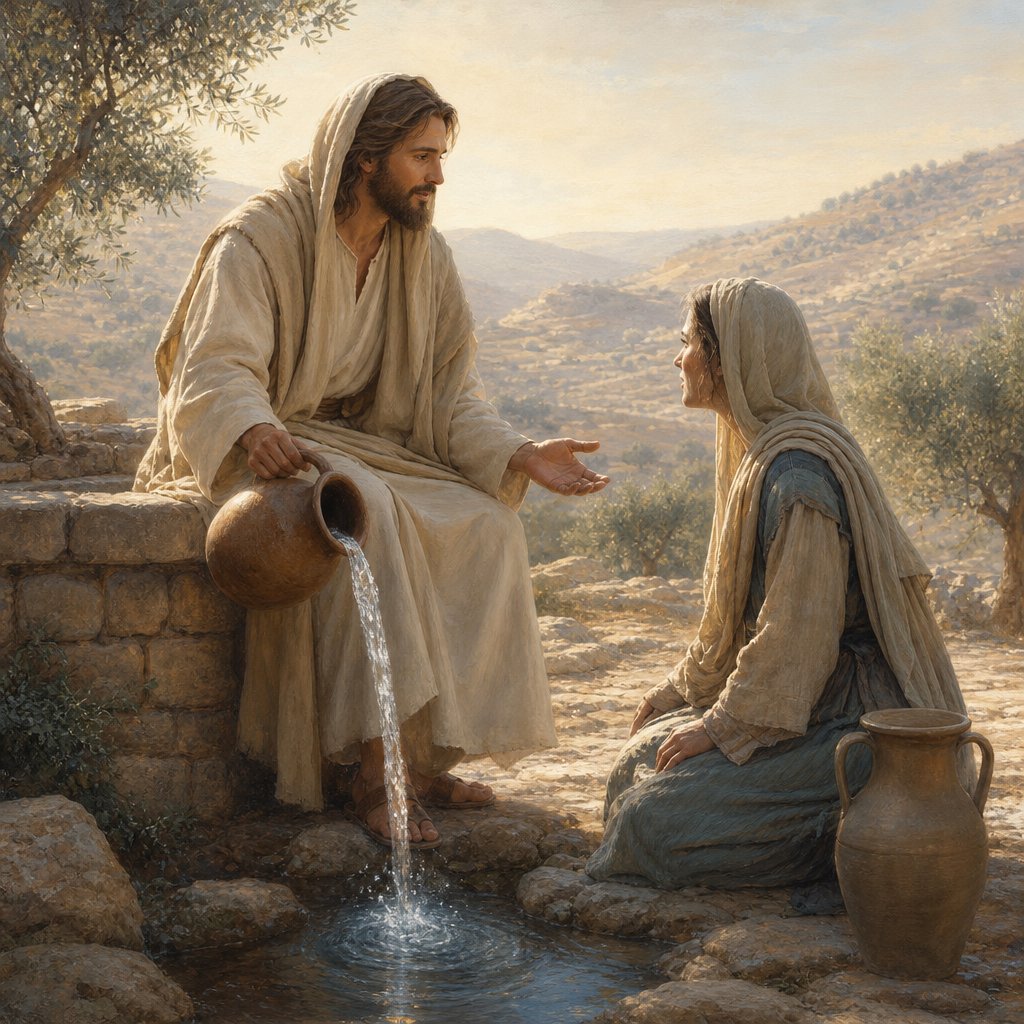
John 4:14 in the King James Version says, “But whosoever drinketh of the water that I shall give him shall never thirst; but the water that I shall give him shall be in him a well of water springing up into everlasting life.”
In its immediate context, these words are spoken by Jesus to the woman of Samaria at Jacob’s well. The scene is deliberately ordinary: a traveler sits by a common source of daily water, and a conversation begins about the most basic of human needs. Yet the passage turns that plain necessity into a doorway for revelation. The woman is thinking in terms of the water she must repeatedly draw, carry, and drink, and Jesus uses that familiar act to unveil a deeper thirst and a deeper provision. The “water” in the verse therefore stands at the intersection of the physical and the spiritual. Natural water temporarily relieves the body’s need and must be sought again and again. The “water that I shall give” addresses the person at the level of the soul and reaches beyond what any repeated human effort can satisfy.
The first theme is the promise of true satisfaction. “Shall never thirst” does not mean that believers never experience desire, hardship, longing, grief, or even seasons of dryness in their feelings. In the plain force of Jesus’ words, it means that the deepest need for life, reconciliation with God, and enduring spiritual refreshment is met in what he gives, not in what a person can fetch for herself. The contrast implied in the conversation is between a cycle of returning to the well and a gift that ends the necessity of seeking life from lesser sources. The verse declares that what Christ gives is not a temporary relief that fades, but a sufficiency that answers the underlying thirst that keeps resurfacing when people try to live on anything less than God.
A second theme is grace as gift and the personal initiative of Christ. The verse is framed by Jesus’ “I shall give him.” The life he offers is not presented as a wage earned by moral achievement, social standing, or religious pedigree. This matters especially in the setting. A Samaritan woman, separated by ethnic hostility, religious dispute, and her own personal history, is not the person society would have chosen as a recipient of special divine attention; the narrative emphasizes that Jesus chooses her. In that light, “whosoever” is not a decorative word but a widening door. The promise is expansive and personal: anyone who drinks may have it, and it is received as one receives water—by taking in what is offered, not by manufacturing it.
A third theme is the inwardness of the gift. Jesus does not say the water will merely be near the person, or available at a location to be revisited. He says it “shall be in him a well of water.” The imagery shifts from an external well, like Jacob’s, to an internal well. Symbolically, the old pattern is dependence on an outside supply that must be accessed repeatedly under the constraints of distance, time, and strength; the new pattern is a source placed within, indicating an inward transformation. In KJV language, “in him” emphasizes that the gift is not merely a new religious routine, but an indwelling reality. It speaks to a changed interior life, where communion with God is not confined to a sacred site but becomes an inward possession that accompanies the believer.
Closely tied to that is the theme of life that is active, not stagnant. “Springing up” is a vivid phrase. A spring is living water: it moves, rises, and renews itself. By choosing this wording, the verse portrays Christ’s gift as dynamic and self-renewing. It is not a stored reservoir that can be exhausted, nor a stagnant pool that can become foul. It rises. It continues. It is life that produces life. The image also implies that the source is deeper than human effort. Springs are fed from hidden depths; they flow because of a source beneath the surface. In the same way, the spiritual life Jesus gives is depicted as having a divine origin that continues to supply and overflow.
The destination and measure of this inner spring is “everlasting life.” In this verse, everlasting life is not presented merely as future duration after death, though it certainly includes that. It is presented as the quality and reality of divine life that begins now and carries on without end. The spring within “springing up” suggests a present experience of life with God that is already moving toward its consummation. The phrase binds present spiritual renewal to eternal hope; it links what happens in the heart now with what God promises beyond the grave. The well within is not simply for coping; it is for life, and its end is everlasting life.
The symbolism of water in Scripture often carries the sense of cleansing, refreshment, and life-giving power. Here, within the immediate narrative, water also becomes a symbol of what the woman lacks and what Jesus supplies. She comes to the well because she is thirsty; she also, as the conversation unfolds, carries a deeper history of brokenness and longing. Jesus’ promise reaches into that layered thirst. The physical act of drinking becomes a sign of receiving. Just as water must be taken in rather than merely admired, the gift Christ offers must be received personally. The verse does not depict salvation as a theory but as an intake: a person “drinketh” of what Christ gives.
The significance of John 4:14, then, is that it presents Jesus as the giver of an inward, enduring, life-producing gift that satisfies the deepest thirst and results in everlasting life. Against the backdrop of an ancient well associated with Jacob and the everyday labor of drawing water, the verse announces something greater than tradition, place, or mere religious debate: a gift that God places within a person, living and springing, carrying the soul into the reality of everlasting life.
Get our apps


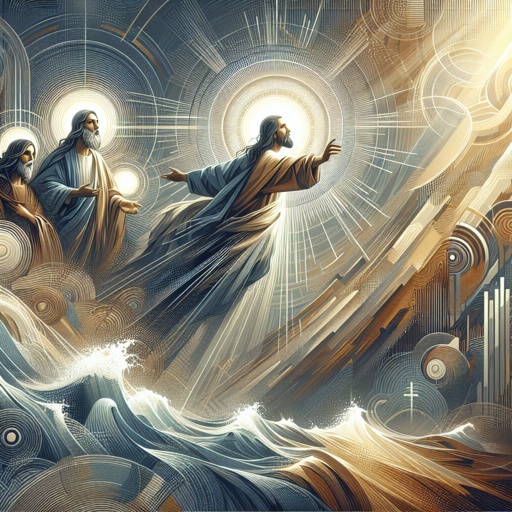
Artwork for John 4:14

1 John 4:14 - "And we have seen and do testify that the Father sent the Son to be the Saviour of the world."

"But whosoever drinketh of the water that I shall give him shall never thirst; but the water that I shall give him shall be in him a well of water springing up into everlasting life." - John 4:14

"But whosoever drinketh of the water that I shall give him shall never thirst; but the water that I shall give him shall be in him a well of water springing up into everlasting life." - John 4:14
John 4:14 - "But whosoever drinketh of the water that I shall give him shall never thirst; but the water that I shall give him shall be in him a well of water springing up into everlasting life."

"And we have seen and do testify that the Father sent the Son to be the Saviour of the world." - 1 John 4:14
"But whosoever drinketh of the water that I shall give him shall never thirst; but the water that I shall give him shall be in him a well of water springing up into everlasting life." - John 4:14
"But whosoever drinketh of the water that I shall give him shall never thirst; but the water that I shall give him shall be in him a well of water springing up into everlasting life." - John 4:14

Matthew 14:4 - "For John said unto him, It is not lawful for thee to have her."

John 14:4 - "And whither I go ye know, and the way ye know."

"And whither I go ye know, and the way ye know." - John 14:4

"For John said unto him, It is not lawful for thee to have her." - Matthew 14:4

John 14

John 14:30

John 3:14

John 14:16

John 14:6

John 14:28

John 20:14

John 14:14 - "If ye shall ask any thing in my name, I will do it."

John 4:13-14 - "Jesus answered, “Everyone who drinks this water will be thirsty again, but whoever drinks the water I give them will never thirst. Indeed, the water I give them will become in them a spring of water welling up to eternal life.”"

John 14:15-21

John 14:23-29

John 14:23-29

John 4:4 - "And he must needs go through Samaria."

1 John 2:14

John 14:23-29

1 John 2:14

John 14:1-2
John 14:16-17

John 4:16