What does John 6:6 mean?
“And this he said to prove him: for he himself knew what he would do.” — John 6:6
John 6:6, from the King James Version, reads: "And this he said to prove him: for he himself knew what he would do."
This verse is taken from the New Testament of the Bible, specifically from the Gospel of John. This particular verse comes at a pivotal moment in the narrative, where Jesus is confronted with the challenge of feeding a multitude of people with limited resources. The overall context of this verse is the story of the feeding of the five thousand, a well-known miracle performed by Jesus.
The themes of this verse revolve around the idea of testing and proving one's faith. Jesus' statement, "And this he said to prove him," refers to the testing of Philip, one of his disciples. In the preceding verses, Jesus asks Philip, "Whence shall we buy bread, that these may eat?" (John 6:5). Philip's response reveals his skepticism and lack of faith, as he questions the feasibility of providing enough food for such a large crowd. Jesus' statement is a test of Philip's trust in his divine power to provide for their needs.
The context of this verse is important for understanding its deeper meaning. Jesus and his disciples are confronted with a practical challenge – how to feed over five thousand people with only five loaves of bread and two fish. The disciples are uncertain about how to address this problem, which prompts Jesus to test their faith. This sets the stage for the miraculous feeding that follows, as Jesus multiplies the loaves and fish to ensure that everyone is fed. This event serves to demonstrate Jesus' divine power and ability to meet the needs of his followers.
The symbolism in this verse is profound. Jesus' testing of Philip and the subsequent miracle of the feeding of the five thousand serve as a metaphor for the broader theme of faith. The disciples' initial doubt and uncertainty mirror the struggles that many people face when confronted with challenging circumstances. Jesus' response, however, serves as a reminder that with faith and trust in him, all things are possible. The multiplication of the loaves and fish symbolizes Jesus' ability to provide abundantly for those in need, regardless of the apparent scarcity of resources.
Furthermore, this verse also speaks to the omniscience of Jesus. The latter part of the verse, "for he himself knew what he would do," underscores the fact that Jesus is aware of the solution to the problem from the beginning. This highlights Jesus' divine knowledge and wisdom, emphasizing his authority and control over the situation.
In summary, John 6:6 from the King James Version of the Bible conveys a powerful message about faith, testing, and the abundance of God's provision. The context of the verse, within the narrative of the feeding of the five thousand, serves to deepen its significance, showcasing Jesus' miraculous power and his ability to meet the needs of his followers. The symbolism of the verse resonates with the broader themes of faith and divine abundance, underscoring the importance of trusting in Jesus' ability to provide for his people.
Get our apps


Artwork for John 6:6

John 6:6 - "And this he said to prove him: for he himself knew what he would do."

"And this he said to prove him: for he himself knew what he would do." - John 6:6

He said this only to test Philip. He himself knew exactly what he was going to do. (Jn 6:6)

John 6:63

John 6:63

John 6:63

John 6:63

John 1:6 - "¶ There was a man sent from God, whose name was John."
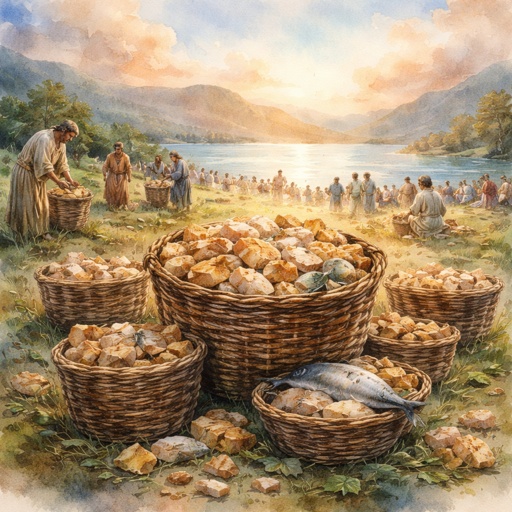
John 6:12

John 6:40

John 21:6

John 14:6

John 6:16

John 21:6

John 6:37

John 21:6

John 21:6

John 6:40

John 6:8-9

JOHN 6:11-13

John 4:6-7

John 6:48 - "I am that bread of life."

John 6:4 - "And the passover, a feast of the Jews, was nigh."

John 6:18 - "And the sea arose by reason of a great wind that blew."

John 6:20 - "But he saith unto them, It is I; be not afraid."

John 14:6 Three dimensional

2 John 1:6 – "And this is love: that we walk in obedience to his commands."

2 John 1:6 – "And this is love: that we walk in obedience to his commands."

John 6:59 - "These things said he in the synagogue, as he taught in Capernaum."

John 6:49 - "Your fathers did eat manna in the wilderness, and are dead."