What does John 9:11 mean?
"He answered and said, A man that is called Jesus made clay, and anointed mine eyes, and said unto me, Go to the pool of Siloam, and wash: and I went and washed, and I received sight." - John 9:11
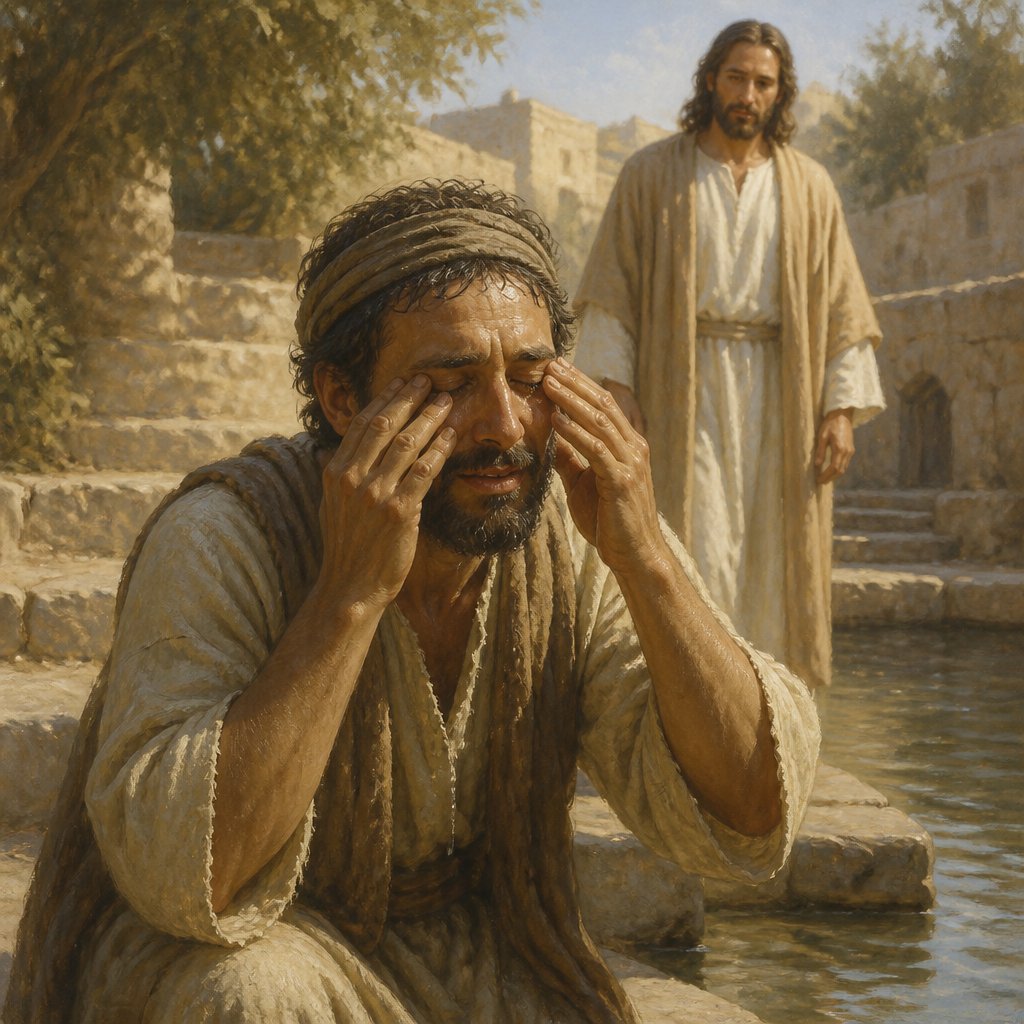
John 9:11 in the King James Version (KJV) of the Bible reads, "He answered and said, A man that is called Jesus made clay, and anointed mine eyes, and said unto me, Go to the pool of Siloam, and wash: and I went and washed, and I received sight." This verse is part of the story of the healing of the man born blind, one of the miracles performed by Jesus Christ.
The context of this verse is that Jesus and his disciples came across a man who was blind from birth. The disciples asked Jesus who had sinned, the man or his parents, that he was born blind. Jesus replied that neither the man nor his parents sinned, but that the works of God should be made manifest in him. After saying this, Jesus spat on the ground, made clay with the saliva, anointed the man's eyes with the clay, and told him to go wash in the pool of Siloam. As the man washed, he received his sight.
This verse highlights several important themes. One of the central themes is the power and authority of Jesus as the Son of God. The fact that Jesus was able to heal the man's blindness with a simple act of making clay and anointing his eyes demonstrates his divinity and miraculous abilities. This theme emphasizes the belief that Jesus is not just a prophet or a teacher, but the Messiah and the Son of God who has power over sickness and physical infirmities.
The theme of faith is also present in this verse. The blind man showed great faith in following Jesus' instructions to go wash in the pool of Siloam. Despite not being able to see, he obeyed Jesus' command and as a result, received his sight. This demonstrates the importance of faith in receiving God's miracles and blessings. It also serves as a lesson for believers to trust in Jesus and follow his instructions, even when the solution may seem unconventional or illogical.
Another significant theme in this verse is the concept of spiritual blindness and sight. This story is not just about physical healing, but also represents the spiritual blindness of the Pharisees and the religious leaders who refused to acknowledge Jesus as the Messiah. The blind man, who was physically blind but gained his sight through the power of Jesus, contrasts with the spiritually blind Pharisees who rejected Jesus despite witnessing his miracles.
The symbolism in this verse is also worth noting. The use of clay and saliva by Jesus to heal the blind man has symbolic significance. In the Jewish tradition, clay was used for healing, and saliva was believed to have therapeutic properties. By using these elements, Jesus is demonstrating his mastery over physical elements and his ability to bring healing and restoration. The act of anointing the man's eyes with the clay also symbolizes the spiritual transformation that accompanies physical healing.
Overall, John 9:11 in the KJV version of the Bible conveys powerful messages about the authority and divinity of Jesus, the importance of faith, and the contrast between spiritual blindness and sight. It presents a compelling narrative of miraculous healing that goes beyond physical restoration, pointing to a deeper spiritual truth about the identity and power of Jesus as the Son of God.
Have questions about John 9:11?
Dive deeper into this scripture with Bible Chat — an AI-powered tool for exploring God's Word through conversation. Ask questions, get context, and grow in your understanding of the Bible.
Get Our Apps


John 9:11 Artwork

John 9:11 - "He answered and said, A man that is called Jesus made clay, and anointed mine eyes, and said unto me, Go to the pool of Siloam, and wash: and I went and washed, and I received sight."
"He answered and said, A man that is called Jesus made clay, and anointed mine eyes, and said unto me, Go to the pool of Siloam, and wash: and I went and washed, and I received sight." - John 9:11

John 11:9 - "Jesus answered, Are there not twelve hours in the day? If any man walk in the day, he stumbleth not, because he seeth the light of this world."

John (11:35) Jesus wept.

john 21:9
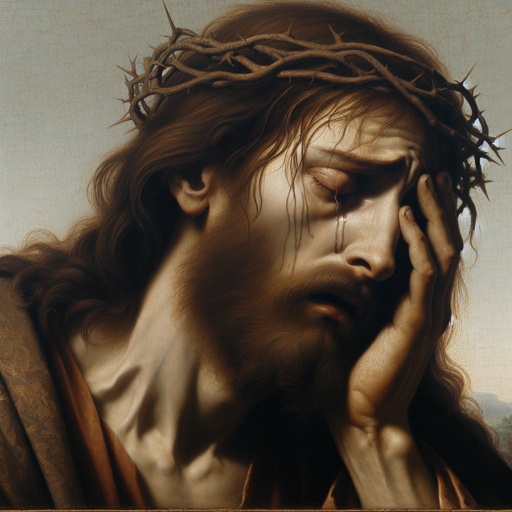
John (11:35) Jesus wept.

John (11:35) Jesus wept.

John 11:35

John 15.1-11

John 11:35

John (11:35) Jesus wept.

John (11:35) Jesus wept.

John (11:35) Jesus wept.

John 10:9

John 10:9

John 10:9

John (11:35) Jesus wept.

John (11:35) Jesus wept.

John (11:35) Jesus wept.
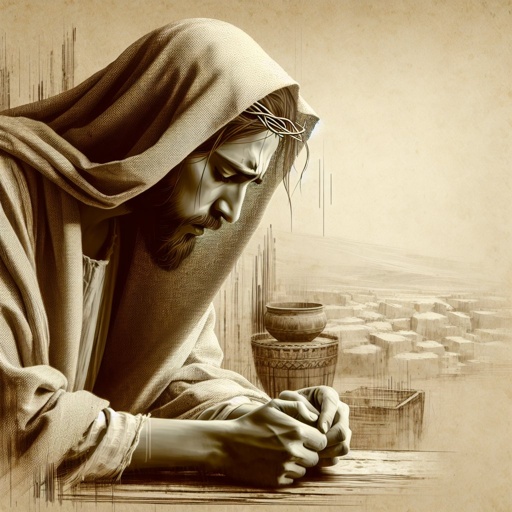
John 11:35 - "Jesus wept."

John (11:35) Jesus wept.

John (11:35) Jesus wept.

John (11:35) Jesus wept.

John (11:35) Jesus wept.

John (11:35) Jesus wept.

John 20:11-12

JOHN 6:11-13

John 20:11-13

John 8:4-11

John 6:8-9