What does Joshua 19:22 mean?
“And the coast reacheth to Tabor, and Shahazimah, and Beth-shemesh; and the outgoings of their border were at Jordan: sixteen cities with their villages.” — Joshua 19:22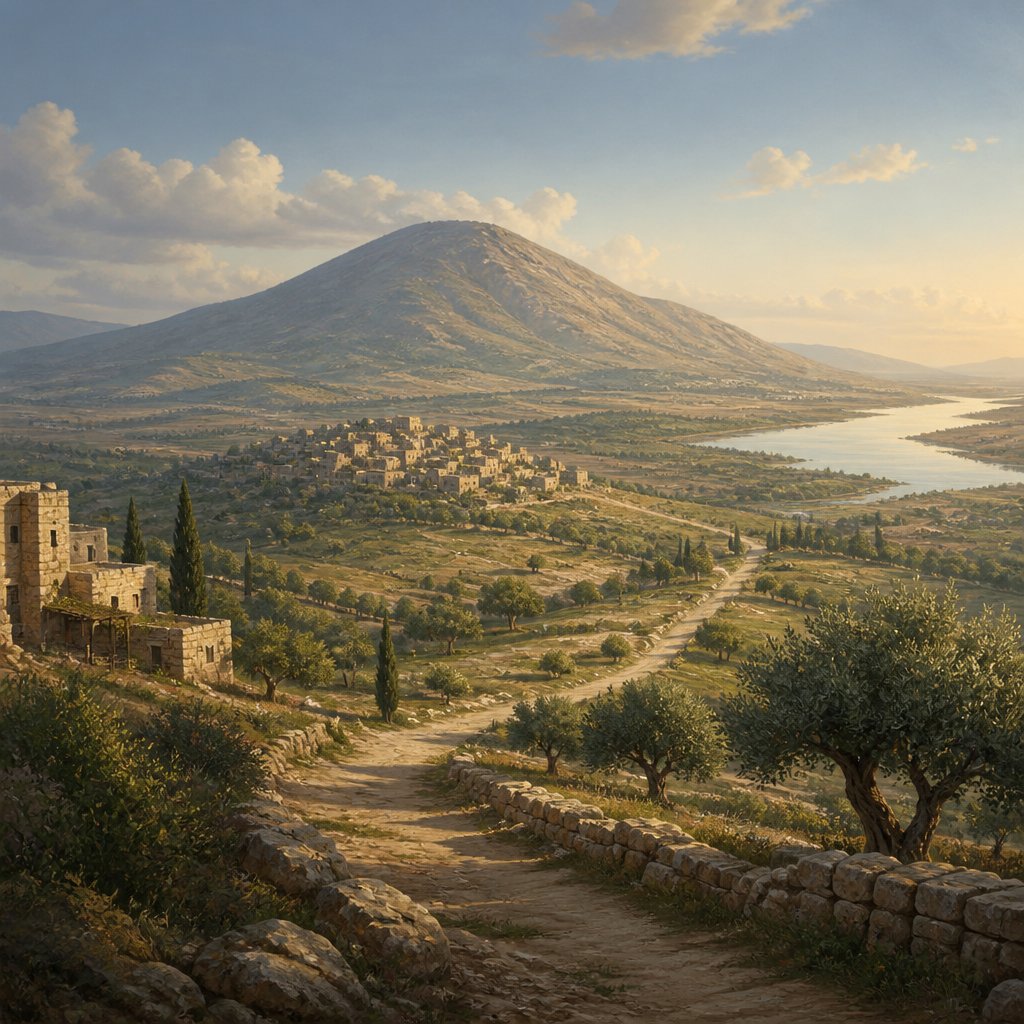
Joshua 19:22 (KJV): And the coast reacheth to Tabor, and Shahazimah, and Bethshemesh; and the outgoings of their border were at Jordan: sixteen cities with their villages.
The Book of Joshua is the sixth book of the Bible, and it describes the Israelites' conquest of Canaan under the leadership of Joshua, after the death of Moses. The verse Joshua 19:22 is part of a larger narrative that outlines the division of the promised land among the tribes of Israel. In this specific verse, the borders of the tribal allotment of the tribe of Issachar are being described.
The verse mentions three specific locations: Tabor, Shahazimah, and Bethshemesh. Tabor is believed to be Mount Tabor, a prominent landmark in the region of Galilee. It is a significant location in the Bible, as it is mentioned in several other instances, including in the accounts of the transfiguration of Jesus. Shahazimah is not as well-known, and its precise location is uncertain. Bethshemesh, however, is a well-documented city in ancient Israel, and it holds significance in several biblical stories, particularly in the times of the judges.
The mention of the Jordan River as the border in this verse is also noteworthy. The Jordan River holds great symbolic and historical significance for the Israelites. It was the barrier they crossed to enter the promised land, and throughout the Bible, it is a recurring symbol of transition and transformation. The fact that the tribal allotment of Issachar's land is defined by the Jordan River illustrates the importance of this geographical feature in both a physical and symbolic sense.
In the broader context of the Book of Joshua, this verse is representative of the fulfillment of God's promise to the Israelites. For generations, they had wandered in the wilderness, and now they were finally settling in the land that God had promised to give them. The detailed descriptions of the tribal boundaries and the allocation of land underscore the meticulous fulfillment of God's promises. It highlights the divine guidance and faithfulness of God to his people.
This verse also exemplifies the theme of unity and cooperation among the tribes of Israel. The allocation of land was done as a collective effort, with each tribe having its own portion, yet still contributing to the overall success of the Israelite settlement. It speaks to the importance of community and collaboration in achieving common goals, a value that holds relevance even today.
Symbolically, the number sixteen mentioned in this verse is significant in biblical numerology. In the Bible, the number sixteen is often associated with love and loving others. It can also represent completeness in a spiritual sense, as it is the sum of 10 (which represents divine order) and 6 (which represents man). This could be seen as a reminder of the importance of love and unity within the community of the Israelites as they settle into their allotted portions of the promised land.
In conclusion, Joshua 19:22 holds a rich tapestry of themes, contexts, and symbolism within the broader narrative of the Book of Joshua. It reflects the fulfillment of God's promises, the unity and cooperation among the Israelite tribes, and the significance of specific geographical locations. It also serves as a powerful reminder of the enduring relevance of these themes and lessons in our lives today.
Get our apps


Artwork for Joshua 19:22

Joshua 19:22 - "And the coast reacheth to Tabor, and Shahazimah, and Beth-shemesh; and the outgoings of their border were at Jordan: sixteen cities with their villages."
"And the coast reacheth to Tabor, and Shahazimah, and Beth-shemesh; and the outgoings of their border were at Jordan: sixteen cities with their villages." - Joshua 19:22

Joshua 19:19 - "And Haphraim, and Shion, and Anaharath,"

Joshua 22:1 - "Then Joshua called the Reubenites, and the Gadites, and the half tribe of Manasseh,"

Joshua 22:6 - "So Joshua blessed them, and sent them away: and they went unto their tents."

"And Haphraim, and Shion, and Anaharath," - Joshua 19:19

Joshua 22:19 - "Notwithstanding, if the land of your possession be unclean, then pass ye over unto the land of the possession of the LORD, wherein the LORD'S tabernacle dwelleth, and take possession among us: but rebel not against the LORD, nor rebel against us, in building you an altar beside the altar of the LORD our God."

Joshua 7:22 - "¶ So Joshua sent messengers, and they ran unto the tent; and, behold, it was hid in his tent, and the silver under it."

Joshua 15:22 - "And Kinah, and Dimonah, and Adadah,"

Joshua 19:4 - "And Eltolad, and Bethul, and Hormah,"

Joshua 19:42 - "And Shaalabbin, and Ajalon, and Jethlah,"

Joshua 10:22 - "Then said Joshua, Open the mouth of the cave, and bring out those five kings unto me out of the cave."

Joshua 19:44 - "And Eltekeh, and Gibbethon, and Baalath,"

Joshua 19:43 - "And Elon, and Thimnathah, and Ekron,"

Joshua 19:36 - "And Adamah, and Ramah, and Hazor,"

Joshua 19:20 - "And Rabbith, and Kishion, and Abez,"

Joshua 19:37 - "And Kedesh, and Edrei, and En-hazor,"

Joshua 19:3 - "And Hazar-shual, and Balah, and Azem,"

Joshua 18:22 - "And Beth-arabah, and Zemaraim, and Beth-el,"

Joshua 19:5 - "And Ziklag, and Beth-marcaboth, and Hazar-susah,"

Rubenites buyilding alter in Joshua 22

"Then Joshua called the Reubenites, and the Gadites, and the half tribe of Manasseh," - Joshua 22:1

Joshua 19:45 - "And Jehud, and Bene-berak, and Gath-rimmon,"

Joshua 19:25 - "And their border was Helkath, and Hali, and Beten, and Achshaph,"

Joshua 19:18 - "And their border was toward Jezreel, and Chesulloth, and Shunem,"

Joshua 24:22 - "And Joshua said unto the people, Ye are witnesses against yourselves that ye have chosen you the LORD, to serve him. And they said, We are witnesses."

Joshua 19:49 - "¶ When they had made an end of dividing the land for inheritance by their coasts, the children of Israel gave an inheritance to Joshua the son of Nun among them:"

Joshua 19:41 - "And the coast of their inheritance was Zorah, and Eshtaol, and Ir-shemesh,"

Joshua 19:2 - "And they had in their inheritance Beer-sheba, or Sheba, and Moladah,"

Joshua 12:19 - "The king of Madon, one; the king of Hazor, one;"