What does Joshua 1:9 mean?
“Have not I commanded thee? Be strong and of a good courage; be not afraid, neither be thou dismayed: for the LORD thy God is with thee whithersoever thou goest.” — Joshua 1:9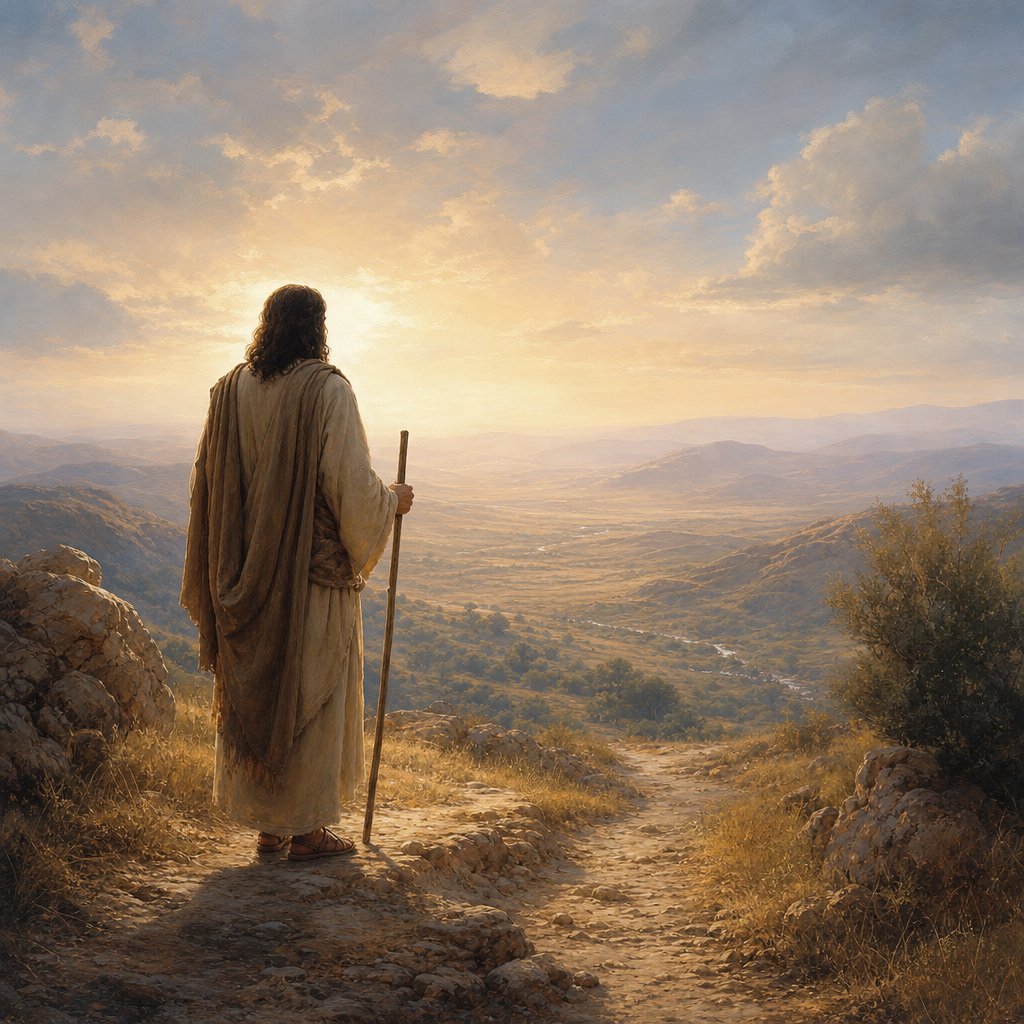
Joshua 1:9 in the King James Version stands as the Lord’s personal charge to Joshua at a decisive turning point in Israel’s history: “Have not I commanded thee? Be strong and of a good courage; be not afraid, neither be thou dismayed: for the LORD thy God is with thee whithersoever thou goest.” Its meaning is shaped by what has just happened, what is about to happen, and who is being addressed.
The setting is the moment after the death of Moses, when leadership passes to Joshua and Israel stands on the edge of the land promised to their fathers. The book opens with the weight of transition: “Moses my servant is dead; now therefore arise, go over this Jordan, thou, and all this people, unto the land which I do give to them” (Joshua 1:2). Joshua is not being asked to preserve the status quo but to lead a nation across a boundary into conflict, settlement, and covenant faithfulness. Joshua 1:9 is therefore not merely a private encouragement; it is the Lord’s commissioning word for a public calling that will test Joshua’s heart, Israel’s obedience, and their confidence in the God who brought them out of Egypt.
The verse begins with a question that is really a divine reminder: “Have not I commanded thee?” Courage here is not presented as a personality trait Joshua must summon from within, but as obedience to a command from God. The Lord does not treat fear as a harmless feeling that can be indulged without consequence; He confronts it with His authority. Joshua is not free to drift into timidity as though the future were governed by circumstance alone. The command makes courage a moral and spiritual response. Joshua’s strength is anchored not in self-assurance but in submission to the One who commands, calls, and goes with him.
When the Lord says, “Be strong and of a good courage,” He is speaking to the kind of strength required for faithful leadership. Joshua will need strength to act, to persevere, to make judgments, and to keep going when the path is costly. He will also need courage of a particular sort: the courage that refuses to be controlled by dread, uncertainty, or opposition. This is significant because Joshua’s task is not only military but covenantal. Earlier in the same chapter the Lord ties Joshua’s success to attentiveness to God’s word: “Only be thou strong and very courageous, that thou mayest observe to do according to all the law, which Moses my servant commanded thee” (Joshua 1:7), and again, “This book of the law shall not depart out of thy mouth; but thou shalt meditate therein day and night” (Joshua 1:8). Joshua 1:9 gathers up that theme and presses it into Joshua’s soul: the strength God commands is the strength to obey, and the courage God commands is the courage to remain faithful under pressure.
The verse then names the enemy of courage in two parallel phrases: “be not afraid, neither be thou dismayed.” Fear can be the immediate panic that shrinks back, but being “dismayed” suggests a deeper collapse of resolve, a breaking of the inner frame, the kind of discouragement that makes a man feel undone and unable to stand. The Lord addresses both the sudden surge of fear and the slow sinking of the heart. The point is not that Joshua will never feel the rising of dread, but that he must not yield to it as a governing power. The command implies that fear and dismay are real contenders for the throne of the heart, and the Lord is claiming that throne for Himself by calling Joshua to trust.
The ground of this courage is given in the final clause, introduced by “for,” which is the hinge of the whole verse: “for the LORD thy God is with thee whithersoever thou goest.” This is the central meaning and the greatest significance of Joshua 1:9. The Lord does not simply tell Joshua to be brave; He gives Joshua a reason that rests on God’s own presence. The phrase “the LORD thy God” joins God’s covenant name with a personal relationship: He is not a distant deity but the LORD who has bound Himself to His people, and He is “thy God” to Joshua in particular as a leader under covenant. The promise of presence answers the fear of the unknown. Joshua is about to enter unfamiliar territory, face fortified cities, and carry responsibility for a nation; the Lord meets all that uncertainty with one unshakeable reality: wherever Joshua goes in obedience to God’s calling, he does not go alone.
This promise also carries deep covenant resonance. Israel’s life as a people was marked by the Lord dwelling with them, guiding them, and not forsaking them. In the same chapter the Lord says, “As I was with Moses, so I will be with thee: I will not fail thee, nor forsake thee” (Joshua 1:5). Joshua 1:9 echoes that assurance and expands it into the breadth of Joshua’s whole path: “whithersoever thou goest.” The words do not suggest that every step Joshua might take in any direction is automatically blessed regardless of obedience, because the chapter repeatedly binds blessing and success to doing “according to all the law” (Joshua 1:7). Rather, the phrase emphasizes that no place of duty will be beyond the reach of God’s faithful presence. The God who calls also accompanies.
Symbolically, the moment underscores the meaning of crossing “this Jordan” (Joshua 1:2). The Jordan River stands as a boundary between wandering and inheritance, between the past under Moses and the future under Joshua, between the desert and the land. Joshua’s commission is therefore a kind of threshold calling: stepping into God’s promise often requires leaving what is familiar, and that crossing can awaken fear. Joshua 1:9 meets that threshold with the assurance that the Lord’s presence is not confined to one side of the river. God is not the God of yesterday only, but the God of the next step, and the next, and the next, “whithersoever thou goest.”
There is also a leadership theme that runs through the verse. Joshua is being shaped as a leader who must steady others. Immediately around this passage Joshua is told to lead the people decisively: “thou shalt cause this people to inherit the land” (Joshua 1:6). He must speak, organize, and command. Yet the Lord begins by commanding Joshua himself. Before Joshua can strengthen Israel, he must be strengthened by the word of God; before he can call others to courage, he must receive courage as an act of obedience to the Lord’s command. In that way, Joshua 1:9 shows that spiritual leadership is not grounded in mere charisma or strategy but in a leader’s submission to God’s word and dependence on God’s presence.
The verse also carries a subtle but profound contrast between human limitation and divine sufficiency. Joshua is not Moses, and the death of Moses could easily have made the future feel fragile. But God’s work does not collapse with the death of a servant, however great. “Moses my servant is dead; now therefore arise” (Joshua 1:2). The strength and continuity of Israel’s hope rests not on the permanence of one man but on the faithfulness of the LORD. Joshua 1:9 crystallizes that reality: the courage of the servant is sustained by the unchanging presence of God.
In sum, Joshua 1:9 means that Joshua is commanded to live and lead with strength and courage, refusing fear and inner collapse, because the covenant LORD is personally with him in every place obedience leads him. It is a verse about courage, but even more it is a verse about God: His authority that commands, His word that directs, and His presence that steadies the heart at the boundary between promise and battle.
Get our apps


Artwork for Joshua 1:9

Joshua 1:9

Joshua 1:9 - "Have not I commanded thee? Be strong and of a good courage; be not afraid, neither be thou dismayed: for the LORD thy God is with thee whithersoever thou goest."

"Have not I commanded thee? Be strong and of a good courage; be not afraid, neither be thou dismayed: for the LORD thy God is with thee whithersoever thou goest." - Joshua 1:9

Joshua 1:9 Have I not commanded you? Be strong and courageous. Do not be afraid; do not be discouraged, for the Lord your God will be with you wherever you go.
!["Have not I commanded thee? Be strong and of a good courage; be not afraid, neither be thou dismayed: for the LORD thy God [is] with thee whithersoever thou goest." - Joshua 1:9](https://media.bible.art/8f485b39-48e5-4f58-94fc-d8dbaf1a2aec-thumbnail.jpg)
"Have not I commanded thee? Be strong and of a good courage; be not afraid, neither be thou dismayed: for the LORD thy God [is] with thee whithersoever thou goest." - Joshua 1:9

"Have not I commanded thee? Be strong and of a good courage; be not afraid, neither be thou dismayed: for the LORD thy God is with thee whithersoever thou goest." - Joshua 1:9

"Have not I commanded thee? Be strong and of a good courage; be not afraid, neither be thou dismayed: for the LORD thy God is with thee whithersoever thou goest." - Joshua 1:9
"Have not I commanded thee? Be strong and of a good courage; be not afraid, neither be thou dismayed: for the LORD thy God is with thee whithersoever thou goest." - Joshua 1:9

"Have not I commanded thee? Be strong and of a good courage; be not afraid, neither be thou dismayed: for the LORD thy God is with thee whithersoever thou goest." - Joshua 1:9

"Have not I commanded thee? Be strong and of a good courage; be not afraid, neither be thou dismayed: for the LORD thy God is with thee whithersoever thou goest." - Joshua 1:9

Joshua 1:7-9

Joshua 9:2 - "That they gathered themselves together, to fight with Joshua and with Israel, with one accord."

Joshua 9:8 - "And they said unto Joshua, We are thy servants. And Joshua said unto them, Who are ye? and from whence come ye?"

Joshua 9:3 - "¶ And when the inhabitants of Gibeon heard what Joshua had done unto Jericho and to Ai,"

Joshua 2:9

Joshua 10:9 - "Joshua therefore came unto them suddenly, and went up from Gilgal all night."

Joshua 3:9 - "¶ And Joshua said unto the children of Israel, Come hither, and hear the words of the LORD your God."

Joshua 11:9 - "And Joshua did unto them as the LORD bade him: he houghed their horses, and burnt their chariots with fire."

Joshua 8:9 - "¶ Joshua therefore sent them forth: and they went to lie in ambush, and abode between Beth-el and Ai, on the west side of Ai: but Joshua lodged that night among the people."

Joshua 9:15 - "And Joshua made peace with them, and made a league with them, to let them live: and the princes of the congregation sware unto them."

Joshua 18:9 - "And the men went and passed through the land, and described it by cities into seven parts in a book, and came again to Joshua to the host at Shiloh."

Joshua And The Walls Of Jericho 16:9

Joshua 4:9 - "And Joshua set up twelve stones in the midst of Jordan, in the place where the feet of the priests which bare the ark of the covenant stood: and they are there unto this day."

"That they gathered themselves together, to fight with Joshua and with Israel, with one accord." - Joshua 9:2

Joshua 9:27 - "And Joshua made them that day hewers of wood and drawers of water for the congregation, and for the altar of the LORD, even unto this day, in the place which he should choose."

Joshua 9:1 - "And it came to pass, when all the kings which were on this side Jordan, in the hills, and in the valleys, and in all the coasts of the great sea over against Lebanon, the Hittite, and the Amorite, the Canaanite, the Perizzite, the Hivite, and the Jebusite, heard thereof;"

Joshua 9:14 - "And the men took of their victuals, and asked not counsel at the mouth of the LORD."

Joshua 1:10 - "¶ Then Joshua commanded the officers of the people, saying,"

Joshua 5:9 - "And the LORD said unto Joshua, This day have I rolled away the reproach of Egypt from off you. Wherefore the name of the place is called Gilgal unto this day."

Joshua 9:6 - "And they went to Joshua unto the camp at Gilgal, and said unto him, and to the men of Israel, We be come from a far country: now therefore make ye a league with us."