What does Joshua 21:7 mean?
“The children of Merari by their families had out of the tribe of Reuben, and out of the tribe of Gad, and out of the tribe of Zebulun, twelve cities.” — Joshua 21:7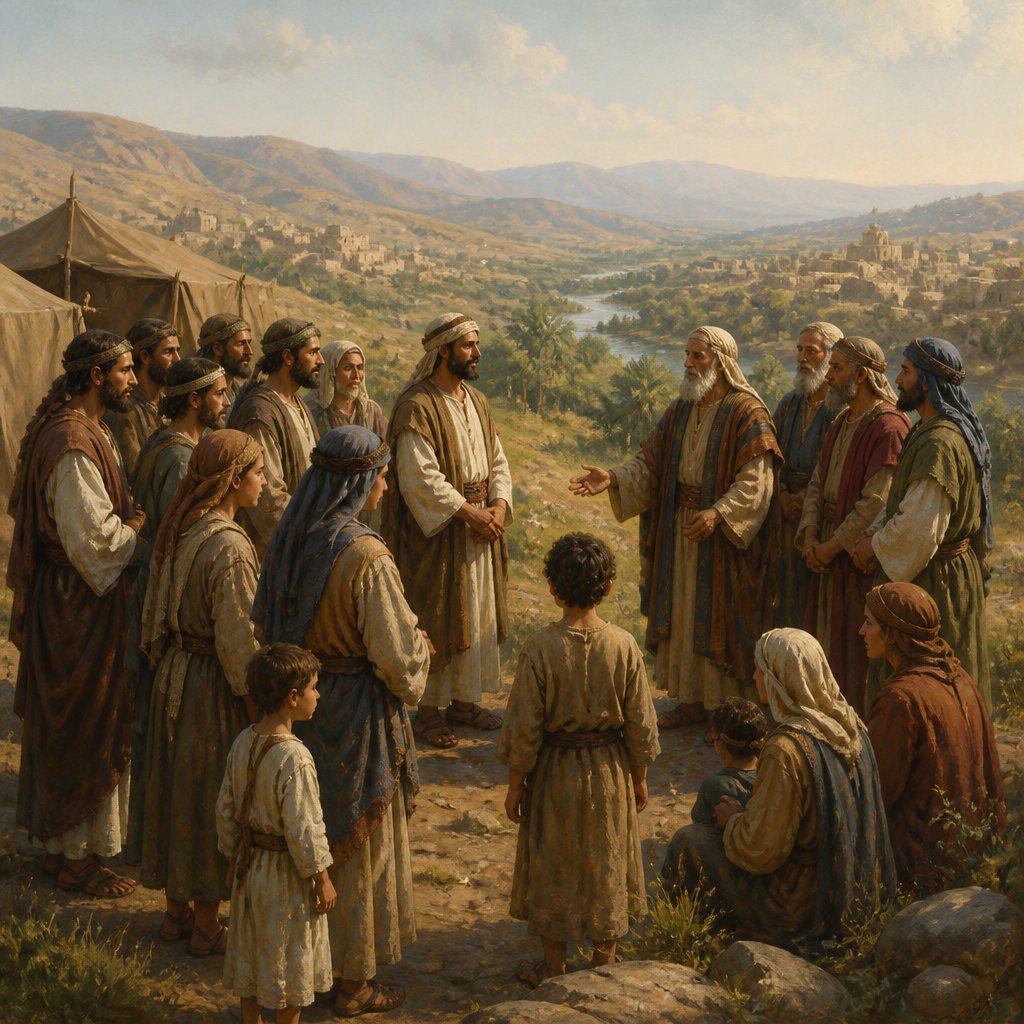
The King James Version of Joshua 21:7 reads, "The children of Merari by their families had out of the tribe of Reuben, and out of the tribe of Gad, and out of the tribe of Zebulun, twelve cities."
This verse is part of the account of the division of the Promised Land among the twelve tribes of Israel as commanded by God. After the conquest of Canaan and the victories led by Joshua, the Israelites were to settle in their respective tribal territories, which had been promised to them by God. The verse specifically mentions the tribe of Merari, which was one of the Levitical tribes responsible for the care of the tabernacle and later the temple.
In this verse, we see the fulfillment of God's promises to the Israelites. The division of the land among the tribes was not just a physical allocation of territory, but it also had deep spiritual and symbolic significance. The land was a tangible manifestation of God's faithfulness and provision for his people. It was a gift from God, a sign of his covenant with them, and a reminder of their identity as his chosen people.
The inclusion of the tribe of Merari in this verse is significant because it highlights the role of the Levites in the religious and communal life of Israel. The Levites were not given a territorial inheritance like the other tribes because their portion was to serve as priests and caretakers of the tabernacle and later the temple. Instead of land, they were given cities scattered throughout the territories of the other tribes.
The number 'twelve' also carries significant symbolism in the Bible. The twelve tribes of Israel represent completeness and wholeness. The number twelve is often associated with governance and order. In the New Testament, Jesus chose twelve disciples to symbolize the restoration of the twelve tribes of Israel and the establishment of a new covenant community.
The verse also emphasizes the unity and cooperation among the tribes of Israel. Despite having their own territories and cities, the tribes were meant to function as a cohesive unit, bound together by their common faith and allegiance to God. Each tribe had its own identity and characteristics, but they were all part of the larger community of Israel.
From a historical and contextual perspective, the division of the land among the tribes of Israel was a pivotal moment in their history. It marked the transition from a nomadic existence to a settled agricultural society. The allocation of land helped solidify the tribal identity and establish a sense of belonging and ownership among the people.
The verse also serves as a reminder of the importance of stewardship and responsibility. The Israelites were entrusted with the land, and it was their duty to cultivate and care for it. This echoes the broader biblical theme of God's people being caretakers of the earth and taking responsible dominion over creation.
In conclusion, Joshua 21:7 from the King James Version of the Bible is a verse rich in symbolism and significance. It reflects God's faithfulness to his people, the unity and cooperation among the tribes of Israel, and the importance of stewardship and responsibility. It also points to the spiritual and symbolic dimensions of the division of the Promised Land, as well as the historical and contextual implications for the Israelites. Ultimately, this verse reminds us of God's sovereignty and provision, as well as the call to live in harmony with one another and to fulfill our responsibilities as caretakers of the earth.
Get our apps


Artwork for Joshua 21:7
Joshua 21:7 - "The children of Merari by their families had out of the tribe of Reuben, and out of the tribe of Gad, and out of the tribe of Zebulun, twelve cities."
"The children of Merari by their families had out of the tribe of Reuben, and out of the tribe of Gad, and out of the tribe of Zebulun, twelve cities." - Joshua 21:7

Joshua 24:21 - "And the people said unto Joshua, Nay; but we will serve the LORD."

Joshua 7:21 - "When I saw among the spoils a goodly Babylonish garment, and two hundred shekels of silver, and a wedge of gold of fifty shekels weight, then I coveted them, and took them; and, behold, they are hid in the earth in the midst of my tent, and the silver under it."

Joshua 10:21 - "And all the people returned to the camp to Joshua at Makkedah in peace: none moved his tongue against any of the children of Israel."

Joshua 21:21 - "For they gave them Shechem with her suburbs in mount Ephraim, to be a city of refuge for the slayer; and Gezer with her suburbs,"

Joshua 8:21 - "And when Joshua and all Israel saw that the ambush had taken the city, and that the smoke of the city ascended, then they turned again, and slew the men of Ai."

Joshua 12:21 - "The king of Taanach, one; the king of Megiddo, one;"

Joshua 21:14 - "And Jattir with her suburbs, and Eshtemoa with her suburbs,"

Joshua 21:15 - "And Holon with her suburbs, and Debir with her suburbs,"

"And the people said unto Joshua, Nay; but we will serve the LORD." - Joshua 24:21

Joshua 11:21 - "¶ And at that time came Joshua, and cut off the Anakims from the mountains, from Hebron, from Debir, from Anab, and from all the mountains of Judah, and from all the mountains of Israel: Joshua destroyed them utterly with their cities."

Joshua 21:1 - "Then came near the heads of the fathers of the Levites unto Eleazar the priest, and unto Joshua the son of Nun, and unto the heads of the fathers of the tribes of the children of Israel;"

Joshua 7:16 - "¶ So Joshua rose up early in the morning, and brought Israel by their tribes; and the tribe of Judah was taken:"

Joshua 19:21 - "And Remeth, and En-gannim, and En-haddah, and Beth-pazzez;"

Joshua 7:22 - "¶ So Joshua sent messengers, and they ran unto the tent; and, behold, it was hid in his tent, and the silver under it."

Joshua 21:31 - "Helkath with her suburbs, and Rehob with her suburbs; four cities."

Joshua 21:35 - "Dimnah with her suburbs, Nahalal with her suburbs; four cities."

Joshua 21:37 - "Kedemoth with her suburbs, and Mephaath with her suburbs; four cities."

Joshua 7:10 - "¶ And the LORD said unto Joshua, Get thee up; wherefore liest thou thus upon thy face?"

Joshua 10:7 - "So Joshua ascended from Gilgal, he, and all the people of war with him, and all the mighty men of valour."

Joshua 21:18 - "Anathoth with her suburbs, and Almon with her suburbs; four cities."

Joshua 1:7-9

Joshua 21:22 - "And Kibzaim with her suburbs, and Beth-horon with her suburbs; four cities."

Joshua 21:28 - "And out of the tribe of Issachar, Kishon with her suburbs, Dabareh with her suburbs,"

Joshua 21:30 - "And out of the tribe of Asher, Mishal with her suburbs, Abdon with her suburbs,"

Joshua 21:17 - "And out of the tribe of Benjamin, Gibeon with her suburbs, Geba with her suburbs,"

Joshua 21:19 - "All the cities of the children of Aaron, the priests, were thirteen cities with their suburbs."

Joshua 11:7 - "So Joshua came, and all the people of war with him, against them by the waters of Merom suddenly; and they fell upon them."

Joshua 21:36 - "And out of the tribe of Reuben, Bezer with her suburbs, and Jahazah with her suburbs,"