What does Judges 17:2 mean?
“And he said unto his mother, The eleven hundred shekels of silver that were taken from thee, about which thou cursedst, and spakest of also in mine ears, behold, the silver is with me; I took it. And his mother said, Blessed be thou of the LORD, my son.” — Judges 17:2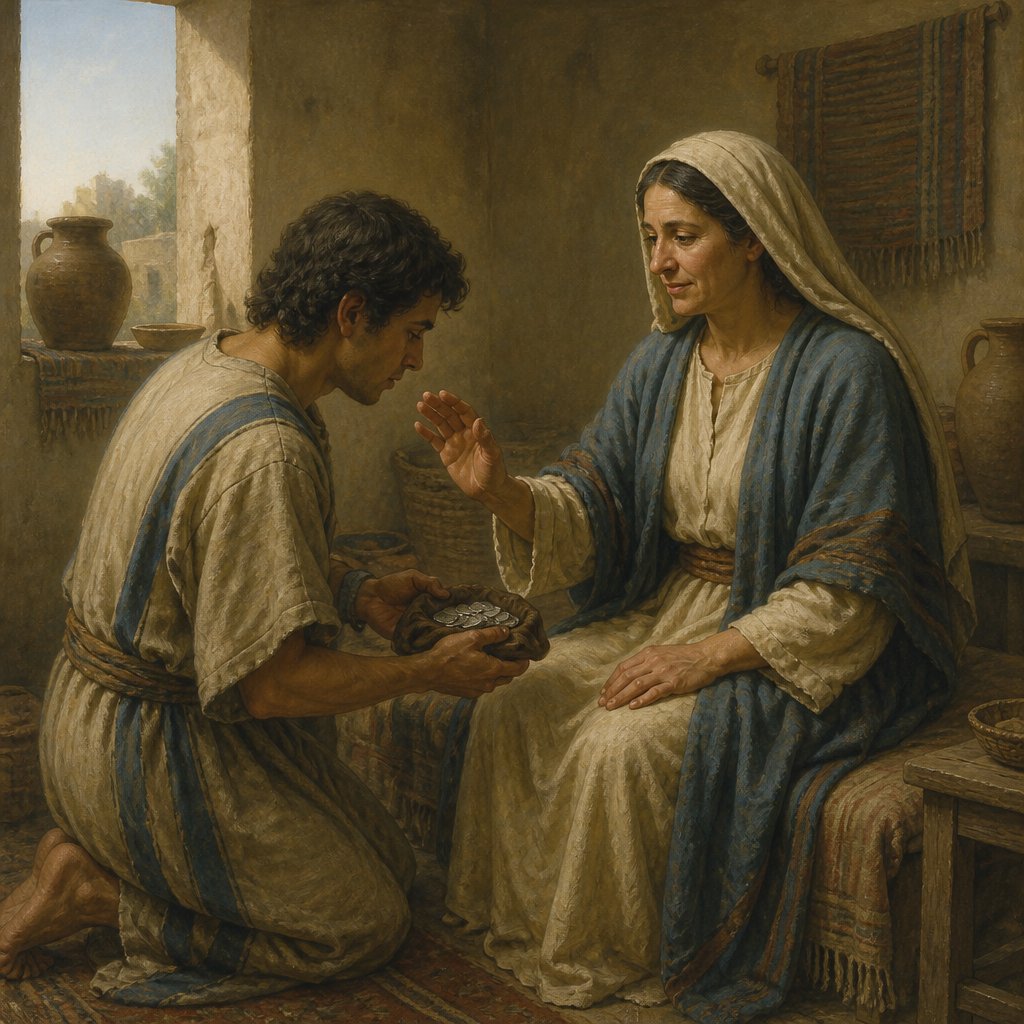
The Bible verse Judges 17:2 from the King James Version (KJV) reads, "And he said unto his mother, The eleven hundred shekels of silver that were taken from thee, about which thou cursedst, and spakest of also in mine ears, behold, the silver is with me; I took it. And his mother said, Blessed be thou of the Lord, my son."
This verse is found in the Old Testament book of Judges, which chronicles the period of time after the Israelites settled in the Promised Land but before the establishment of the monarchy. This particular passage is part of a larger narrative about the idolatry and moral decay that characterized this period in Israel's history.
The verse introduces us to a young man who confesses to his mother that he has stolen a large sum of money from her. The mother had cursed the person responsible for the theft, not knowing that her own son was the culprit.
The themes present in this verse include deception, dishonesty, and the consequences of sin. Throughout the book of Judges, there is a recurring pattern of the Israelites turning away from God, engaging in idol worship, and facing the consequences of their actions. This verse is a prime example of the kind of moral decay and corruption that plagued Israel during this time.
The context of this verse is important to understanding its significance. The book of Judges is essentially a record of Israel's moral and spiritual decline. After the death of Joshua, the Israelites began to turn away from God and embrace the practices of the surrounding pagan nations. This led to a cycle of sin, judgment, and deliverance, as God raised up a series of judges to lead and deliver the people.
In the specific context of Judges 17:2, the verse is part of a larger narrative about a man named Micah and his mother. Micah had stolen the silver from his mother and then confessed to the theft. Instead of condemning her son for his actions, the mother blesses him, showing a lack of moral integrity and an acceptance of dishonesty.
Symbolism is also present in this verse. The silver that was stolen represents material wealth and the temptation to sin for personal gain. The fact that Micah confesses to his mother signifies a moment of recognition and acknowledgment of wrongdoing. However, his mother's response of blessing him reveals a moral ambiguity and a lack of accountability for his actions.
From a spiritual perspective, this verse serves as a warning against the dangers of deceit and dishonesty. It also highlights the erosion of moral values that can occur when people turn away from God and His principles. The consequences of sin are evident as the characters in this passage demonstrate a lack of integrity and righteousness.
In conclusion, Judges 17:2 is a significant passage within the larger narrative of the book of Judges. It serves as a stark illustration of the moral decay and spiritual decline that characterized the period of the judges. The themes of deception, dishonesty, and the consequences of sin are brought to the forefront in this verse, and the context and symbolism further enrich its meaning. As with many passages in the Bible, there are timeless lessons to be gleaned from this verse about the importance of integrity, accountability, and living in accordance with God's will.
Get our apps


Artwork for Judges 17:2

Judges 17:2 - "And he said unto his mother, The eleven hundred shekels of silver that were taken from thee, about which thou cursedst, and spakest of also in mine ears, behold, the silver is with me; I took it. And his mother said, Blessed be thou of the LORD, my son."
"And he said unto his mother, The eleven hundred shekels of silver that were taken from thee, about which thou cursedst, and spakest of also in mine ears, behold, the silver is with me; I took it. And his mother said, Blessed be thou of the LORD, my son." - Judges 17:2

Judges 2:17 - "And yet they would not hearken unto their judges, but they went a whoring after other gods, and bowed themselves unto them: they turned quickly out of the way which their fathers walked in, obeying the commandments of the LORD; but they did not so."

Judges 17:1 - "And there was a man of mount Ephraim, whose name was Micah."

Job 12:17 - "He leadeth counsellors away spoiled, and maketh the judges fools."

Judges 8:17 - "And he beat down the tower of Penuel, and slew the men of the city."

Judges 17:12 - "And Micah consecrated the Levite; and the young man became his priest, and was in the house of Micah."

Judges 21:17 - "And they said, There must be an inheritance for them that be escaped of Benjamin, that a tribe be not destroyed out of Israel."

Judges 3:17 - "And he brought the present unto Eglon king of Moab: and Eglon was a very fat man."

Judges 17:11 - "And the Levite was content to dwell with the man; and the young man was unto him as one of his sons."

Judges 17:7 - "¶ And there was a young man out of Beth-lehem-judah of the family of Judah, who was a Levite, and he sojourned there."

Judges 17:6 - "In those days there was no king in Israel, but every man did that which was right in his own eyes."

Judges 9:17 - "(For my father fought for you, and adventured his life far, and delivered you out of the hand of Midian:"

"And yet they would not hearken unto their judges, but they went a whoring after other gods, and bowed themselves unto them: they turned quickly out of the way which their fathers walked in, obeying the commandments of the LORD; but they did not so." - Judges 2:17

Judges 10:17 - "Then the children of Ammon were gathered together, and encamped in Gilead. And the children of Israel assembled themselves together, and encamped in Mizpeh."

"And there was a man of mount Ephraim, whose name was Micah." - Judges 17:1

Judges 2:16 - "¶ Nevertheless the LORD raised up judges, which delivered them out of the hand of those that spoiled them."

Judges 2:31

Judges 1:17 - "And Judah went with Simeon his brother, and they slew the Canaanites that inhabited Zephath, and utterly destroyed it. And the name of the city was called Hormah."

Judges 17:13 - "Then said Micah, Now know I that the LORD will do me good, seeing I have a Levite to my priest."

Judges 17:5 - "And the man Micah had an house of gods, and made an ephod, and teraphim, and consecrated one of his sons, who became his priest."

Judges 5:17 - "Gilead abode beyond Jordan: and why did Dan remain in ships? Asher continued on the sea shore, and abode in his breaches."

Deuteronomy 19:17 - "Then both the men, between whom the controversy is, shall stand before the LORD, before the priests and the judges, which shall be in those days;"

Judges 20:17 - "And the men of Israel, beside Benjamin, were numbered four hundred thousand men that drew sword: all these were men of war."

Matthew 7:1-2 - "Do not judge, or you too will be judged. For in the same way you judge others, you will be judged, and with the measure you use, it will be measured to you."

Judges 6:17 - "And he said unto him, If now I have found grace in thy sight, then shew me a sign that thou talkest with me."

"And he beat down the tower of Penuel, and slew the men of the city." - Judges 8:17

Judges 13:17 - "And Manoah said unto the angel of the LORD, What is thy name, that when thy sayings come to pass we may do thee honour?"

Judges 4:17 - "Howbeit Sisera fled away on his feet to the tent of Jael the wife of Heber the Kenite: for there was peace between Jabin the king of Hazor and the house of Heber the Kenite."

Isaiah 1:17 - "Learn to do well; seek judgment, relieve the oppressed, judge the fatherless, plead for the widow."