What does Judges 3:17 mean?
“And he brought the present unto Eglon king of Moab: and Eglon was a very fat man.” — Judges 3:17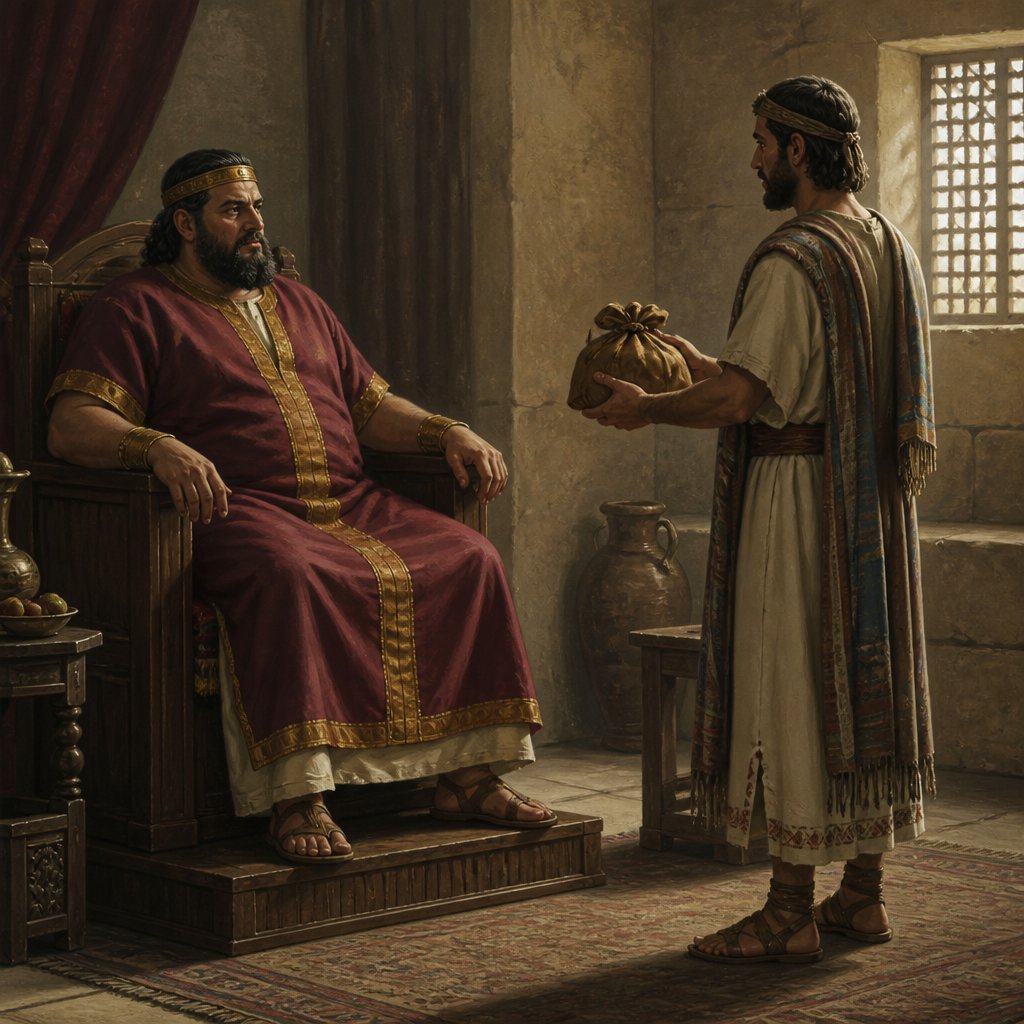
The Bible verse Judges 3:17 from the King James Version (KJV) states, "And he brought the present unto Eglon king of Moab: and Eglon was a very fat man." This verse is found in the book of Judges, which is part of the historical narrative of the Hebrew Bible. The book of Judges describes the period of time in the history of Israel when there was no king, and the people were governed by a series of tribal leaders, or judges, who delivered them from oppression and led them in battle. The verse Judges 3:17 is part of the story of Ehud, one of the judges of Israel.
The verse describes the presentation of a tribute to Eglon, the king of Moab, by the Israelites. According to the preceding verses, the Israelites had been oppressed by Eglon and the Moabites for 18 years. The tribute was brought by Ehud, a left-handed man who had crafted a double-edged sword and concealed it on his right thigh. The mention of Eglon being a very fat man is relevant because it foreshadows the way in which Ehud will ultimately assassinate him.
This verse carries several important themes and messages that are relevant to the broader context of the book of Judges and the Bible as a whole. One of the key themes is the concept of divine intervention and deliverance. Throughout the book of Judges, the Israelites find themselves in oppressive situations, and time and time again, God raises up a leader or judge to deliver them. In the case of Ehud and Eglon, the oppression of the Moabites leads to Ehud's rise as a deliverer for the Israelites.
The verse also illustrates the theme of unexpected heroes and unconventional methods. Ehud's status as a left-handed man is highlighted, and the fact that he concealed his weapon in a non-standard location on his person is significant. This unconventional approach ultimately leads to his successful assassination of King Eglon and the liberation of the Israelites from Moabite oppression.
Another important theme in this verse is the concept of power dynamics and the way in which God can use the weak to triumph over the strong. Eglon, as the king of Moab, holds power and authority over the Israelites, but with the help of God, they are able to overcome his rule through the courageous act of Ehud.
Symbolism also plays a significant role in this verse. The fact that Eglon is described as a very fat man has both literal and symbolic significance. From a literal standpoint, his physical stature makes him a vulnerable target for Ehud's assassination. Symbolically, Eglon's excessive physicality represents the oppression and excess of the Moabite rule over the Israelites.
Overall, Judges 3:17 is a verse that contributes to the larger narrative of the book of Judges. It highlights themes such as divine intervention, unexpected heroes, power dynamics, and symbolism. The verse serves as a reminder of God's ability to deliver his people from oppression and the ways in which he can use unconventional means to achieve his purposes. It also underscores the consistent pattern of God raising up leaders to deliver his people, demonstrating his faithfulness and sovereignty in the midst of challenging circumstances.
Get our apps


Artwork for Judges 3:17

Judges 3:17 - "And he brought the present unto Eglon king of Moab: and Eglon was a very fat man."
"And he brought the present unto Eglon king of Moab: and Eglon was a very fat man." - Judges 3:17

Ecclesiastes 3:17 - "I said in mine heart, God shall judge the righteous and the wicked: for there is a time there for every purpose and for every work."

Judges 17:1 - "And there was a man of mount Ephraim, whose name was Micah."

Judges 3:31

Job 12:17 - "He leadeth counsellors away spoiled, and maketh the judges fools."

Judges 8:17 - "And he beat down the tower of Penuel, and slew the men of the city."

Judges 17:3 - "And when he had restored the eleven hundred shekels of silver to his mother, his mother said, I had wholly dedicated the silver unto the LORD from my hand for my son, to make a graven image and a molten image: now therefore I will restore it unto thee."

Judges 17:12 - "And Micah consecrated the Levite; and the young man became his priest, and was in the house of Micah."

Judges 21:17 - "And they said, There must be an inheritance for them that be escaped of Benjamin, that a tribe be not destroyed out of Israel."

Judges 17:11 - "And the Levite was content to dwell with the man; and the young man was unto him as one of his sons."

Judges 2:17 - "And yet they would not hearken unto their judges, but they went a whoring after other gods, and bowed themselves unto them: they turned quickly out of the way which their fathers walked in, obeying the commandments of the LORD; but they did not so."

"I said in mine heart, God shall judge the righteous and the wicked: for there is a time there for every purpose and for every work." - Ecclesiastes 3:17

Judges 17:7 - "¶ And there was a young man out of Beth-lehem-judah of the family of Judah, who was a Levite, and he sojourned there."

Judges 17:6 - "In those days there was no king in Israel, but every man did that which was right in his own eyes."

Zephaniah 3:3 - "Her princes within her are roaring lions; her judges are evening wolves; they gnaw not the bones till the morrow."

Judges 10:3 - "¶ And after him arose Jair, a Gileadite, and judged Israel twenty and two years."

Judges 9:17 - "(For my father fought for you, and adventured his life far, and delivered you out of the hand of Midian:"

Judges 10:17 - "Then the children of Ammon were gathered together, and encamped in Gilead. And the children of Israel assembled themselves together, and encamped in Mizpeh."

"And there was a man of mount Ephraim, whose name was Micah." - Judges 17:1

Judges 3:6 - "And they took their daughters to be their wives, and gave their daughters to their sons, and served their gods."

Judges 3:11 - "And the land had rest forty years. And Othniel the son of Kenaz died."

Judges 1:17 - "And Judah went with Simeon his brother, and they slew the Canaanites that inhabited Zephath, and utterly destroyed it. And the name of the city was called Hormah."

Judges 17:13 - "Then said Micah, Now know I that the LORD will do me good, seeing I have a Levite to my priest."

Judges 17:5 - "And the man Micah had an house of gods, and made an ephod, and teraphim, and consecrated one of his sons, who became his priest."

Judges 5:17 - "Gilead abode beyond Jordan: and why did Dan remain in ships? Asher continued on the sea shore, and abode in his breaches."

Deuteronomy 19:17 - "Then both the men, between whom the controversy is, shall stand before the LORD, before the priests and the judges, which shall be in those days;"

Judges 3:14 - "So the children of Israel served Eglon the king of Moab eighteen years."

Judges 13:3 make the Angel of the Lord male

Judges 3:3 - "Namely, five lords of the Philistines, and all the Canaanites, and the Sidonians, and the Hivites that dwelt in mount Lebanon, from mount Baal-hermon unto the entering in of Hamath."