What does Judges 4:5 mean?
"And she dwelt under the palm tree of Deborah between Ramah and Beth-el in mount Ephraim: and the children of Israel came up to her for judgment." - Judges 4:5
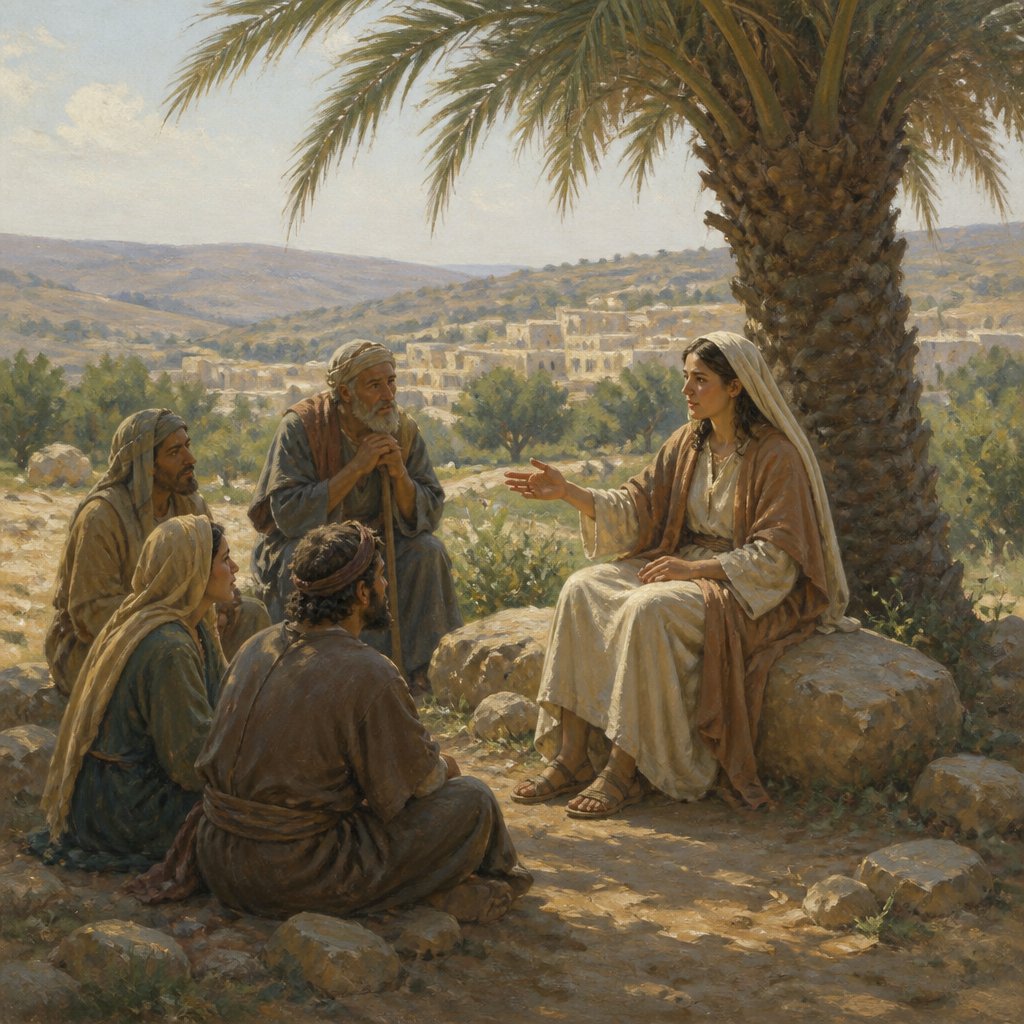
The verse Judges 4:5 from the King James Version of the Bible reads, "And she dwelt under the palm tree of Deborah between Ramah and Bethel in mount Ephraim: and the children of Israel came up to her for judgment."
This verse is part of the Old Testament book of Judges, which describes the period of time after the Israelites entered the Promised Land and before the monarchy was established in Israel. During this time, the Israelites were ruled by a series of leaders called judges. The verse in question specifically refers to a woman named Deborah, who was a judge in Israel.
In this verse, we learn that Deborah "dwelt under the palm tree" between Ramah and Bethel in mount Ephraim. This location is significant, as it indicates that Deborah was accessible to the Israelites who came to her for judgment. The fact that she was positioned under a palm tree also carries symbolic and practical meanings.
Palm trees were often associated with peace, prosperity, and righteousness in the Bible. Their presence was considered a sign of God's blessing and protection. Thus, the fact that Deborah sat under a palm tree could be seen as a symbol of her authority and God's presence with her as she administered justice. Additionally, palm trees provided shade and shelter from the sun, making them a practical place for Deborah to meet with the people seeking her judgment.
It is important to note that the reference to the palm tree of Deborah is not merely a geographical detail; it underscores her role and significance as a leader and judge in Israel. The fact that the children of Israel came up to her for judgment speaks to her respected position as a wise and impartial arbiter.
Furthermore, the verse provides insight into the character of Deborah. She is depicted as a strong and capable leader who took on the responsibility of representing God and delivering justice to her people. Her willingness to serve as a judge demonstrates her dedication to the well-being and righteousness of the nation of Israel.
The historical context of this verse is also significant. During the time of the judges, the Israelites experienced cycles of disobedience, oppression by foreign nations, repentance, and deliverance. Deborah's leadership came during a time of oppression, as the Israelites were being oppressed by the Canaanite king, Jabin, and his general, Sisera. Deborah's role as a judge and prophetess was instrumental in rallying the Israelites to fight against their oppressors and secure their freedom.
The verse Judges 4:5 also highlights the theme of female leadership in the Bible. In a male-dominated society, Deborah's position as a judge and prophetess was not only rare but also a powerful testimony to the value and capability of women in leadership roles. Her leadership serves as a reminder that God can and does raise up individuals, regardless of gender, to fulfill His purposes and bring about justice and deliverance for His people.
In conclusion, Judges 4:5 from the King James Version of the Bible offers a rich tapestry of themes, context, and symbolism. It provides insight into the character of Deborah, the historical context of the period of the judges, and the theme of female leadership. Deborah's position as a judge under the palm tree signifies her authority, God's blessing, and the practical aspect of providing justice to the people. Her leadership and the events surrounding her role also point to God's faithfulness and His ability to use individuals, regardless of their gender, to accomplish His purposes. Overall, this verse is a testament to the enduring relevance and power of the Scriptures in shaping our understanding of history, leadership, and justice.
Have questions about Judges 4:5?
Dive deeper into this scripture with Bible Chat — an AI-powered tool for exploring God's Word through conversation. Ask questions, get context, and grow in your understanding of the Bible.
Get Our Apps


Judges 4:5 Artwork

Judges 4:5 - "And she dwelt under the palm tree of Deborah between Ramah and Beth-el in mount Ephraim: and the children of Israel came up to her for judgment."
"And she dwelt under the palm tree of Deborah between Ramah and Beth-el in mount Ephraim: and the children of Israel came up to her for judgment." - Judges 4:5

1 Peter 4:5 - "Who shall give account to him that is ready to judge the quick and the dead."

Judges 5:4 - "LORD, when thou wentest out of Seir, when thou marchedst out of the field of Edom, the earth trembled, and the heavens dropped, the clouds also dropped water."

Judges 4:4

Judges 5:4-5 - "LORD, when thou wentest out of Seir, when thou marchedst out of the field of Edom, the earth trembled, and the heavens dropped, the clouds also dropped water. The mountains melted from before the LORD, even that Sinai from before the LORD God of Israel."

Judges 5:7

Judges 4:4 - "¶ And Deborah, a prophetess, the wife of Lapidoth, she judged Israel at that time."

"Who shall give account to him that is ready to judge the quick and the dead." - 1 Peter 4:5

Judges 5:4-5 - "LORD, when thou wentest out of Seir, when thou marchedst out of the field of Edom, the earth trembled, and the heavens dropped, the clouds also dropped water. The mountains melted from before the LORD, even that Sinai from before the LORD God of Israel."

Judges 10:5 - "And Jair died, and was buried in Camon."

Judges 5:5 - "The mountains melted from before the LORD, even that Sinai from before the LORD God of Israel."

1 Corinthians 4:5 - "Therefore judge nothing before the time, until the Lord come, who both will bring to light the hidden things of darkness, and will make manifest the counsels of the hearts: and then shall every man have praise of God."

Judges 5:1 - "Then sang Deborah and Barak the son of Abinoam on that day, saying,"

Judges 2:5 - "And they called the name of that place Bochim: and they sacrificed there unto the LORD."

Judges 4:4 - "¶ And Deborah, a prophetess, the wife of Lapidoth, she judged Israel at that time."

Judges 5:20 - "They fought from heaven; the stars in their courses fought against Sisera."

"¶ And Deborah, a prophetess, the wife of Lapidoth, she judged Israel at that time." - Judges 4:4

Judges 5:22 - "Then were the horsehoofs broken by the means of the pransings, the pransings of their mighty ones."

James 2:4 - "Are ye not then partial in yourselves, and are become judges of evil thoughts?"

"And Jair died, and was buried in Camon." - Judges 10:5

Judges 4:15 – "The Lord routed Sisera and all his chariots and army by the sword."

Judges 5:29 - "Her wise ladies answered her, yea, she returned answer to herself,"

Judges 5:10 - "Speak, ye that ride on white asses, ye that sit in judgment, and walk by the way."

Judges 5:2 - "Praise ye the LORD for the avenging of Israel, when the people willingly offered themselves."

Judges 1:5 - "And they found Adoni-bezek in Bezek: and they fought against him, and they slew the Canaanites and the Perizzites."

1 Corinthians 5:12 - "For what have I to do to judge them also that are without? do not ye judge them that are within?"

Judges 3:5 - "¶ And the children of Israel dwelt among the Canaanites, Hittites, and Amorites, and Perizzites, and Hivites, and Jebusites:"

Judges 4:12 - "And they shewed Sisera that Barak the son of Abinoam was gone up to mount Tabor."

Judges 5:18 - "Zebulun and Naphtali were a people that jeoparded their lives unto the death in the high places of the field."