What does Judges 5:12 mean?
“Awake, awake, Deborah: awake, awake, utter a song: arise, Barak, and lead thy captivity captive, thou son of Abinoam.” — Judges 5:12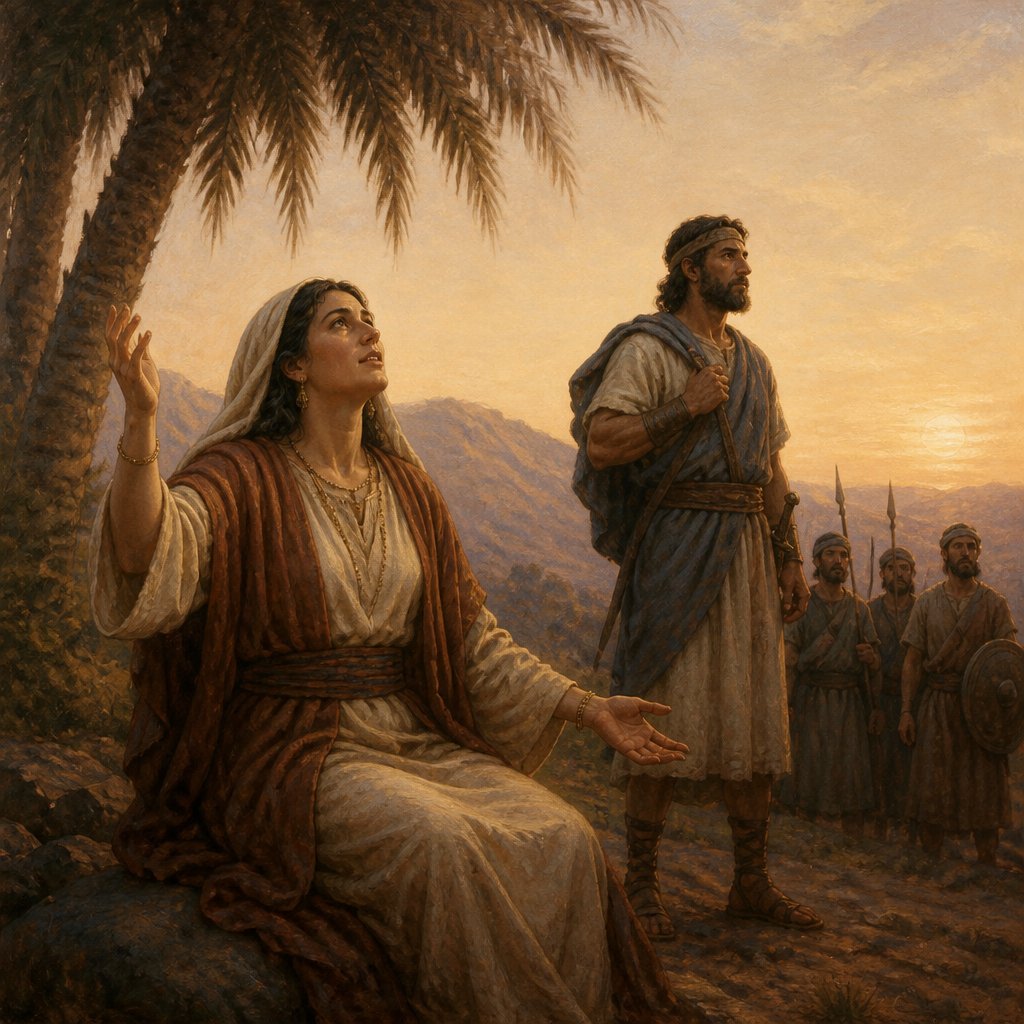
The verse Judges 5:12 from the King James Version (KJV) reads: "Awake, awake, Deborah: awake, awake, utter a song: arise, Barak, and lead thy captivity captive, thou son of Abinoam."
This verse comes from the Song of Deborah, which is a poetic and triumphant passage in the book of Judges. The song is attributed to Deborah, a prophetess and judge in Israel, and Barak, a military leader who fought alongside her. The verse itself is a call to action, urging Deborah and Barak to wake up and celebrate their victory over the Canaanite army led by Sisera.
The themes in this verse and the Song of Deborah as a whole include bravery, courage, and the deliverance of God's people from their enemies. The verse also highlights the role of women in leadership and their contributions to the nation of Israel. In a time when gender roles were very rigid, Deborah's leadership as a judge and prophetess was unique and significant.
In the context of the book of Judges, this verse comes at the conclusion of a narrative that recounts the battle between the Israelites and the Canaanites. The Israelites are oppressed and subjected to harsh rule by the Canaanites, and they cry out to God for deliverance. Deborah, as a leader and prophetess, receives a message from God and summons Barak to lead the Israelite army into battle against Sisera and his forces.
The symbolism in this verse is rich and profound. The repeated calls to "awake" symbolize an awakening or stirring of the spirit, a call to action and celebration. The mention of Deborah and Barak by name underscores their leadership and the pivotal roles they played in delivering the Israelites from their oppressors. Deborah's name means "bee," and she is often associated with strength and industriousness, while Barak's name means "lightning," symbolizing his swift and decisive actions in battle.
The imagery of leading captivity captive is a powerful symbol of victory and triumph. It harkens back to ancient military triumphal processions, in which victorious leaders would parade their defeated enemies as captives before the cheering crowds. In this verse, it signifies the complete defeat and subjugation of the Canaanite forces by the Israelites under the leadership of Deborah and Barak.
Overall, Judges 5:12 is a rousing call to action, a celebration of victory, and a tribute to the courage and leadership of Deborah and Barak. It encapsulates the themes of deliverance, the role of women in leadership, and the ultimate triumph of God's people over their adversaries. As a part of the Song of Deborah, it stands as a timeless testament to the power of faith, courage, and the divine intervention of God in the affairs of humanity.
Get our apps


Artwork for Judges 5:12

Judges 5:12 - "Awake, awake, Deborah: awake, awake, utter a song: arise, Barak, and lead thy captivity captive, thou son of Abinoam."
"Awake, awake, Deborah: awake, awake, utter a song: arise, Barak, and lead thy captivity captive, thou son of Abinoam." - Judges 5:12

1 Corinthians 5:12 - "For what have I to do to judge them also that are without? do not ye judge them that are within?"
"For what have I to do to judge them also that are without? do not ye judge them that are within?" - 1 Corinthians 5:12

Judges 12:12 - "And Elon the Zebulonite died, and was buried in Aijalon in the country of Zebulun."

Judges 12:5 - "And the Gileadites took the passages of Jordan before the Ephraimites: and it was so, that when those Ephraimites which were escaped said, Let me go over; that the men of Gilead said unto him, Art thou an Ephraimite? If he said, Nay;"

Judges 5:7

Judges 12:11 - "¶ And after him Elon, a Zebulonite, judged Israel; and he judged Israel ten years."

Judges 12:8 - "¶ And after him Ibzan of Beth-lehem judged Israel."

Judges 12:10 - "Then died Ibzan, and was buried at Beth-lehem."

Judges 10:5 - "And Jair died, and was buried in Camon."

Judges 12:13 - "¶ And after him Abdon the son of Hillel, a Pirathonite, judged Israel."

Judges 5:5 - "The mountains melted from before the LORD, even that Sinai from before the LORD God of Israel."

"And Elon the Zebulonite died, and was buried in Aijalon in the country of Zebulun." - Judges 12:12

Job 12:17 - "He leadeth counsellors away spoiled, and maketh the judges fools."

Judges 5:1 - "Then sang Deborah and Barak the son of Abinoam on that day, saying,"

Judges 2:5 - "And they called the name of that place Bochim: and they sacrificed there unto the LORD."

Judges 12:7 - "And Jephthah judged Israel six years. Then died Jephthah the Gileadite, and was buried in one of the cities of Gilead."

Judges 4:12 - "And they shewed Sisera that Barak the son of Abinoam was gone up to mount Tabor."

Judges 9:12 - "Then said the trees unto the vine, Come thou, and reign over us."

Judges 5:20 - "They fought from heaven; the stars in their courses fought against Sisera."

Judges 5:22 - "Then were the horsehoofs broken by the means of the pransings, the pransings of their mighty ones."

Judges 17:12 - "And Micah consecrated the Levite; and the young man became his priest, and was in the house of Micah."

John 12:47 - "And if any man hear my words, and believe not, I judge him not: for I came not to judge the world, but to save the world."

"And Jair died, and was buried in Camon." - Judges 10:5

Judges 12:15 - "And Abdon the son of Hillel the Pirathonite died, and was buried in Pirathon in the land of Ephraim, in the mount of the Amalekites."

Judges 5:29 - "Her wise ladies answered her, yea, she returned answer to herself,"

Judges 5:10 - "Speak, ye that ride on white asses, ye that sit in judgment, and walk by the way."

Judges 5:2 - "Praise ye the LORD for the avenging of Israel, when the people willingly offered themselves."

Judges 1:5 - "And they found Adoni-bezek in Bezek: and they fought against him, and they slew the Canaanites and the Perizzites."