What does Lamentations 1:21 mean?
“They have heard that I sigh: there is none to comfort me: all mine enemies have heard of my trouble; they are glad that thou hast done it: thou wilt bring the day that thou hast called, and they shall be like unto me.” — Lamentations 1:21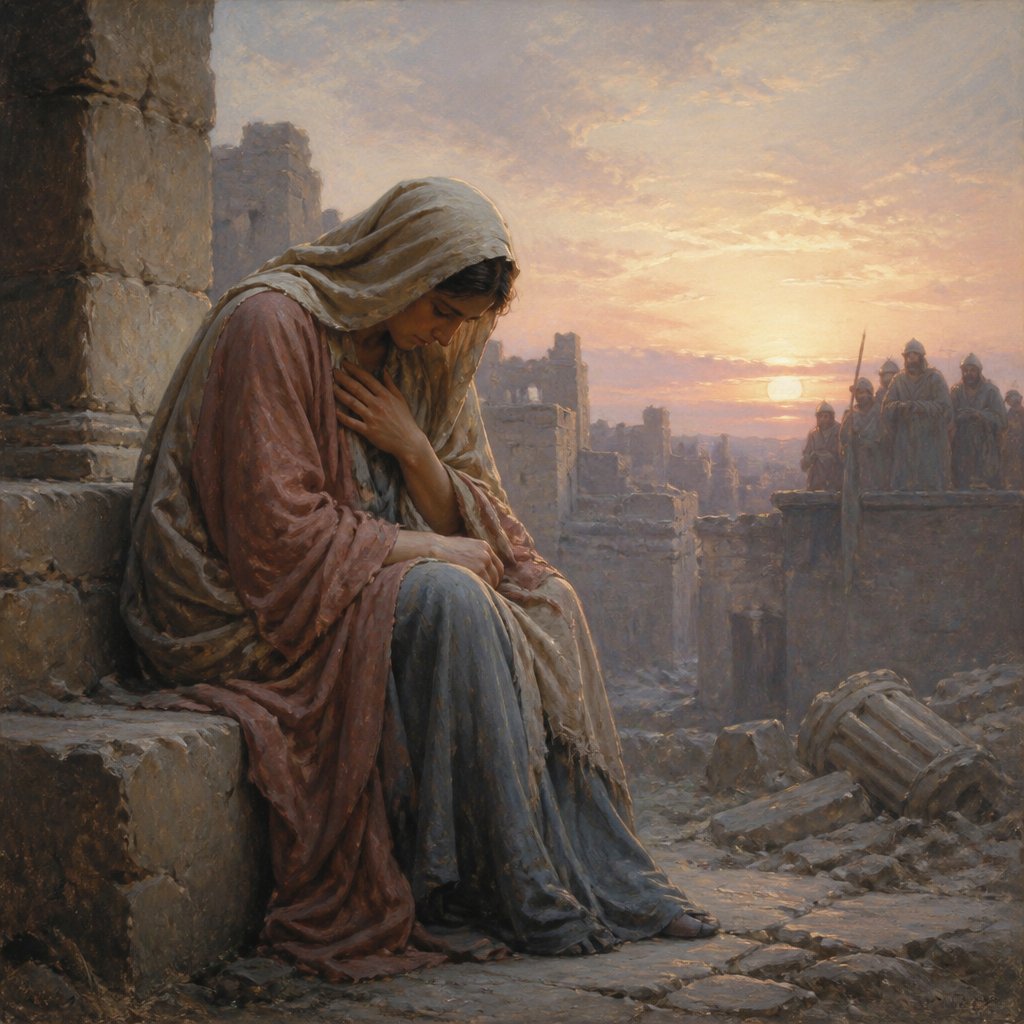
The Bible verse Lamentations 1:21 from the King James Version (KJV) states: "They have heard that I sigh: there is none to comfort me: all mine enemies have heard of my trouble; they are glad that thou hast done it: thou wilt bring the day that thou hast called, and they shall be like unto me."
The book of Lamentations is a collection of five poems expressing grief and sorrow over the destruction of Jerusalem and the temple by the Babylonians in 586 B.C. These poems are traditionally attributed to the prophet Jeremiah, who is believed to have witnessed the fall of Jerusalem and penned his deep lamentations in response to the devastation.
In the verse Lamentations 1:21, the speaker, commonly understood to be Jeremiah, expresses his despair and sadness over the lack of comfort and solace he receives in the wake of his suffering. The use of the word "sigh" emphasizes the depth of the speaker's anguish and the intensity of his emotional turmoil. The speaker laments that there is no one to comfort him in his time of need, highlighting his feelings of isolation and abandonment.
The verse also acknowledges the malicious joy of the speaker's enemies in response to his suffering. The enemies have heard of the speaker's trouble and are pleased by it, reveling in the misfortune that has befallen him. This further adds to the speaker's sense of despair and betrayal, as he is left to suffer alone while his enemies take pleasure in his pain.
The verse concludes with a note of divine judgment, as the speaker calls for the day when God will bring retribution upon his enemies. The speaker anticipates the day when his enemies will experience the same suffering and devastation that he has endured, bringing them to a state of likeness with himself.
In this verse, the themes of suffering, isolation, and divine judgment are prominent. The speaker's deep sense of sorrow and grief over the destruction of Jerusalem and the suffering he experiences is palpable. His plea for comfort and solace emphasizes the human need for compassion and support in times of distress. The recognition of the joy of his enemies at his suffering adds a layer of betrayal and injustice to the speaker's lament, highlighting the cruelty and callousness of those who take pleasure in the pain of others.
Furthermore, the verse alludes to the concept of divine justice and the eventual retribution that will be brought upon the enemies of the speaker. This serves as a reminder of the belief in God's sovereignty and ultimate judgment, offering a source of hope and vindication for the speaker in the midst of his anguish.
In addition to the themes of suffering and divine judgment, the verse also carries a sense of symbolism. The speaker's personal suffering and the destruction of Jerusalem can be seen as symbolic of the broader human experience of pain and loss. The expression of despair and longing for comfort resonates with the universal human condition, as people seek solace in the midst of their own trials and tribulations. The anticipation of divine justice also speaks to the enduring human desire for righteousness and retribution in the face of injustice and oppression.
Overall, Lamentations 1:21 is a poignant and powerful expression of grief, despair, and hope for justice in the face of suffering. It offers a moving portrayal of the human experience of loss and the longing for comfort and vindication, while also pointing to the enduring belief in divine justice and ultimate redemption.
Get our apps


Artwork for Lamentations 1:21

Lamentations 1:21 - "They have heard that I sigh: there is none to comfort me: all mine enemies have heard of my trouble; they are glad that thou hast done it: thou wilt bring the day that thou hast called, and they shall be like unto me."
"They have heard that I sigh: there is none to comfort me: all mine enemies have heard of my trouble; they are glad that thou hast done it: thou wilt bring the day that thou hast called, and they shall be like unto me." - Lamentations 1:21

Lamentations 3:21 - "This I recall to my mind, therefore have I hope."

Lamentations 5:21 - "Turn thou us unto thee, O LORD, and we shall be turned; renew our days as of old."

Lamentations 2:1

Lamentations 2:1

Lamentations 2:1

Lamentations 3:1-18

Lamentations 3:13

"This I recall to my mind, therefore have I hope." - Lamentations 3:21

Lamentations 4:21 - "¶ Rejoice and be glad, O daughter of Edom, that dwellest in the land of Uz; the cup also shall pass through unto thee: thou shalt be drunken, and shalt make thyself naked."

Lamentations 2:21 - "The young and the old lie on the ground in the streets: my virgins and my young men are fallen by the sword; thou hast slain them in the day of thine anger; thou hast killed, and not pitied."

Lamentations 3:21-23 - "But this I call to mind, and therefore I have hope: The steadfast love of the Lord never ceases; his mercies never come to an end; they are new every morning; great is your faithfulness."

Lamentations 3:1 - "I am the man that hath seen affliction by the rod of his wrath."

Lamentations 5:1 - "Remember, O LORD, what is come upon us: consider, and behold our reproach."

Lamentations 1:1 How deserted lies the city, once so full of people!

Lamentations 1:1 How deserted lies the city, once so full of people!

Lamentations 1:1 How deserted lies the city, once so full of people!

Lamentations 1:1 How deserted lies the city, once so full of people!

Ezekiel 19:1 - "Moreover take thou up a lamentation for the princes of Israel,"

Lamentations 1:1 How deserted lies the city, once so full of people!

Lamentations 1:1 How deserted lies the city, once so full of people!

"Turn thou us unto thee, O LORD, and we shall be turned; renew our days as of old." - Lamentations 5:21

2 Samuel 1:17 - "¶ And David lamented with this lamentation over Saul and over Jonathan his son:"

Lamentations 1:1 - "How doth the city sit solitary, that was full of people! how is she become as a widow! she that was great among the nations, and princess among the provinces, how is she become tributary!"

Lamentations 1:15 In his winepress the Lord has trampled Virgin Daughter Judah.

Lamentations 3:49 KJV Mine eye trickleth down, and ceaseth not, without any intermission,

Lamentations 4:1 - "How is the gold become dim! how is the most fine gold changed! the stones of the sanctuary are poured out in the top of every street."

Lamentations 1:3 After affliction and harsh labor, Judah has gone into exile.

Lamentations 1:4 The roads to Zion mourn, for no one comes to her appointed festivals.