What does Leviticus 14:18 mean?
“And the remnant of the oil that is in the priest’s hand he shall pour upon the head of him that is to be cleansed: and the priest shall make an atonement for him before the LORD.” — Leviticus 14:18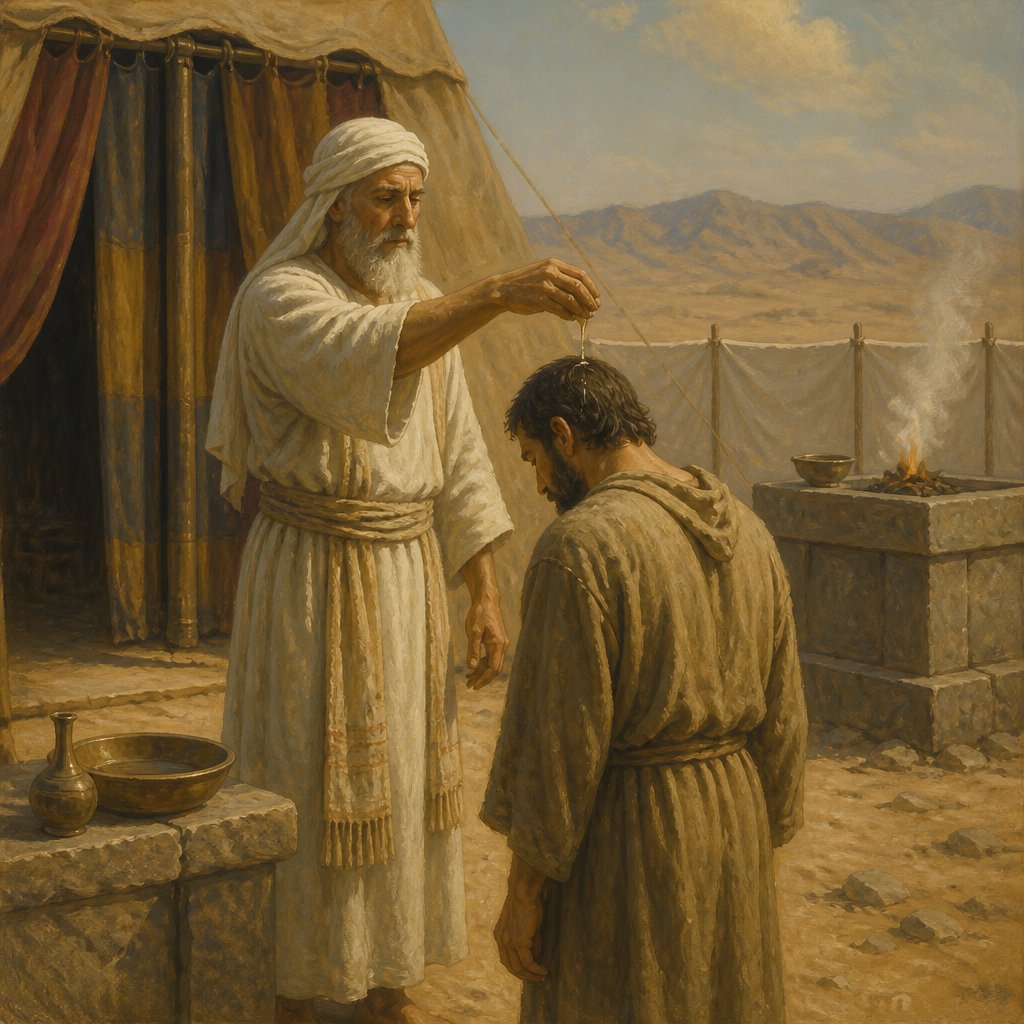
Leviticus 14:18 (KJV) reads: "And the remnant of the oil that is in the priest's hand he shall pour upon the head of him that is to be cleansed: and the priest shall make an atonement for him before the LORD."
This verse is part of the laws and regulations given by God to the Israelites through Moses, specifically addressing the process of cleansing a person from a skin disease, often understood to be leprosy in ancient times. The verse provides instructions for the ritual to be performed by the priest in order to atone for the person's impurity and facilitate their reintegration into the community.
The use of oil in this ritual holds rich symbolism throughout the Bible, representing several important themes such as anointing, consecration, and healing. The pouring of the oil by the priest on the head of the afflicted person is symbolic of the cleansing and renewal that God brings to those who seek His forgiveness and restoration. It also signifies the act of setting apart a person for a specific purpose or consecrating them to God.
Additionally, the act of anointing with oil is a symbol of healing and restoration. In ancient times, oil was used for its therapeutic properties, and it became associated with the idea of healing and health. When the priest pours the oil on the head of the person with the skin disease, it represents God's power to bring healing and wholeness to that individual, physically, spiritually, and socially.
The atonement made by the priest before the Lord is an essential aspect of this ritual. The concept of atonement is central to the Judeo-Christian faith and refers to the process of reconciling humanity with God. In this context, the priest acts as a mediator between the person seeking cleansing and God, making amends for their sins and impurities. This ritual demonstrates God's desire to restore His people to a state of purity and fellowship with Him, even after they have been afflicted with a contagious and isolating disease.
The significance of this verse extends beyond the specific ritual outlined in Leviticus to broader theological themes. It points to the universal human experience of sin and impurity, and the need for cleansing and atonement in the presence of God. The ritual of cleansing described here provides a powerful metaphor for the redemptive work of God, who offers forgiveness and healing to all who seek it.
In the New Testament, the symbolism of oil and anointing continues to be significant, particularly in the context of the ministry and work of Jesus Christ. Jesus is often referred to as the "Anointed One," and His ministry was marked by acts of healing and restoration. The pouring of oil in Leviticus 14:18 prefigures the ultimate act of atonement and healing brought about by Christ through His sacrificial death and resurrection. In this light, the verse points forward to the redemptive work of Christ, who makes atonement for humanity once and for all.
In conclusion, Leviticus 14:18 carries profound symbolism and spiritual significance, pointing to the themes of cleansing, healing, atonement, and restoration that are central to the Christian faith. It serves as a reminder of God's desire to reconcile humanity to Himself and bring about wholeness and renewal in every aspect of our lives. The ritual described in this verse finds its ultimate fulfillment in the redemptive work of Jesus Christ, whose atonement brings about complete and lasting restoration for all who believe in Him.
Get our apps


Artwork for Leviticus 14:18

Leviticus 14:18 - "And the remnant of the oil that is in the priest's hand he shall pour upon the head of him that is to be cleansed: and the priest shall make an atonement for him before the LORD."
"And the remnant of the oil that is in the priest's hand he shall pour upon the head of him that is to be cleansed: and the priest shall make an atonement for him before the LORD." - Leviticus 14:18

Leviticus 18:14 - "Thou shalt not uncover the nakedness of thy father's brother, thou shalt not approach to his wife: she is thine aunt."

Leviticus 14:51

"Thou shalt not uncover the nakedness of thy father's brother, thou shalt not approach to his wife: she is thine aunt." - Leviticus 18:14

Leviticus 11:18 - "And the swan, and the pelican, and the gier eagle,"

Leviticus 14:55 - "And for the leprosy of a garment, and of a house,"

Leviticus 18:1 - "And the LORD spake unto Moses, saying,"

Leviticus 14:56 - "And for a rising, and for a scab, and for a bright spot:"

Leviticus 18:22 - "Thou shalt not lie with mankind, as with womankind: it is abomination."

Leviticus 14:1 - "And the LORD spake unto Moses, saying,"

Leviticus 11:14 - "And the vulture, and the kite after his kind;"

Leviticus 5:14 - "¶ And the LORD spake unto Moses, saying,"

Leviticus 14:54 - "This is the law for all manner of plague of leprosy, and scall,"

Leviticus 18:18 - "Neither shalt thou take a wife to her sister, to vex her, to uncover her nakedness, beside the other in her life time."

Leviticus 13:18 - "¶ The flesh also, in which, even in the skin thereof, was a boil, and is healed,"

Leviticus 24:18 - "And he that killeth a beast shall make it good; beast for beast."

Leviticus 26:14 - "¶ But if ye will not hearken unto me, and will not do all these commandments;"

Leviticus 14:33 - "¶ And the LORD spake unto Moses and unto Aaron, saying,"

Leviticus 14:57 - "To teach when it is unclean, and when it is clean: this is the law of leprosy."

Leviticus 18:16 - "Thou shalt not uncover the nakedness of thy brother's wife: it is thy brother's nakedness."

"And for the leprosy of a garment, and of a house," - Leviticus 14:55

Leviticus 18:8 - "The nakedness of thy father's wife shalt thou not uncover: it is thy father's nakedness."

"And the swan, and the pelican, and the gier eagle," - Leviticus 11:18

Leviticus 13:14 - "But when raw flesh appeareth in him, he shall be unclean."

Leviticus 14:26 - "And the priest shall pour of the oil into the palm of his own left hand:"

Leviticus 18:20 - "Moreover thou shalt not lie carnally with thy neighbour's wife, to defile thyself with her."

Leviticus 14:30 - "And he shall offer the one of the turtledoves, or of the young pigeons, such as he can get;"

"And for a rising, and for a scab, and for a bright spot:" - Leviticus 14:56

Leviticus 18:2 - "Speak unto the children of Israel, and say unto them, I am the LORD your God."