What does Leviticus 2:13 mean?
"And every oblation of thy meat offering shalt thou season with salt; neither shalt thou suffer the salt of the covenant of thy God to be lacking from thy meat offering: with all thine offerings thou shalt offer salt." - Leviticus 2:13
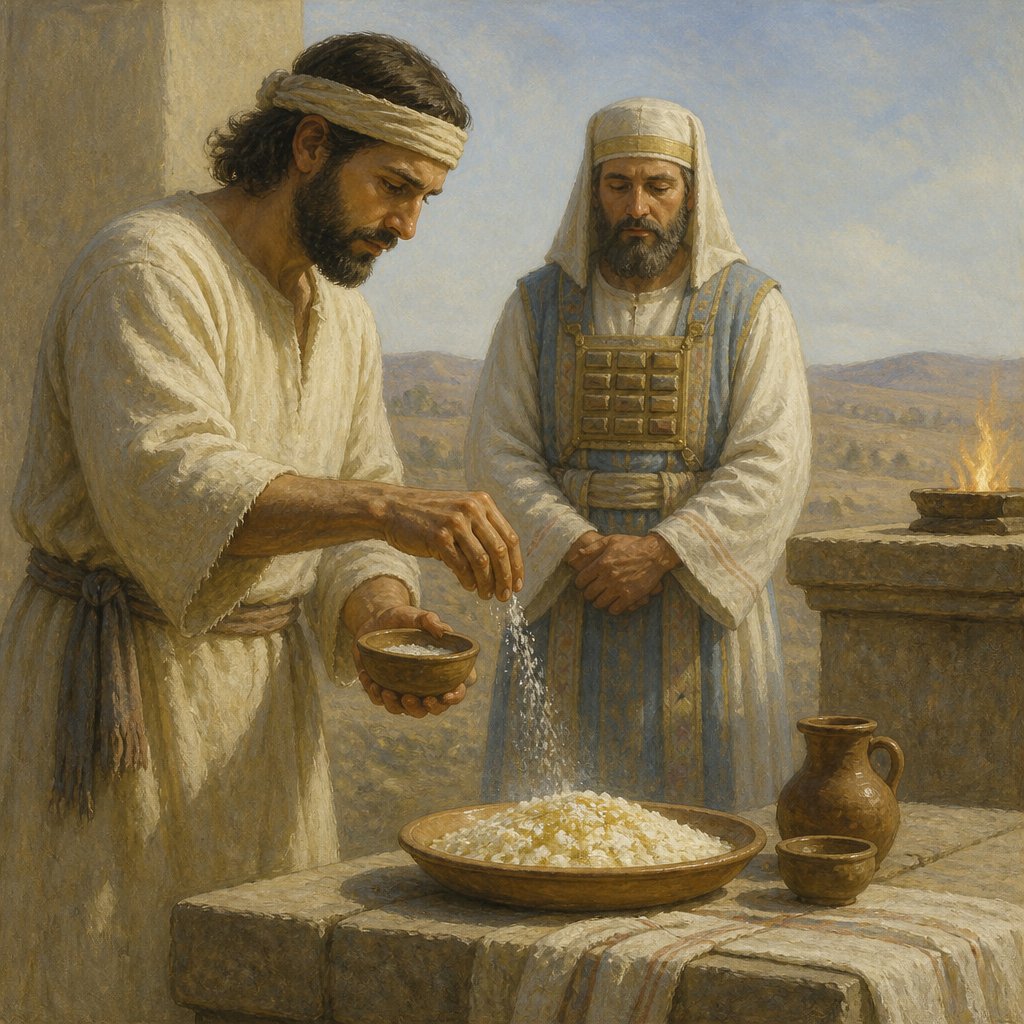
Leviticus 2:13 in the King James Version of the Bible reads, "And every oblation of thy meat offering shalt thou season with salt; neither shalt thou suffer the salt of the covenant of thy God to be lacking from thy meat offering: with all thine offerings thou shalt offer salt." This verse is part of a larger passage in Leviticus that outlines the regulations for grain offerings.
The use of salt in the context of Leviticus has significant symbolism and meaning. Salt has been a valuable commodity throughout history and is often associated with preservation, purification, and flavor. In ancient times, salt was used to preserve food, especially meat, and to enhance the taste of sacrifices and offerings. It was also used as a symbol of purity and permanence.
In the context of Leviticus 2:13, the use of salt in the meat offering is a symbol of the covenant between God and the people of Israel. The covenant was a sacred agreement between God and the Israelites, and the use of salt in the offerings served as a reminder of this divine covenant. By seasoning the meat offering with salt, the Israelites were signifying their commitment to the covenant and their desire for their offerings to be acceptable to God.
The use of salt in the meat offering also symbolizes the permanence and enduring nature of the covenant. Salt does not spoil or lose its flavor over time, and it was used as a symbol of incorruptibility and permanence. By including salt in their offerings, the Israelites were acknowledging their belief in the everlasting nature of their covenant with God.
Furthermore, the use of salt in the meat offering can be seen as a symbol of purification. In ancient times, salt was used to purify and cleanse, and it was believed to have spiritual significance in some cultures. In the context of the meat offering, the use of salt symbolizes the desire for purity and holiness in the offerings presented to God. It serves as a reminder to the Israelites to present their offerings with a pure and sincere heart, free from impurity and sin.
Additionally, the use of salt in the meat offering can be understood as a symbol of hospitality. In many ancient cultures, offering salt to a guest was a gesture of hospitality and friendship. By including salt in their offerings, the Israelites were expressing their desire to welcome and honor God as their guest. It was a way of showing respect and reverence for God and acknowledging His presence in their lives.
In a broader sense, the use of salt in the meat offering is a reminder of the importance of obedience and reverence in worship. The Israelites were instructed to include salt in all their offerings, emphasizing the need for sincerity, purity, and commitment in their worship of God. It served as a reminder that their offerings were not just ritualistic acts but expressions of their faith and devotion to God.
In conclusion, Leviticus 2:13 carries deep spiritual significance and symbolism. The use of salt in the meat offering symbolizes the covenant between God and the Israelites, the enduring nature of the covenant, purity, hospitality, and the importance of sincerity and reverence in worship. It serves as a reminder of the sacred and solemn nature of worship and the need for the Israelites to approach God with humility, obedience, and devotion.
Have questions about Leviticus 2:13?
Dive deeper into this scripture with Bible Chat — an AI-powered tool for exploring God's Word through conversation. Ask questions, get context, and grow in your understanding of the Bible.
Get Our Apps


Leviticus 2:13 Artwork

Leviticus 2:13 - "And every oblation of thy meat offering shalt thou season with salt; neither shalt thou suffer the salt of the covenant of thy God to be lacking from thy meat offering: with all thine offerings thou shalt offer salt."
"And every oblation of thy meat offering shalt thou season with salt; neither shalt thou suffer the salt of the covenant of thy God to be lacking from thy meat offering: with all thine offerings thou shalt offer salt." - Leviticus 2:13

Leviticus 24:13 - "And the LORD spake unto Moses, saying,"

Leviticus 21:13 - "And he shall take a wife in her virginity."

Leviticus 13:1 - "And the LORD spake unto Moses and Aaron, saying,"

Leviticus 13:35 - "But if the scall spread much in the skin after his cleansing;"

Leviticus 13:2 - "When a man shall have in the skin of his flesh a rising, a scab, or bright spot, and it be in the skin of his flesh like the plague of leprosy; then he shall be brought unto Aaron the priest, or unto one of his sons the priests:"

Leviticus 13:29 - "¶ If a man or woman have a plague upon the head or the beard;"

Leviticus 13:18 - "¶ The flesh also, in which, even in the skin thereof, was a boil, and is healed,"

Leviticus 13:14 - "But when raw flesh appeareth in him, he shall be unclean."

Leviticus 13:47 - "¶ The garment also that the plague of leprosy is in, whether it be a woollen garment, or a linen garment;"

Leviticus 13:9 - "¶ When the plague of leprosy is in a man, then he shall be brought unto the priest;"

Leviticus 13:22 - "And if it spread much abroad in the skin, then the priest shall pronounce him unclean: it is a plague."

Leviticus 25:13 - "In the year of this jubile ye shall return every man unto his possession."

Leviticus 6:13 - "The fire shall ever be burning upon the altar; it shall never go out."

Leviticus 13:19 - "And in the place of the boil there be a white rising, or a bright spot, white, and somewhat reddish, and it be shewed to the priest;"

Leviticus 13:48 - "Whether it be in the warp, or woof; of linen, or of woollen; whether in a skin, or in any thing made of skin;"

Leviticus 13:50 - "And the priest shall look upon the plague, and shut up it that hath the plague seven days:"

Leviticus 13:13 - "Then the priest shall consider: and, behold, if the leprosy have covered all his flesh, he shall pronounce him clean that hath the plague: it is all turned white: he is clean."

Leviticus 27:13 - "But if he will at all redeem it, then he shall add a fifth part thereof unto thy estimation."

Leviticus 13:38 - "¶ If a man also or a woman have in the skin of their flesh bright spots, even white bright spots;"

Leviticus 13:16 - "Or if the raw flesh turn again, and be changed unto white, he shall come unto the priest;"

Leviticus 13:40 - "And the man whose hair is fallen off his head, he is bald; yet is he clean."

Leviticus 13:15 - "And the priest shall see the raw flesh, and pronounce him to be unclean: for the raw flesh is unclean: it is a leprosy."

Leviticus 18:13 - "Thou shalt not uncover the nakedness of thy mother's sister: for she is thy mother's near kinswoman."

Leviticus 13:8 - "And if the priest see that, behold, the scab spreadeth in the skin, then the priest shall pronounce him unclean: it is a leprosy."

"And the LORD spake unto Moses, saying," - Leviticus 24:13

Leviticus 13:23 - "But if the bright spot stay in his place, and spread not, it is a burning boil; and the priest shall pronounce him clean."

Leviticus 11:13 - "¶ And these are they which ye shall have in abomination among the fowls; they shall not be eaten, they are an abomination: the eagle, and the ossifrage, and the ospray,"

Leviticus 13:53 - "And if the priest shall look, and, behold, the plague be not spread in the garment, either in the warp, or in the woof, or in any thing of skin;"