What does Leviticus 8:18 mean?
“And he brought the ram for the burnt offering: and Aaron and his sons laid their hands upon the head of the ram.” — Leviticus 8:18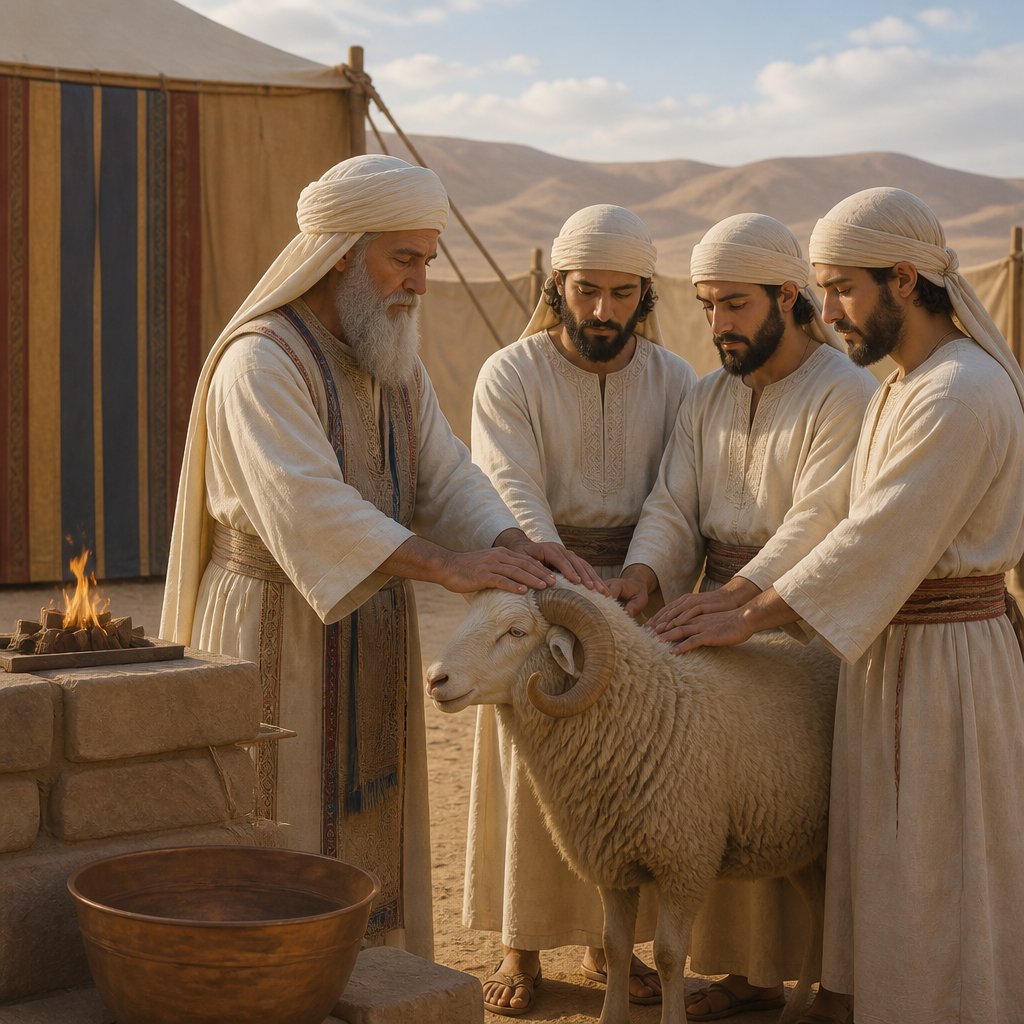
Leviticus 8:18 (KJV) reads, "And he brought the ram for the burnt offering: and Aaron and his sons laid their hands upon the head of the ram."
To truly understand the significance of this verse, it is necessary to provide some context. Leviticus is the third book of the Hebrew Bible, and it focuses on the laws and regulations given to the Israelites by God through the prophet Moses. The book is primarily concerned with outlining the various rituals and sacrifices that were to be carried out by the priestly class, in particular the Levites, to atone for the sins of the people and maintain purity and sanctification before God.
In the preceding verses of chapter 8, we see the detailed description of the ordination of Aaron and his sons as priests. They are instructed to bring various animals as offerings and perform rituals as part of the initiation process. These rituals were meant to symbolize the transfer of sin and guilt from the people onto the animals, thus allowing for atonement and reconciliation with God.
Now, let us delve into the specific significance of Leviticus 8:18. This verse focuses on the offering of a ram for a burnt offering and the act of Aaron and his sons laying their hands upon its head. In the ancient Israelite sacrificial system, the burnt offering was a voluntary act of worship and the complete sacrifice of the animal symbolized complete dedication and surrender to God. By laying their hands on the animal's head, Aaron and his sons were symbolically transferring their sins and the sins of the people onto the ram, thus allowing for atonement and forgiveness.
The laying on of hands in this context also symbolizes the transfer of authority and responsibility. By physically placing their hands on the head of the ram, Aaron and his sons were acknowledging their role as intermediaries between God and the people, and accepting the weight of their duties as priests. This act signified their willingness to take on the burden of representing the people before God and performing the necessary rituals to maintain the covenant relationship between God and Israel.
Furthermore, the choice of a ram for the burnt offering holds symbolic significance. In Jewish tradition, the ram was often associated with strength and power, and its sacrifice served as a reminder of the need for humility and obedience before God. Additionally, the ram was also significant in the story of Abraham and Isaac, where God provided a ram as a substitute for Isaac as a sacrifice, emphasizing the concept of redemption and substitutionary atonement.
As with many passages in Leviticus, the ultimate significance of this verse lies in its foreshadowing of the ultimate sacrifice of Jesus Christ. Christians believe that Jesus, as the perfect and unblemished Lamb of God, offered himself as the ultimate atoning sacrifice for the sins of humanity. The act of laying on of hands also finds parallels in the New Testament, as it is used in the commissioning and ordination of leaders in the early Christian church.
In conclusion, Leviticus 8:18 holds deep symbolic and theological significance within its historical and religious context. It serves as a powerful reminder of the need for atonement, the responsibility of the priesthood, and the anticipation of the ultimate sacrifice of Jesus Christ. It also underscores the themes of surrender, dedication, and the transfer of sin and guilt, providing a rich and meaningful insight into the religious practices and beliefs of ancient Israel.
Get our apps


Artwork for Leviticus 8:18

Leviticus 8:18 - "¶ And he brought the ram for the burnt offering: and Aaron and his sons laid their hands upon the head of the ram."
"¶ And he brought the ram for the burnt offering: and Aaron and his sons laid their hands upon the head of the ram." - Leviticus 8:18

Leviticus 18:8 - "The nakedness of thy father's wife shalt thou not uncover: it is thy father's nakedness."
"The nakedness of thy father's wife shalt thou not uncover: it is thy father's nakedness." - Leviticus 18:8

Leviticus 11:18 - "And the swan, and the pelican, and the gier eagle,"

Leviticus 16:8

Leviticus 8:30

Leviticus 18:1 - "And the LORD spake unto Moses, saying,"

Leviticus 18:22 - "Thou shalt not lie with mankind, as with womankind: it is abomination."
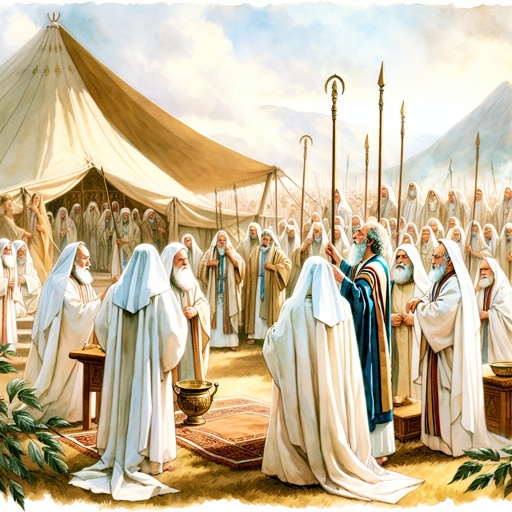
Leviticus 8:1-12

Leviticus 8:8 - "And he put the breastplate upon him: also he put in the breastplate the Urim and the Thummim."

Leviticus 18:18 - "Neither shalt thou take a wife to her sister, to vex her, to uncover her nakedness, beside the other in her life time."

Leviticus 13:18 - "¶ The flesh also, in which, even in the skin thereof, was a boil, and is healed,"

Leviticus 6:8 - "¶ And the LORD spake unto Moses, saying,"
Leviticus 10:8 - "¶ And the LORD spake unto Aaron, saying,"

Leviticus 24:18 - "And he that killeth a beast shall make it good; beast for beast."

Leviticus 8:1 - "And the LORD spake unto Moses, saying,"

Leviticus 18:16 - "Thou shalt not uncover the nakedness of thy brother's wife: it is thy brother's nakedness."

"And the swan, and the pelican, and the gier eagle," - Leviticus 11:18

Leviticus 18:20 - "Moreover thou shalt not lie carnally with thy neighbour's wife, to defile thyself with her."

Leviticus 8:32 - "And that which remaineth of the flesh and of the bread shall ye burn with fire."

Leviticus 18:2 - "Speak unto the children of Israel, and say unto them, I am the LORD your God."

"And the LORD spake unto Moses, saying," - Leviticus 18:1

Leviticus 18:12 - "Thou shalt not uncover the nakedness of thy father's sister: she is thy father's near kinswoman."

Leviticus 18:27 - "(For all these abominations have the men of the land done, which were before you, and the land is defiled;)"

Leviticus 18:13 - "Thou shalt not uncover the nakedness of thy mother's sister: for she is thy mother's near kinswoman."

Leviticus 8:6 - "And Moses brought Aaron and his sons, and washed them with water."

Leviticus 8:19 - "And he killed it; and Moses sprinkled the blood upon the altar round about."

Leviticus 8:3 - "And gather thou all the congregation together unto the door of the tabernacle of the congregation."

Leviticus 8:5 - "And Moses said unto the congregation, This is the thing which the LORD commanded to be done."