What does Luke 1:35 mean?
“And the angel answered and said unto her, The Holy Ghost shall come upon thee, and the power of the Highest shall overshadow thee: therefore also that holy thing which shall be born of thee shall be called the Son of God.” — Luke 1:35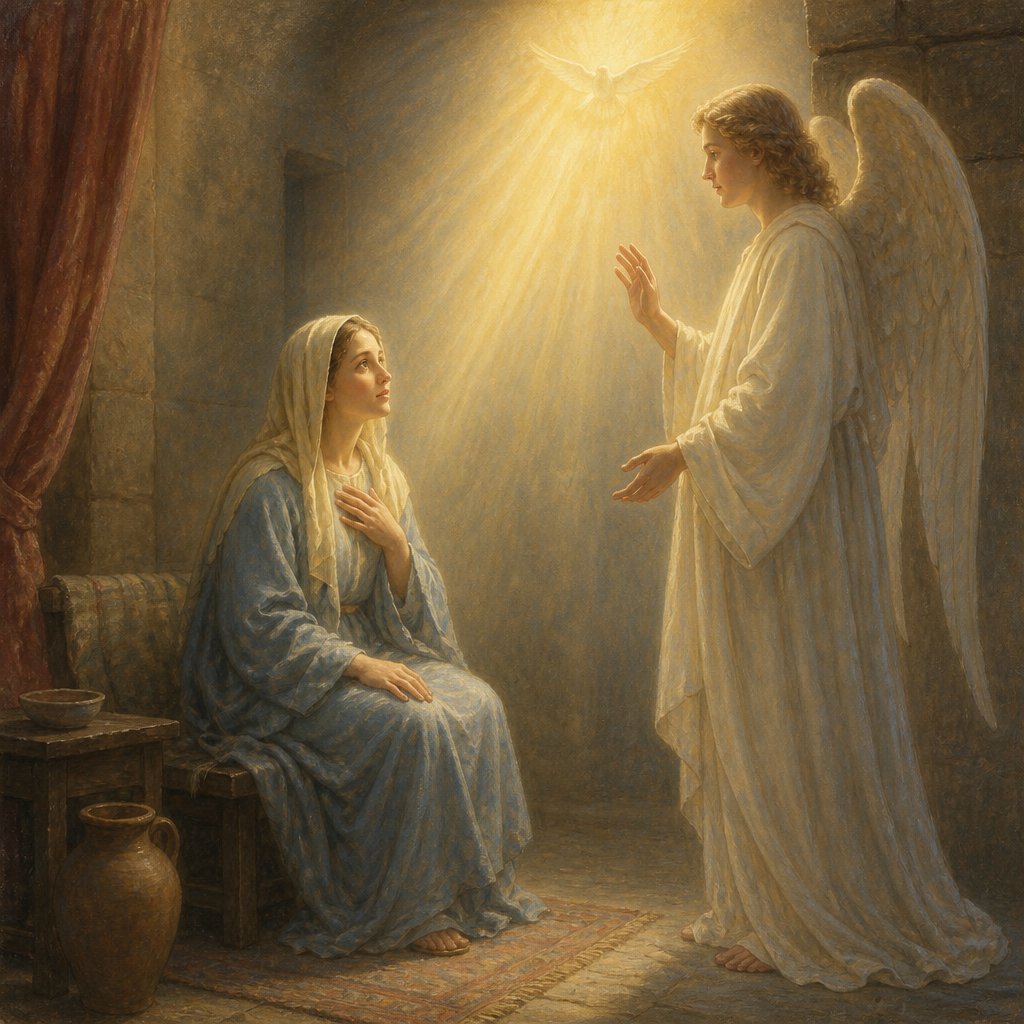
Luke 1:35 in the King James Version reads, “And the angel answered and said unto her, The Holy Ghost shall come upon thee, and the power of the Highest shall overshadow thee: therefore also that holy thing which shall be born of thee shall be called the Son of God.”
The verse stands at the heart of Luke’s opening account of the incarnation, spoken by the angel Gabriel in response to Mary’s question about how she could bear a child, “seeing I know not a man” (Luke 1:34, KJV). The immediate context is crucial: Luke is carefully narrating not merely a surprising birth, but a birth that is utterly unlike any other. The angel is not offering a medical explanation but a theological one. Mary is told that the conception will be God’s direct act, and that this act will define who the child is. In other words, the method of conception and the identity of the child belong together in the logic of the verse: because the conception is of God, the child is rightly named “the Son of God.”
When Gabriel says, “The Holy Ghost shall come upon thee,” the language evokes divine initiative and divine presence. In Scripture, the Holy Ghost is not an impersonal force but God at work, accomplishing what human power cannot. The phrase “come upon” recalls the way God’s Spirit in the Old Testament came upon individuals for divine purposes, yet here the purpose is singular and unmatched: not empowerment for a task, but the miraculous begetting of a human life in the womb of a virgin. The Holy Ghost is presented as the immediate agent of this holy conception, emphasizing that the origin of Jesus’ humanity is not sinful humanity generating its own deliverer, but God himself providing the Savior.
“The power of the Highest shall overshadow thee” deepens this idea with a rich biblical image. “The Highest” is a reverent title for God, underscoring his transcendence and supreme authority. “Overshadow” is not the language of violence or intrusion; it is the language of covering presence, a holy nearness that both reveals and conceals. The word suggests the imagery of God’s glory-cloud in the Scriptures, where God “overshadowed” sacred space with his presence. The tabernacle in the wilderness was filled by the cloud of the LORD’s glory so that it became the place where God dwelt among his people; similarly, Mary is portrayed as the one upon whom God’s presence rests so that, in her, God’s promise takes flesh. The symbolism points to a new kind of holy dwelling: not a tent of skins, not a stone temple, but the womb of a young woman in whom God’s purpose is brought forth into the world.
The verse then draws an explicit conclusion: “therefore also that holy thing which shall be born of thee shall be called the Son of God.” “Therefore” shows that what follows is not merely a title added later by admiration, but a name grounded in the divine act described. The child is “that holy thing,” a striking phrase that emphasizes the child’s consecration and purity from the beginning. In the KJV wording, “thing” is not meant to diminish personhood but to stress the mysterious reality of what is being spoken of: a birth in which the ordinary categories are strained, because the child is both truly born “of thee” and yet uniquely of God. The holiness spoken of here is not simply moral innocence as a result of good upbringing; it is holiness connected to origin and mission. From the first moment of his human life, the child is set apart to God, coming into the world under the sign and power of God’s own presence.
To be “called the Son of God” in this context is more than a label of honor. In Luke’s narrative, it identifies Jesus as the promised King and Savior whose coming fulfills God’s covenant purposes. The title “Son of God” gathers up several strands of biblical meaning: divine relationship, royal identity, and saving authority. It signals that Jesus is not merely another prophet or righteous man. The verse ties his sonship to the overshadowing power of God, implying that his identity is rooted in God’s own action, not in human lineage alone. Yet Luke is equally careful to say he will be “born of thee,” preserving the full reality of his humanity. The significance of the verse lies in this union: Jesus is truly Mary’s child, and yet his origin is the Holy Ghost; he is fully human in birth, and yet uniquely God’s Son in identity.
Luke 1:35 also carries the theme of God’s faithfulness and the pattern of divine reversal that runs through the opening chapters of Luke. God chooses what is lowly in the world’s eyes to accomplish what is greatest. Mary is not introduced as powerful or prominent, but as a humble servant who receives a word impossible by human measure. The miraculous conception becomes a sign that salvation is God’s gift, not humanity’s achievement, and that God’s promises arrive by grace and power rather than by human planning.
In its symbolism, the verse points to a new creation. The Holy Ghost coming upon Mary and the power of the Highest overshadowing her echoes the biblical motif of God’s Spirit bringing life where life cannot be produced by human ability. It presents the coming of Christ as God’s decisive act to enter human history, not merely to speak from afar, but to be born, to dwell, and to redeem. Thus the verse is significant not only for what it says about Mary, but for what it reveals about Jesus: his birth is holy, his identity is divine sonship, and his coming is the overshadowing nearness of the Highest bringing God’s salvation into the world.
Get our apps


Artwork for Luke 1:35

"And the angel answered and said unto her, The Holy Ghost shall come upon thee, and the power of the Highest shall overshadow thee: therefore also that holy thing which shall be born of thee shall be called the Son of God." - Luke 1:35

Luke 1:35 - "And the angel answered and said unto her, The Holy Ghost shall come upon thee, and the power of the Highest shall overshadow thee: therefore also that holy thing which shall be born of thee shall be called the Son of God."
"And the angel answered and said unto her, The Holy Ghost shall come upon thee, and the power of the Highest shall overshadow thee: therefore also that holy thing which shall be born of thee shall be called the Son of God." - Luke 1:35

Luke 24:35

Luke 24:13-35

luke 9:35

luke 9:35

Luke 7:35 - "But wisdom is justified of all her children."

Luke 11:35 - "Take heed therefore that the light which is in thee be not darkness."

Luke 12:35 - "Let your loins be girded about, and your lights burning;"

Luke 21:35 - "For as a snare shall it come on all them that dwell on the face of the whole earth."

Luke 19:35 - "And they brought him to Jesus: and they cast their garments upon the colt, and they set Jesus thereon."

Luke 17:35 - "Two women shall be grinding together; the one shall be taken, and the other left."

Luke 9:35 - "And there came a voice out of the cloud, saying, This is my beloved Son: hear him."

Luke 24:35 - "And they told what things were done in the way, and how he was known of them in breaking of bread."

"But wisdom is justified of all her children." - Luke 7:35

Luke 5:35 - "But the days will come, when the bridegroom shall be taken away from them, and then shall they fast in those days."

Luke 2:35 - "(Yea, a sword shall pierce through thy own soul also,) that the thoughts of many hearts may be revealed."

Luke 18:35 - "¶ And it came to pass, that as he was come nigh unto Jericho, a certain blind man sat by the way side begging:"

Luke 20:35 - "But they which shall be accounted worthy to obtain that world, and the resurrection from the dead, neither marry, nor are given in marriage:"

Luke 3:35 - "Which was the son of Saruch, which was the son of Ragau, which was the son of Phalec, which was the son of Heber, which was the son of Sala,"

Luke 14:35 - "It is neither fit for the land, nor yet for the dunghill; but men cast it out. He that hath ears to hear, let him hear."

"Take heed therefore that the light which is in thee be not darkness." - Luke 11:35

Luke 22:35 - "And he said unto them, When I sent you without purse, and scrip, and shoes, lacked ye any thing? And they said, Nothing."

Luke 17:35 Two women will be grinding grain together; one will be taken and the other left.

"Let your loins be girded about, and your lights burning;" - Luke 12:35

1 Samuel 17:34-35

Genesis 31:35

Luke 23:35 - "And the people stood beholding. And the rulers also with them derided him, saying, He saved others; let him save himself, if he be Christ, the chosen of God."
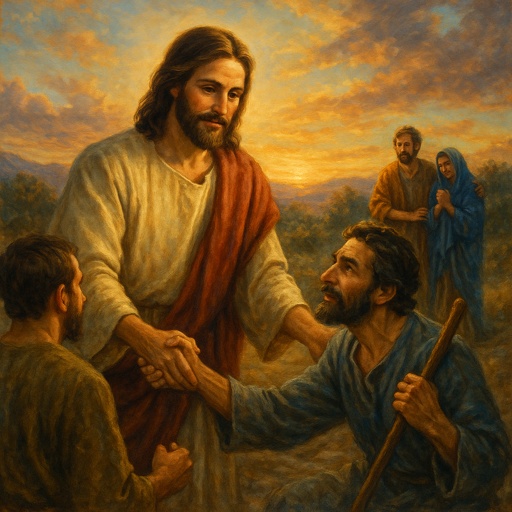
"But love ye your enemies, and do good, and lend, hoping for nothing again; and your reward shall be great, and ye shall be the children of the Highest: for he is kind unto the unthankful and to the evil." - Luke 6:35