What does Luke 22:44 mean?
“And being in an agony he prayed more earnestly: and his sweat was as it were great drops of blood falling down to the ground.” — Luke 22:44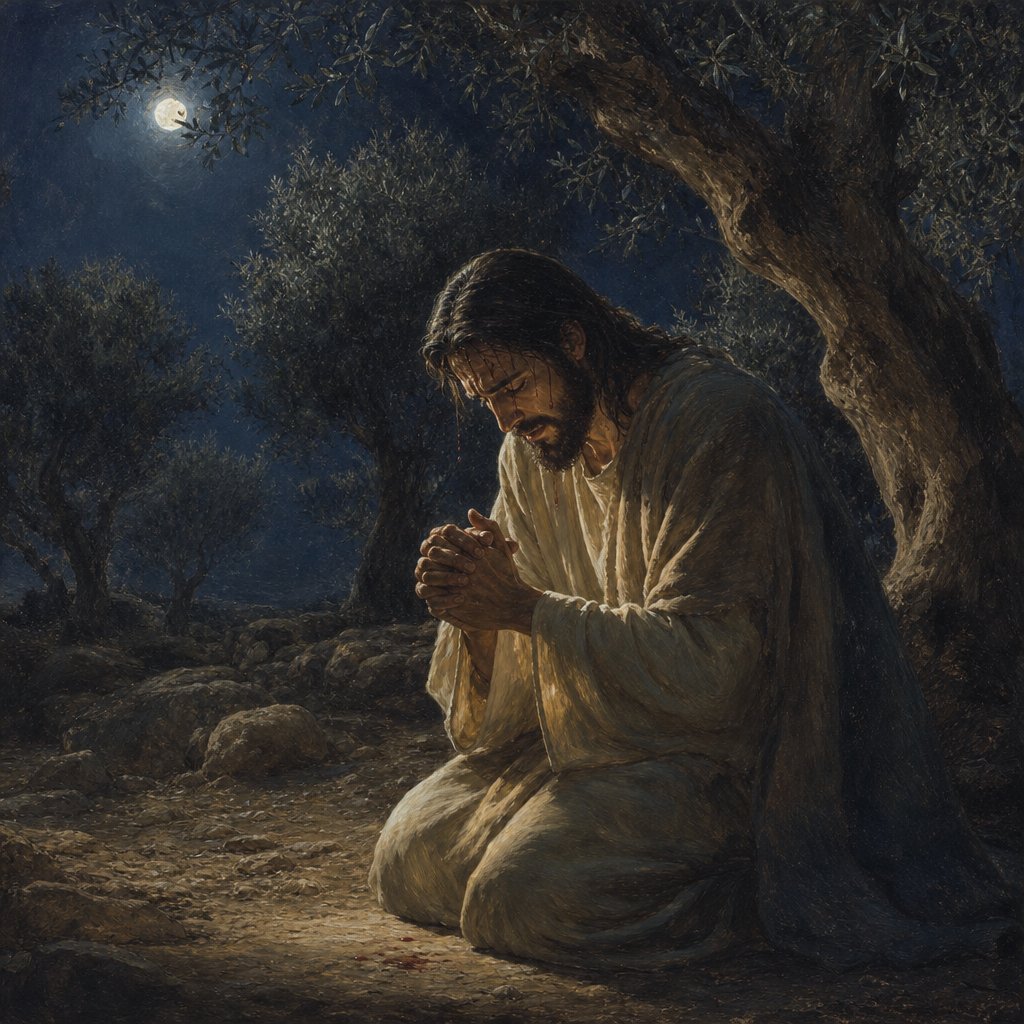
Luke 22:44 in the KJV reads, “And being in an agony he prayed more earnestly: and his sweat was as it were great drops of blood falling down to the ground.” The verse belongs to the scene in which Jesus withdraws to pray on the Mount of Olives, at the place called Gethsemane, on the night of his betrayal. It stands between his deliberate movement toward the cross and the arrival of the armed crowd, so it is meant to be heard as the inner crisis that precedes the outer violence. In that narrow space, Luke lets the reader see not only what Jesus is about to suffer, but how he bears it: he enters “an agony,” and in that agony he prays.
The word “agony” in this verse is not presented as mere sadness or fear; it is the language of strain, conflict, and crushing pressure. In Luke’s narrative, Jesus is not surprised by what is coming. He has spoken repeatedly of his death and resurrection, and he goes to this place with intention. Yet Luke 22:44 insists that full knowledge does not cancel real anguish. The Son of man is shown here with a true human will that feels the weight of the approaching “hour,” and the holiness of his mission does not numb him to pain. The significance of the verse is that it refuses a shallow reading of the passion: Jesus is not acting out a part untouched; he is entering the cost of obedience in the deepest way. The agony is part of the atonement’s path, because it reveals that what he offers is not accidental suffering but chosen submission under the heaviest inward load.
In that agony, “he prayed more earnestly.” Luke highlights prayer as the decisive response to temptation and sorrow. The context surrounding this verse makes prayer the battlefield. Earlier in the same scene Jesus warns his disciples, “Pray that ye enter not into temptation,” and he himself models what that looks like when temptation is not merely moral seduction but the dreadful pull to shrink back from the appointed cup. Luke 22:44 shows that the intensifying of pressure does not drive Jesus away from communion with the Father; it drives him deeper into it. The verse therefore carries a theme of spiritual steadfastness: earnest prayer is not portrayed as a calm religious exercise but as labor, as struggle, as persevering engagement with God when the soul is pressed beyond ordinary strength. It also quietly rebukes the disciples’ later sleepiness in the same garden. Their bodies give way under sorrow; Jesus, though overwhelmed, keeps watch by praying.
The phrase “his sweat was as it were great drops of blood” is carefully framed. Luke does not say simply that it was blood; he says it was “as it were,” a comparison meant to convey appearance and intensity. The image is vivid and bodily, consistent with Luke’s attention to physical detail elsewhere. The point is not sensation for its own sake but testimony: the inward agony is so severe that it expresses itself outwardly. The Messiah’s sorrow is not abstract. It touches the skin, the nerves, the breath. Luke wants the reader to grasp that the passion begins before nails and thorns; it begins in the soul, and the soul’s distress spills into the body. The “great drops” emphasize heaviness and abundance, as if the prayer is poured out with the sweat, and the “falling down to the ground” underscores how lowly and exposed he is in that moment. The Lord who calms seas is here bent to the earth, emptied, alone, in a garden at night, with the ground receiving the evidence of his struggle.
The garden setting adds symbolism. Gethsemane is a place of pressing; it is associated with the pressing of olives to produce oil. While the KJV in Luke does not explain the name, the scene itself functions like a pressing. Under pressure, what is within is brought out, and in Jesus what comes out is obedient prayer. A garden at night also evokes the broader biblical pattern of decisive moments happening in gardens, where humanity’s will is tested. Here, however, the new Adam does not seize, hide, or blame; he yields and prays. Luke 22:44 thus participates in a theme of reversal: where the first man’s disobedience brought ruin, the obedient suffering of Christ begins to undo the curse. The very sweat—an emblem of toil and the burden of fallen life—becomes part of the portrait of redemption as Jesus accepts the labor of bearing sin’s consequences.
The comparison to blood carries further resonance without needing to leave Luke’s wording. Blood in Scripture is inseparable from life poured out and from sacrifice. By describing sweat that appears like blood, Luke places the reader already in the atmosphere of sacrifice before the arrest even happens. It foreshadows that real blood will soon be shed, but it also suggests that the offering has begun in the heart. Jesus’ passion is not only a legal transaction that happens at the cross; it is an obedient self-offering that includes the inner torment of facing sin’s weight and death’s terror while remaining faithful. The verse therefore heightens the solemnity of what follows: when Judas arrives and violence begins, the reader knows the battle has already been fought in prayer, and Jesus rises to meet his betrayer not as a victim caught off guard but as one who has submitted his will to God through agony.
Theologically, Luke 22:44 safeguards two truths at once. It underscores Jesus’ true humanity: he can experience anguish so intense that it affects him physically. At the same time, it displays his sinless obedience: the agony does not produce rebellion but “more earnest” prayer. He does not escape the suffering by denying it, nor does he surrender to despair; he brings it into the presence of the Father. That is why the verse is spiritually significant for readers: it presents prayer as the place where obedience is forged under pressure, and it shows that holiness is not the absence of emotional strain but faithfulness within it.
Finally, the verse’s emotional force serves Luke’s wider theme of Jesus as the righteous sufferer who entrusts himself to God. Luke often portrays Jesus in prayer at critical moments, and here the pattern reaches its climax. The sweat “falling down to the ground” reads like a silent witness that the Messiah’s path is one of humiliation before exaltation. The ground receives the drops, but heaven receives the prayer. In that exchange—the earth marked by suffering while the heart clings to God—Luke 22:44 captures the mystery of the passion: the King advances toward his throne through agony, and the saving work begins, not with a show of power, but with earnest prayer under crushing sorrow.
Get our apps


Artwork for Luke 22:44

luke 22 44

Luke 22:44 - "And being in an agony he prayed more earnestly: and his sweat was as it were great drops of blood falling down to the ground."

"And being in an agony he prayed more earnestly: and his sweat was as it were great drops of blood falling down to the ground." - Luke 22:44

"And being in an agony he prayed more earnestly: and his sweat was as it were great drops of blood falling down to the ground." - Luke 22:44
"And being in an agony he prayed more earnestly: and his sweat was as it were great drops of blood falling down to the ground." - Luke 22:44

Luke 4:44 - "And he preached in the synagogues of Galilee."

1 Kings 22:44 - "And Jehoshaphat made peace with the king of Israel."

Luke 20:44 - "David therefore calleth him Lord, how is he then his son?"

"And he preached in the synagogues of Galilee." - Luke 4:44

Luke 23:44 - "And it was about the sixth hour, and there was a darkness over all the earth until the ninth hour."

Luke 8:44 - "Came behind him, and touched the border of his garment: and immediately her issue of blood stanched."

Create a 16.9 image of the bible verse Luke 2:44

Luke 1:44 - "For, lo, as soon as the voice of thy salutation sounded in mine ears, the babe leaped in my womb for joy."

Luke 12:44 - "Of a truth I say unto you, that he will make him ruler over all that he hath."

Luke 9:44 - "Let these sayings sink down into your ears: for the Son of man shall be delivered into the hands of men."

Psalms 44:22 - "Yea, for thy sake are we killed all the day long; we are counted as sheep for the slaughter."

Luke 2:44 - "But they, supposing him to have been in the company, went a day's journey; and they sought him among their kinsfolk and acquaintance."

"And Jehoshaphat made peace with the king of Israel." - 1 Kings 22:44

Luke 23:44-45 - "And it was about the sixth hour, and there was a darkness over all the earth until the ninth hour. And the sun was darkened, and the veil of the temple was rent in the midst."

Luke 6:44 - "For every tree is known by his own fruit. For of thorns men do not gather figs, nor of a bramble bush gather they grapes."

Luke 11:44 - "Woe unto you, scribes and Pharisees, hypocrites! for ye are as graves which appear not, and the men that walk over them are not aware of them."

Matthew 22:44 - "The LORD said unto my Lord, Sit thou on my right hand, till I make thine enemies thy footstool?"

luke 22:42

Luke 22:39

Luke 22:61,62

Luke 22:39
luke 22:42

Luke 22:42

Isaiah 44:22 - "I have blotted out, as a thick cloud, thy transgressions, and, as a cloud, thy sins: return unto me; for I have redeemed thee."

"David therefore calleth him Lord, how is he then his son?" - Luke 20:44