What does Luke 22:57 mean?
"And he denied him, saying, Woman, I know him not." - Luke 22:57
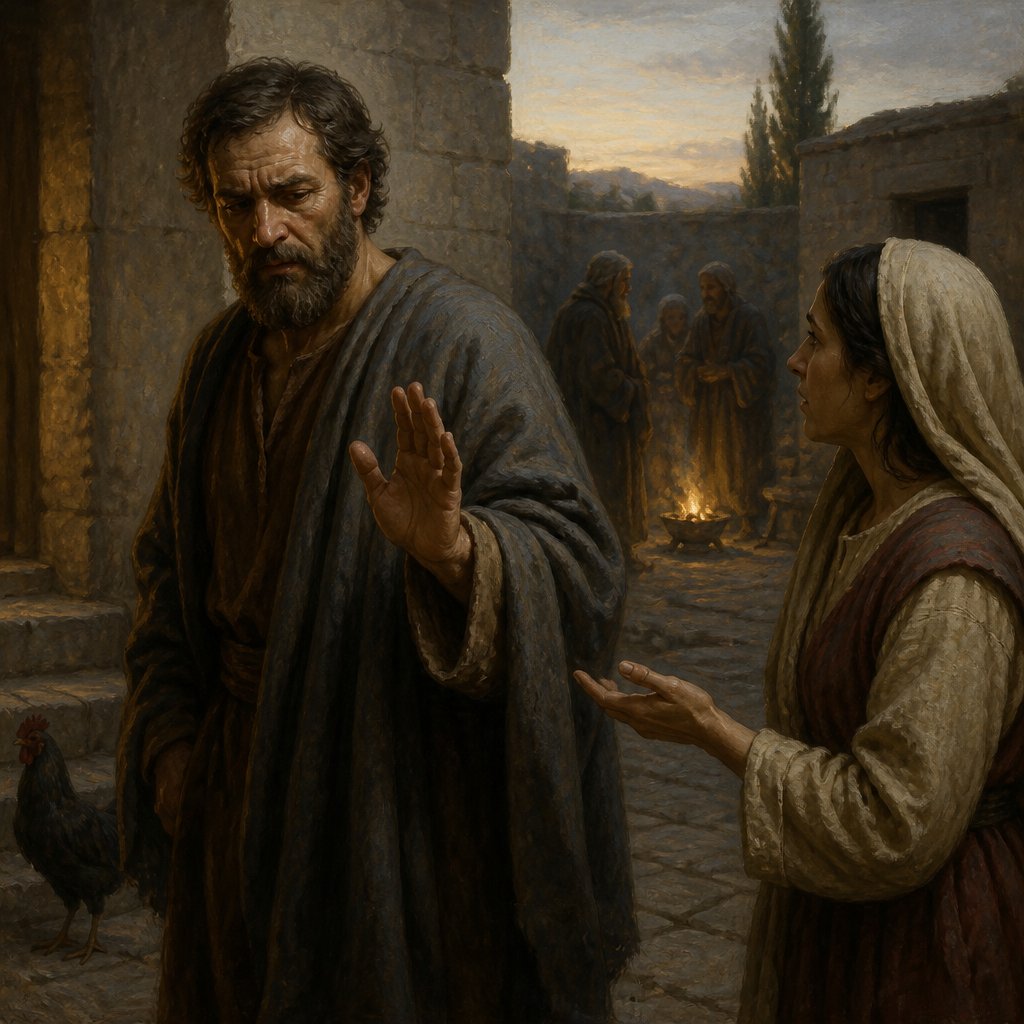
Luke 22:57 (KJV) states, "And he denied him, saying, Woman, I know him not." This verse is found in the New Testament of the Bible and is part of the story of Peter denying his relationship with Jesus three times before the rooster crowed, just as Jesus predicted.
The context of this verse is during the events leading up to Jesus' crucifixion. Prior to this verse, Jesus had been arrested in the Garden of Gethsemane, and Peter followed at a distance to see what would happen to Jesus. As Jesus was being questioned and abused by the soldiers, Peter was asked if he was one of Jesus' disciples. In fear for his own safety, Peter denied knowing Jesus, as suggested in Luke 22:57.
This verse is significant in the greater narrative of Jesus' betrayal and crucifixion because it highlights the human tendency to prioritize personal safety over loyalty and faithfulness. Peter's denial of Jesus represents the struggle that many people face when their allegiance to their faith is tested in difficult circumstances.
The theme of betrayal and forgiveness is prevalent in this verse and the surrounding passages. Peter's denial of Jesus is a betrayal of their close relationship and the teachings of their faith. It serves as a reminder that even those who are considered the most loyal followers of Christ are capable of betraying him in moments of weakness. However, Jesus demonstrates forgiveness and understanding toward Peter, and this theme of forgiveness is central to the Christian faith.
Symbolically, Peter's denial of Jesus represents the human inclination to give in to fear and self-preservation, even at the expense of one's beliefs and relationships. It also serves as a cautionary tale about the consequences of denying one's faith in times of trial.
This verse also emphasizes the humanity of the disciples and the relatability of their struggles. Just like Peter, people are often faced with situations where they are pressured to compromise their beliefs for personal gain or safety. This verse serves as a reminder that even those who are closest to Jesus can falter, but there is always the opportunity for forgiveness and redemption.
The verse also carries a message about the importance of honesty and standing up for one's beliefs, even in the face of adversity. It encourages believers to remain steadfast in their faith, even when it may be challenging or unpopular to do so.
In a broader theological context, this verse and the story of Peter's denial are often seen as a precursor to the ultimate forgiveness and redemption that Jesus offers to humanity through his sacrifice on the cross. It serves as a reminder of the resilience of Christ's love and the opportunity for repentance and restoration, even in the face of human weakness.
In conclusion, Luke 22:57 in the King James Version of the Bible is a poignant reminder of the human propensity to deny one's faith and the forgiveness and redemption that Jesus offers. It serves as a cautionary tale about the consequences of prioritizing self-preservation over loyalty and faithfulness. The verse is a powerful example of the complex and relatable struggles that are inherent to the human experience, as well as the unwavering forgiveness and grace of Christ.
Have questions about Luke 22:57?
Dive deeper into this scripture with Bible Chat — an AI-powered tool for exploring God's Word through conversation. Ask questions, get context, and grow in your understanding of the Bible.
Get Our Apps


Luke 22:57 Artwork

Luke 22:57 - "And he denied him, saying, Woman, I know him not."
"And he denied him, saying, Woman, I know him not." - Luke 22:57

Luke 12:57 - "Yea, and why even of yourselves judge ye not what is right?"

Luke 1:57 - "Now Elisabeth's full time came that she should be delivered; and she brought forth a son."

Luke 9:57 - "¶ And it came to pass, that, as they went in the way, a certain man said unto him, Lord, I will follow thee whithersoever thou goest."

"Yea, and why even of yourselves judge ye not what is right?" - Luke 12:57

"Now Elisabeth's full time came that she should be delivered; and she brought forth a son." - Luke 1:57

luke 22:42

Luke 22:39

Luke 22:61,62

Luke 22:39

luke 22 44
luke 22:42

Luke 22:42

"¶ And it came to pass, that, as they went in the way, a certain man said unto him, Lord, I will follow thee whithersoever thou goest." - Luke 9:57

Luke 16:22-26

Luke 22:62 - "And Peter went out, and wept bitterly."

Luke 20:22 - "Is it lawful for us to give tribute unto Caesar, or no?"

Luke 22:5 - "And they were glad, and covenanted to give him money."

Luke 22:28 - "Ye are they which have continued with me in my temptations."

Luke 22:65 - "And many other things blasphemously spake they against him."

Luke 22:63 - "¶ And the men that held Jesus mocked him, and smote him."

Luke 22:31-32 - "Luke 22:31-32: And the Lord said, Simon, Simon, behold, Satan hath desired to have you, that he may sift you as wheat: But I have prayed for thee, that thy faith fail not: and when thou art converted, strengthen thy brethren."

Luke 22:21 - "¶ But, behold, the hand of him that betrayeth me is with me on the table."

Luke 22:43 - "And there appeared an angel unto him from heaven, strengthening him."

Luke 22:3 - "¶ Then entered Satan into Judas surnamed Iscariot, being of the number of the twelve."

Luke 22:7 - "¶ Then came the day of unleavened bread, when the passover must be killed."

Luke 21:22 - "For these be the days of vengeance, that all things which are written may be fulfilled."

Luke 22:9 - "And they said unto him, Where wilt thou that we prepare?"

Luke 22:24 - "¶ And there was also a strife among them, which of them should be accounted the greatest."