What does Luke 23:1 mean?
“And the whole multitude of them arose, and led him unto Pilate.” — Luke 23:1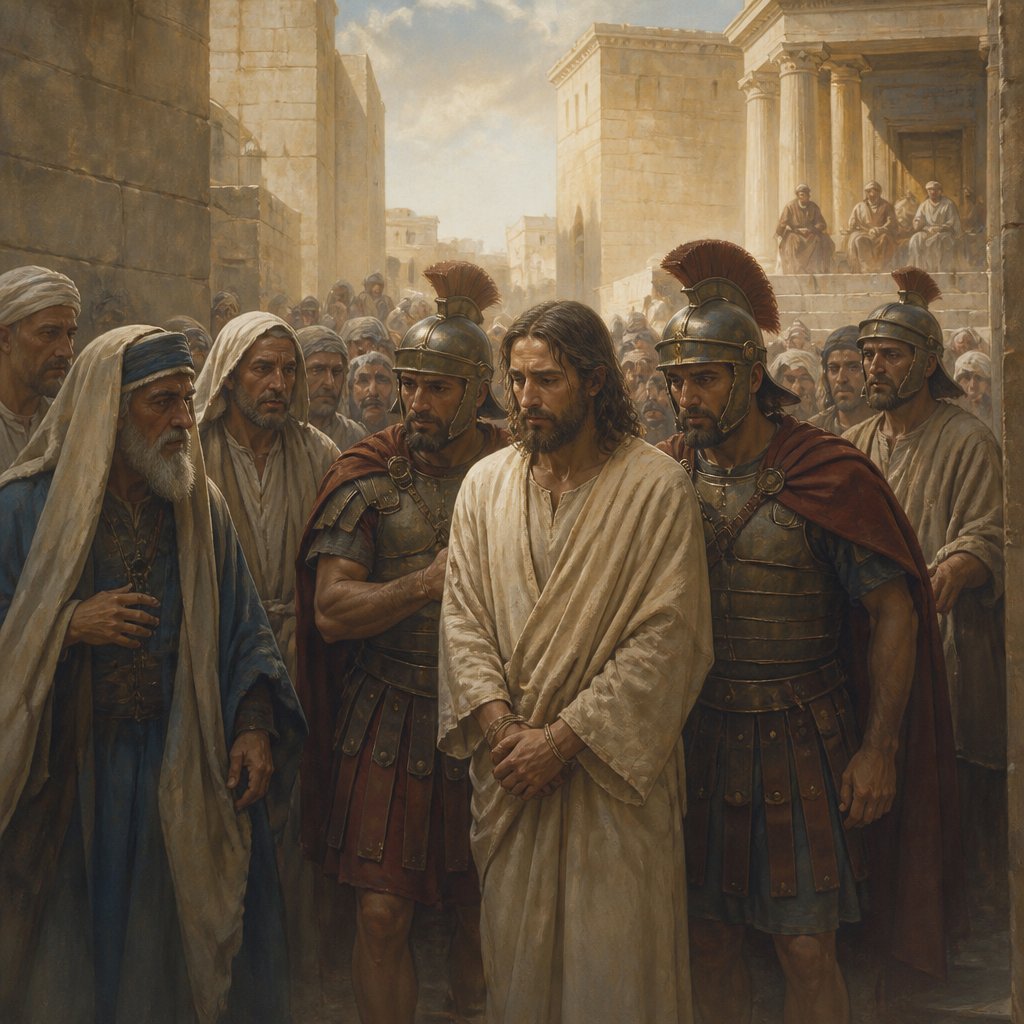
The Bible verse Luke 23:1 from the King James Version states, "And the whole multitude of them arose, and led him unto Pilate." This verse is part of the larger narrative of the crucifixion of Jesus Christ, and it holds significant theological, historical, and literary significance within the Gospel of Luke.
First, it is important to understand the context in which this verse takes place. In the preceding chapters of the Gospel of Luke, Jesus has been teaching, performing miracles, and gaining a following among the people. This has caused tension and conflict with the religious and political authorities of the time, particularly the Jewish religious leaders and the Roman government. These leaders view Jesus as a threat to their power and authority, and they seek to have him arrested and killed.
In Luke 22, Jesus is betrayed by one of his disciples, Judas Iscariot, and he is arrested by the religious authorities. In Luke 23:1, we see that the religious leaders have now brought Jesus before the Roman governor, Pontius Pilate, in order to have him condemned to death. This verse sets the stage for the events that will ultimately lead to Jesus' crucifixion.
From a theological perspective, this verse speaks to the fulfillment of Old Testament prophecies regarding the suffering and death of the Messiah. Throughout the Gospels, Jesus is portrayed as the long-awaited Messiah who has come to redeem and save God's people. The fact that he is brought before Pilate, the Roman governor, reflects the political and historical context of the time. The Jewish religious leaders did not have the authority to carry out a death sentence, so they had to bring Jesus before the Roman authorities in order to have him executed. This fulfills the prophecies regarding the suffering and death of the Messiah, as well as the broader theme of Jesus' willingness to undergo suffering and death in order to bring about salvation for humanity.
Furthermore, this verse also speaks to the broader theme of Jesus' innocence and the injustice of his condemnation. Throughout the Gospels, Jesus is consistently portrayed as a righteous and blameless individual who is unjustly accused and condemned by those in power. This theme of innocence and injustice is seen throughout the crucifixion narrative, as Jesus is falsely accused, mocked, and ultimately crucified despite his innocence. This serves as a powerful reminder of the fallen nature of humanity and the need for a Savior who can redeem and reconcile us to God.
Symbolically, the act of leading Jesus before Pilate can also be seen as a representation of the larger spiritual battle between good and evil. In the Gospel of Luke, Jesus is portrayed as the Son of God who has come to confront and defeat the forces of darkness and sin. The act of bringing him before Pilate can be seen as a symbolic representation of the cosmic battle between the forces of good and evil, with Jesus ultimately triumphing over sin and death through his sacrificial death and resurrection.
In conclusion, Luke 23:1 holds significant theological, historical, and literary importance within the larger narrative of the crucifixion of Jesus Christ. It speaks to the fulfillment of Old Testament prophecies, the theme of Jesus' innocence and the injustice of his condemnation, and the broader spiritual battle between good and evil. This verse serves as a poignant reminder of the love and sacrifice of Jesus, as well as the hope and redemption that is available to all who believe in him.
Get our apps


Artwork for Luke 23:1

Luke 23:1 - "And the whole multitude of them arose, and led him unto Pilate."
"And the whole multitude of them arose, and led him unto Pilate." - Luke 23:1

luke 11:23

Luke 1:23 - "And it came to pass, that, as soon as the days of his ministration were accomplished, he departed to his own house."

Luke 23:53

Luke 19:23

Luke 19:23

luke 11:23

Luke 15:23

luke 11:23

luke 11:23

Luke 23:54 - "And that day was the preparation, and the sabbath drew on."

Luke 23:23 - "And they were instant with loud voices, requiring that he might be crucified. And the voices of them and of the chief priests prevailed."

Luke 23:24 - "And Pilate gave sentence that it should be as they required."

Luke 23:45 - "And the sun was darkened, and the veil of the temple was rent in the midst."

Luke 7:23 - "And blessed is he, whosoever shall not be offended in me."

Luke 23:21 - "But they cried, saying, Crucify him, crucify him."

Luke 23:16 - "I will therefore chastise him, and release him."

Luke 23:37 - "And saying, If thou be the king of the Jews, save thyself."

Luke 23:10 - "And the chief priests and scribes stood and vehemently accused him."

Luke 23:52 - "This man went unto Pilate, and begged the body of Jesus."

Luke 11:23 - "He that is not with me is against me: and he that gathereth not with me scattereth."

Luke 23:20 - "Pilate therefore, willing to release Jesus, spake again to them."

Luke 23:31 - "For if they do these things in a green tree, what shall be done in the dry?"

Luke 23:19 - "(Who for a certain sedition made in the city, and for murder, was cast into prison.)"

Luke 23:17 - "(For of necessity he must release one unto them at the feast.)"

Luke 12:23 - "The life is more than meat, and the body is more than raiment."

Luke 23:36 - "And the soldiers also mocked him, coming to him, and offering him vinegar,"

Luke 23:4 - "Then said Pilate to the chief priests and to the people, I find no fault in this man."

Luke 18:23 - "And when he heard this, he was very sorrowful: for he was very rich."