What does Luke 23:34 mean?
“Then said Jesus, Father, forgive them; for they know not what they do. And they parted his raiment, and cast lots.” — Luke 23:34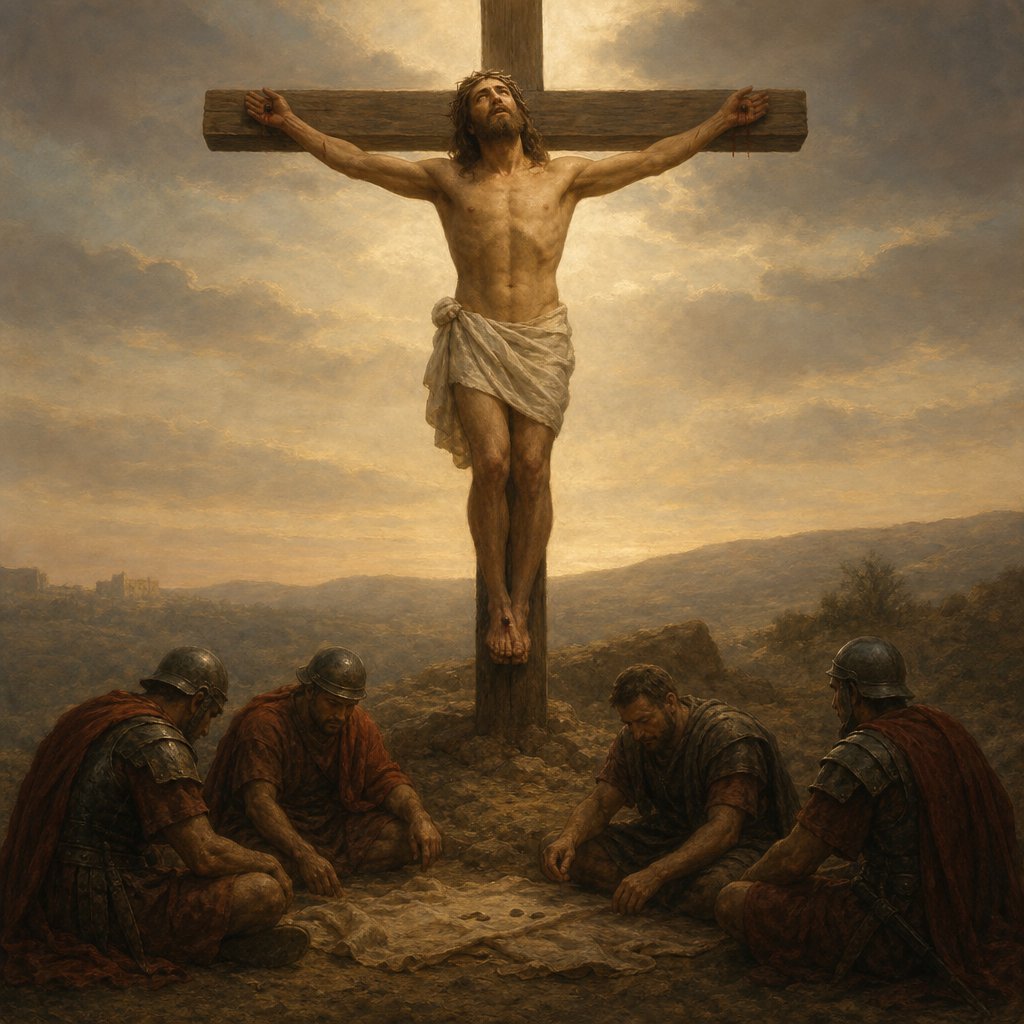
Luke 23:34 in the King James Bible reads, “Then said Jesus, Father, forgive them; for they know not what they do. And they parted his raiment, and cast lots.” Spoken at the very moment of crucifixion, this sentence stands as one of the clearest windows into the heart of Christ’s mission in Luke’s Gospel: mercy offered in the midst of violence, intercession rising while injustice is still in progress, and forgiveness expressed not after repentance has been proven, but while sin is actively being committed against him.
The immediate context matters. Luke places these words right as Jesus is being nailed to the cross and exposed to shame, pain, and public scorn. The crucifixion is not described as a tragic accident but as a deliberate execution carried out by human authorities, soldiers, and a crowd. Yet the first recorded saying of Jesus from the cross in Luke is not a cry for revenge or even a defense of innocence; it is a prayer addressed to “Father.” That address keeps the reader inside the relationship that has framed Jesus’ entire life in Luke. Even as men reject him, Jesus speaks from filial communion with God, showing that his suffering is not chaos outside of God’s notice but an obedient endurance in the Father’s presence. The cross is therefore presented not only as human cruelty but also as the arena where divine mercy is most openly displayed.
When Jesus prays, “Father, forgive them,” the verse portrays him acting as an intercessor. In Luke, Jesus repeatedly shows compassion toward sinners and prays for others, and here that compassion reaches its climax. The request is not simply that God overlook wrongdoing; “forgive” in Scripture carries the sense of releasing a debt or sending away guilt. Jesus asks that the guilt of those involved in his death not be held against them. The shocking feature is the timing: he intercedes while the offense is still unfolding. That makes the prayer itself a living demonstration of his own teaching earlier in Luke about loving enemies and doing good to them that hate you. The crucifixion becomes the place where the ethic of the kingdom is not merely preached but embodied.
The phrase “for they know not what they do” does not declare that the act is harmless or that ignorance makes it righteous. The crucifixion remains sin and injustice. Rather, it points to the blindness that can coexist with religious and political confidence. Those who condemn Jesus believe they are protecting order, defending tradition, or carrying out duty. The soldiers treat it as routine labor. The crowd is swept up in the moment. Jesus identifies a real moral darkness: people can participate in evil without grasping the full weight of what they are doing, and sometimes without recognizing who it is they are opposing. In the broader biblical sense, ignorance does not erase responsibility, but it highlights humanity’s need for mercy because the human heart can be wrong even when it feels justified. Luke’s larger narrative will later show how forgiveness can reach those who acted in ignorance, because the Gospel is offered first at Jerusalem, even to those who had a hand in Jesus’ death.
The second sentence, “And they parted his raiment, and cast lots,” may look like a mere historical detail, but Luke places it immediately after the prayer to underline the contrast between heaven and earth at the cross. While Jesus prays for forgiveness, the executioners divide his clothing. That detail intensifies the humiliation: the condemned man is stripped, and his last possessions are treated as spoil. It shows the utter poverty and meekness of Christ in his suffering, as if the world takes everything from him. Yet it also carries the weight of Scripture’s patterns: the righteous sufferer is mocked, exposed, and treated as a target of chance and greed. The casting of lots symbolizes how casually humanity can treat what is holy. They gamble beneath the cross as though nothing of cosmic importance is happening, and that casualness itself becomes part of the portrait of “they know not what they do.”
At the same time, Luke’s wording invites the reader to see that even such degrading details do not dethrone Christ. He is not depicted as a helpless victim lacking purpose; he is actively praying, actively loving, actively entrusting himself to the Father. The cross, then, is a throne of a different kind: power expressed as mercy, authority revealed as forgiveness. The symbolism of the divided garments also points to the stripping away that Christ accepts in order to clothe others with grace. He is uncovered so that sinners might be covered; he is treated as one who has nothing so that those who have nothing before God may receive pardon.
The verse’s significance is therefore layered. It reveals the character of Jesus as one who forgives at the point of greatest injury. It reveals the nature of God as “Father” who is approached with a plea for mercy even for perpetrators. It reveals the condition of humanity as capable of grave wrong while remaining blind to the magnitude of its actions. And it holds together the shame of the crucifixion with the purpose of redemption: the world is dividing garments and rolling dice, but Christ is opening a way for forgiveness. Luke 23:34 thus stands as a concentrated statement of the Gospel itself: in the darkest act of human history, the first word from the dying Savior is not condemnation but intercession—“Father, forgive them.”
Get our apps


Artwork for Luke 23:34

Luke 23:34 - "¶ Then said Jesus, Father, forgive them; for they know not what they do. And they parted his raiment, and cast lots."
"¶ Then said Jesus, Father, forgive them; for they know not what they do. And they parted his raiment, and cast lots." - Luke 23:34

Matthew 2:3-4

Matthew 2:3-4

Matthew 2:3-4

Matthew 2:3-4

Luke 12:34

Matthew 18:23-34

Matthew 18:23-34

Matthew 18:23-34

Matthew 18:23-34

Luke 19:34 - "And they said, The Lord hath need of him."

Luke 12:34 - "For where your treasure is, there will your heart be also."

Luke 24:34 - "Saying, The Lord is risen indeed, and hath appeared to Simon."

Luke 14:34 - "¶ Salt is good: but if the salt have lost his savour, wherewith shall it be seasoned?"

Numbers 34:23 - "The prince of the children of Joseph, for the tribe of the children of Manasseh, Hanniel the son of Ephod."

Luke 23:53

Luke 19:23

luke 11:23

Luke 19:23

Luke 1:34 - "Then said Mary unto the angel, How shall this be, seeing I know not a man?"

Luke 20:34 - "And Jesus answering said unto them, The children of this world marry, and are given in marriage:"

luke 11:23
Luke 15:23

luke 11:23

luke 11:23

Luke 8:34 - "When they that fed them saw what was done, they fled, and went and told it in the city and in the country."

Luke 9:34 - "While he thus spake, there came a cloud, and overshadowed them: and they feared as they entered into the cloud."

2 Samuel 23:34 - "Eliphelet the son of Ahasbai, the son of the Maachathite, Eliam the son of Ahithophel the Gilonite,"

Proverbs 23:34 - "Yea, thou shalt be as he that lieth down in the midst of the sea, or as he that lieth upon the top of a mast."