What does Luke 23:4 mean?
“Then said Pilate to the chief priests and to the people, I find no fault in this man.” — Luke 23:4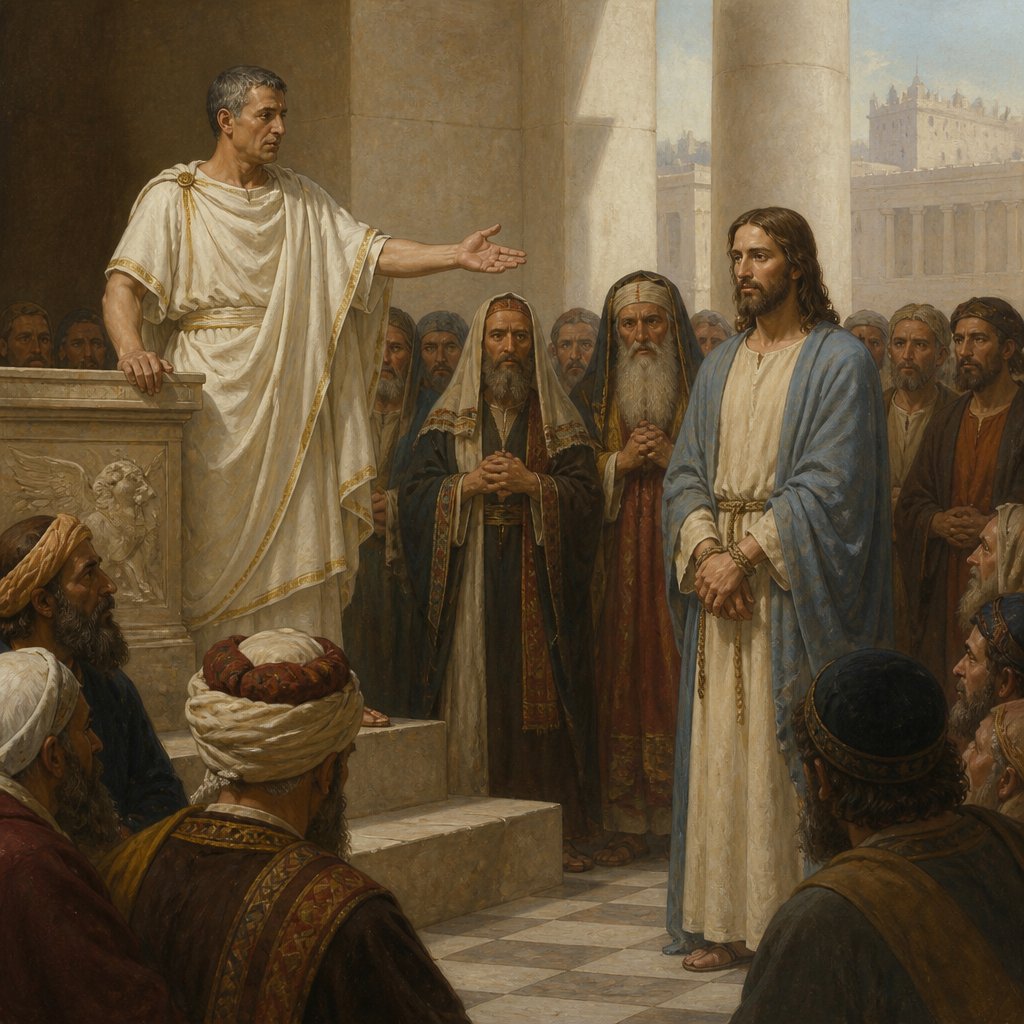
In Luke 23:4, Pilate says to the chief priests and the people, "I find no fault in this man." This statement comes during the trial of Jesus before his crucifixion. Pilate, the Roman governor, is addressing a crowd that has brought Jesus to him, accusing him of subverting the nation, opposing payment of taxes to Caesar, and claiming to be Christ, a king.
The significance of Pilate's statement, "I find no fault in this man," lies in the fact that it reveals the innocence of Jesus. Despite the accusations brought against him, Pilate, in his position as judge, declares that he finds no wrongdoing in Jesus. This declaration is crucial in the Christian narrative as it underscores the blamelessness and righteousness of Jesus, who is later crucified for the sins of humanity.
The context of this verse is set against the backdrop of the trial and eventual crucifixion of Jesus. The chief priests and the people of Jerusalem bring Jesus before Pilate, seeking his condemnation and death. This is part of the fulfillment of the prophecy and the plan of God for the salvation of humanity, as foretold in the Old Testament.
One of the central themes of this verse is the innocence of Jesus. The Bible consistently portrays Jesus as sinless and blameless, and Pilate's declaration serves as an affirmation of this truth. This innocence is crucial in understanding the Christian belief in Jesus' sacrificial death on the cross for the forgiveness of sins. As the Lamb of God, Jesus had to be without blemish or fault in order to bear the sins of the world.
Another theme is the role of human judgment in the crucifixion of Jesus. Pilate, the earthly authority at the time, finds no fault in Jesus, yet he ultimately succumbs to the pressure from the crowd and the Jewish leaders and condemns Jesus to be crucified. This highlights the flawed and unjust nature of human judgment and the deeper spiritual forces at play in the crucifixion of Jesus. It also serves as a reminder of the fallen nature of humanity and the need for divine intervention in the salvation of mankind.
Symbolically, Pilate's declaration also represents the acknowledgment of Jesus' innocence by a secular authority. It serves as a testament to the divine nature of Jesus and the truth of his innocence, even in the eyes of those who do not profess faith in him. This adds to the weight of his sacrificial death and the significance of his role in the redemption of humanity.
In the broader theological context, this verse emphasizes the fulfillment of prophecy and the overarching plan of God for the salvation of humanity. Jesus’ innocence, as affirmed by Pilate, is integral to the redemptive work of Christ on the cross. It also serves as a testament to the divine nature and authority of Jesus, who willingly submitted to the unjust judgment and death in order to bring salvation to mankind.
In conclusion, Luke 23:4, with Pilate's declaration of finding no fault in Jesus, carries profound theological implications for Christian belief. It underscores the innocence of Jesus, the flawed nature of human judgment, and the divine plan for the redemption of humanity through the sacrificial death of Christ. This verse serves as a pivotal moment in the biblical narrative, pointing to the central Christian belief in the sinless nature of Jesus, the Lamb of God who takes away the sins of the world.
Get our apps


Artwork for Luke 23:4

Luke 23:4 - "Then said Pilate to the chief priests and to the people, I find no fault in this man."
"Then said Pilate to the chief priests and to the people, I find no fault in this man." - Luke 23:4

Luke 4:23 - "And he said unto them, Ye will surely say unto me this proverb, Physician, heal thyself: whatsoever we have heard done in Capernaum, do also here in thy country."

Luke 23:53

Luke 19:23

luke 11:23

Luke 19:23

luke 11:23

Luke 15:23

luke 11:23

luke 11:23

Luke 23:54 - "And that day was the preparation, and the sabbath drew on."

Luke 23:23 - "And they were instant with loud voices, requiring that he might be crucified. And the voices of them and of the chief priests prevailed."

Luke 23:24 - "And Pilate gave sentence that it should be as they required."

Luke 23:45 - "And the sun was darkened, and the veil of the temple was rent in the midst."

Luke 7:23 - "And blessed is he, whosoever shall not be offended in me."

Luke 23:21 - "But they cried, saying, Crucify him, crucify him."

Luke 23:16 - "I will therefore chastise him, and release him."

Luke 23:37 - "And saying, If thou be the king of the Jews, save thyself."

Luke 23:10 - "And the chief priests and scribes stood and vehemently accused him."

Proverbs 4:23

Luke 23:52 - "This man went unto Pilate, and begged the body of Jesus."

Luke 11:23 - "He that is not with me is against me: and he that gathereth not with me scattereth."

Luke 23:1 - "And the whole multitude of them arose, and led him unto Pilate."

Luke 23:20 - "Pilate therefore, willing to release Jesus, spake again to them."

Proverbs 4:23

Proverbs 4:23

Proverbs 4:23

Proverbs 4:23

Luke 23:31 - "For if they do these things in a green tree, what shall be done in the dry?"