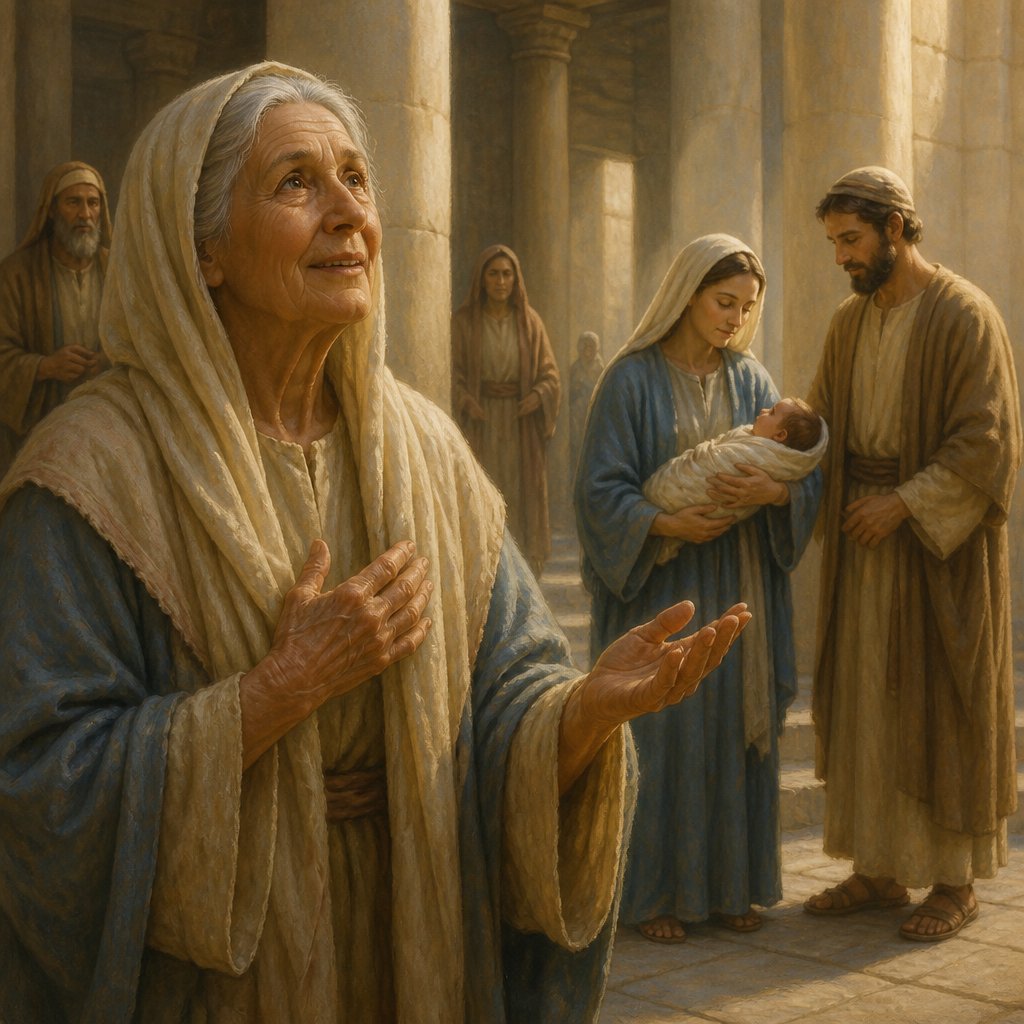
The Bible verse Luke 2:36-38 in the King James Version (KJV) reads as follows:
"And there was one Anna, a prophetess, the daughter of Phanuel, of the tribe of Aser: she was of a great age, and had lived with an husband seven years from her virginity; And she was a widow of about fourscore and four years, which departed not from the temple, but served God with fastings and prayers night and day. And she coming in that instant gave thanks likewise unto the Lord, and spake of him to all them that looked for redemption in Jerusalem."
This passage is a brief account of a prophetess named Anna who encountered the infant Jesus in the temple in Jerusalem. Despite its brevity, this passage is rich in themes, context, and symbolism that contribute to the overall message of the Gospel of Luke and the larger message of the Bible.
Themes:
1. Faithfulness and devotion: Anna is described as an elderly widow who was steadfast in her commitment to serving God. Despite the challenges she faced, including the loss of her husband and a life of devotion, she remained faithful to God through fasting and prayer. This theme emphasizes the importance of unwavering devotion to God and the rewards of such faithfulness.
2. Recognition of the Messiah: Anna's encounter with Jesus in the temple is significant in that it represents the fulfillment of Old Testament prophecies regarding the coming of the Messiah. As a prophetess, Anna recognizes the infant Jesus as the long-awaited savior and gives thanks to God for his arrival.
3. Witness and evangelism: After encountering Jesus, Anna "spake of him to all them that looked for redemption in Jerusalem." This demonstrates the theme of witness and evangelism, as Anna shares the good news of the Messiah's arrival with others who were eagerly anticipating redemption.
Context:
The context of this passage is essential for understanding its significance. The Gospel of Luke is one of the four canonical Gospels in the New Testament and is attributed to Luke, a companion of the apostle Paul. Luke emphasizes the humanity and compassion of Jesus, as well as his concern for the marginalized and oppressed. The account of Anna in the temple is significant in that it underscores the broader themes of faith, redemption, and the fulfillment of prophecy that are central to the Gospel of Luke.
Symbolism:
1. Anna as a representative of the faithful remnant: Anna's advanced age and her status as a widow symbolize the faithful remnant of Israel who eagerly awaited the coming of the Messiah. Despite her marginalized position in society, Anna's encounter with Jesus signifies the inclusion of all people, regardless of their social status, in God's redemptive plan.
2. The temple as a symbol of God's presence: Anna is described as someone who "departed not from the temple." This symbolizes her constant proximity to the presence of God and her unwavering commitment to serving Him. The temple is a representation of God's dwelling place and the center of Jewish worship, and Anna's presence there signifies her close connection to God.
3. Recognition of Jesus as the Messiah: Anna's response to encountering Jesus is significant in that she immediately recognizes him as the fulfillment of Messianic prophecies. Her thanksgiving and proclamation of Jesus as the long-awaited Redeemer symbolize the fulfillment of God's promises and the dawning of a new era of salvation for humanity.
In conclusion, the passage of Anna in the temple in Luke 2:36-38 is a brief but profound account that conveys important themes, context, and symbolism within the larger narrative of the Gospel of Luke. Through Anna's faithful devotion, recognition of Jesus as the Messiah, and evangelistic witness, this passage contributes to the overarching message of redemption and the fulfillment of God's promises through the coming of Jesus Christ.
Get our apps


Artwork for Luke 2:36-38

Luke 2:36-38 - "And there was one Anna, a prophetess, the daughter of Phanuel, of the tribe of Asher: she was of a great age, and had lived with a husband seven years from her virginity; And she was a widow of about fourscore and four years, which departed not from the temple, but served God with fastings and prayers night and day. And she coming in that instant gave thanks likewise unto the Lord, and spoke of him to all them that looked for redemption in Jerusalem."
"And there was one Anna, a prophetess, the daughter of Phanuel, of the tribe of Asher: she was of a great age, and had lived with a husband seven years from her virginity; And she was a widow of about fourscore and four years, which departed not from the temple, but served God with fastings and prayers night and day. And she coming in that instant gave thanks likewise unto the Lord, and spoke of him to all them that looked for redemption in Jerusalem." - Luke 2:36-38

Job 38:36

Job 38:36

Job 38:36

Job 38:36

Luke 2:38 - "And she coming in that instant gave thanks likewise unto the Lord, and spake of him to all them that looked for redemption in Jerusalem."

Genesis 36:38 - "And Saul died, and Baal-hanan the son of Achbor reigned in his stead."

Elijah in the scene 1 Kings 18:36–38

Job 38:36 - "Who hath put wisdom in the inward parts? or who hath given understanding to the heart?"

Luke 2:36 - "And there was one Anna, a prophetess, the daughter of Phanuel, of the tribe of Aser: she was of a great age, and had lived with an husband seven years from her virginity;"

Luke 5:36

Luke 11.33-36

Exodus 36:38 - "And the five pillars of it with their hooks: and he overlaid their chapiters and their fillets with gold: but their five sockets were of brass."

Luke 5:36-38 - "He also told them a parable: “No one tears a piece from a new garment and sews it on an old garment; otherwise the new will be torn, and the piece from the new will not match the old. And no one puts new wine into old wineskins; otherwise the new wine will burst the skins and will be spilled, and the skins will be destroyed. But new wine must be put into fresh wineskins."

Luke 6:27-38

Luke 6: 27-38

Luke 7:36-50

Luke 7:36–50

Luke 19:36 - "And as he went, they spread their clothes in the way."

Luke 6:38 Give, and it will be given to you

Luke 5:38 - "But new wine must be put into new bottles; and both are preserved."

Luke 20:38 - "For he is not a God of the dead, but of the living: for all live unto him."

Luke 6:36 - "Be ye therefore merciful, as your Father also is merciful."

Luke 18:36 - "And hearing the multitude pass by, he asked what it meant."

Ezekiel 36:38 - "As the holy flock, as the flock of Jerusalem in her solemn feasts; so shall the waste cities be filled with flocks of men: and they shall know that I am the LORD."

Luke 21:38 - "And all the people came early in the morning to him in the temple, for to hear him."

Luke 20:27-38. All people of color.

Job 38:36 (KJV) Who hath put wisdom in the inward parts? or who hath given understanding to the heart?

Luke 18:38 - "And he cried, saying, Jesus, thou Son of David, have mercy on me."