What does Mark 15:38 mean?
“And the veil of the temple was rent in twain from the top to the bottom.” — Mark 15:38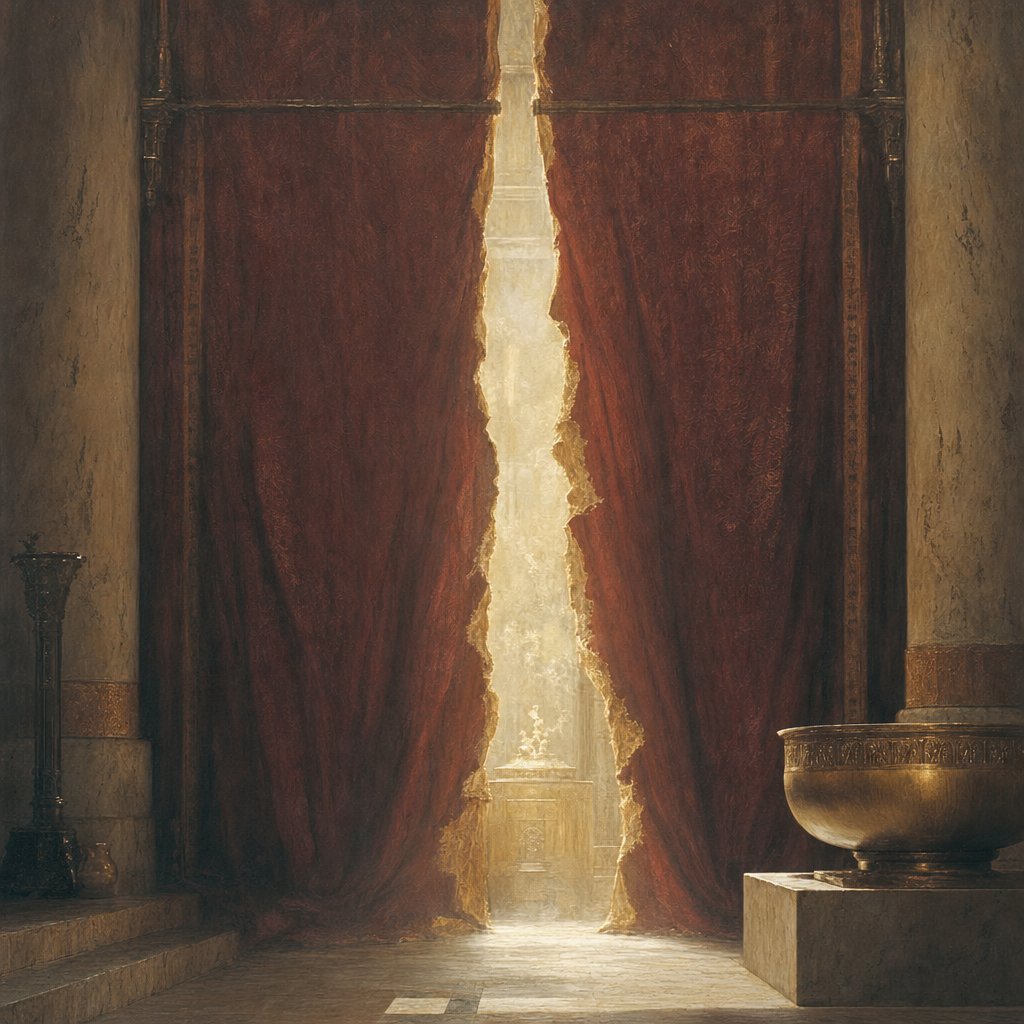
Mark 15:38 in the King James Version reads, “And the veil of the temple was rent in twain from the top to the bottom.” It is a single, stark sentence placed at the climax of the crucifixion narrative, and its power comes from how much meaning it gathers from Israel’s worship, the temple’s purpose, and the moment in which it occurs.
In Mark’s account, this happens immediately after Jesus “cried with a loud voice, and gave up the ghost” (Mark 15:37). Mark does not treat the tearing as a random wonder; it is a divine sign that interprets the death that has just occurred. The temple in Jerusalem was the center of sacrificial worship, the place where the people understood God’s presence to be uniquely manifested, and the place that embodied separation as well as nearness: God is near, yet not approached casually. The “veil” evokes that boundary. In temple imagery, a veil is not merely decoration; it is a barrier that marks holy space and restricts access. By saying the veil was “rent in twain,” Scripture depicts a decisive breach in what had stood between worshippers and the innermost sanctity of the temple.
The direction of the tear is its own commentary: “from the top to the bottom.” A tear from the bottom upward might suggest human action—someone grasping and ripping. Mark’s wording suggests something done from above, as though the act originates with God rather than with men. It reads like heaven’s response to the crucifixion: not simply that something tragic has happened, but that something has been accomplished. The torn veil becomes a sign that God himself is acting to change the terms of access, approach, and reconciliation.
Symbolically, the veil represents separation. In the biblical story, separation from God is tied to sin, uncleanness, and mortality. The temple system taught Israel both the reality of God’s holiness and the costliness of communion with him. Sacrifice, priesthood, and sacred boundaries all spoke the same message: God is holy, and sinners do not wander unmediated into his presence. Therefore, the tearing of the veil at the moment of Jesus’ death signifies that the barrier is being removed by a death that satisfies what the temple worship prefigured. Mark does not pause to explain this with doctrinal statements, but he places the sign at the precise moment when Jesus gives up his life, inviting the reader to see Jesus’ death as the event that opens what had been shut.
In context, Mark 15 is saturated with irony and revelation. Jesus is mocked as “King of the Jews” (Mark 15:18), crowned with thorns, and enthroned on a cross in the eyes of the world. Yet Mark steadily portrays the crucifixion as the very arena where Jesus’ true identity and mission are unveiled. Immediately after the veil is torn, Mark records the confession of the centurion: “Truly this man was the Son of God” (Mark 15:39). The sequence matters. As Jesus dies, the temple veil is torn; as the veil is torn, a Gentile soldier speaks truth that many in Israel’s leadership refused to speak. The tearing therefore has a revelatory force. What was hidden is being exposed. What was restricted is being opened. What was confined to the inner sanctum now breaks outward into the public event of the cross, where even an outsider can see and confess.
The verse also carries a theme of judgment and transition. The temple veil’s tearing can be read as an enacted announcement that the old order, centered in the temple’s sacrificial boundaries, has reached its fulfillment and is giving way to something new that God is doing through the death of Christ. Mark’s Gospel begins with a voice “crying in the wilderness” (Mark 1:3) and proceeds with Jesus redefining purity, forgiveness, and authority in ways that often bring him into conflict with established religious structures. When the veil tears, it is as though the central symbol of that structure is being altered at its core. The place that signified distance is marked by an opening, and the tearing suggests something irreversible: you do not neatly repair a veil that has been ripped in two. It is an apocalypse in miniature—a small unveiling that signals a great shift.
There is also deep symbolism in the material act of tearing. A veil separates sight as well as space; it hides. To say it is “rent” is to say what was concealed is no longer concealed. Mark’s crucifixion scene is full of darkness over the land (Mark 15:33), yet here is a tearing that implies disclosure. Paradoxically, at the moment of deepest apparent defeat, the sign declares access and revelation. The God who seems silent answers not with words but with an action that redefines the meaning of the cross.
Finally, Mark 15:38 has personal and communal significance. It is not only about architecture in Jerusalem; it is about approach to God. In the logic of the temple, approach required mediation and restriction. In the logic implied by the torn veil, the decisive obstacle has been removed by the death of Jesus. Mark states it simply and lets the sign speak: the boundary has been breached from above, at the instant the Son gives his life. In that torn fabric, Mark depicts the end of one kind of separation and the opening of a new and living access to God grounded in the crucified Christ.
Get our apps


Artwork for Mark 15:38

Mark 15:38 - "And the veil of the temple was rent in twain from the top to the bottom."
"And the veil of the temple was rent in twain from the top to the bottom." - Mark 15:38

"And the veil of the temple was rent in twain from the top to the bottom." - Mark 15:38

Mark 9:38

"But Paul thought not good to take him with them, who departed from them from Pamphylia, and went not with them to the work." - Acts 15:38

Mark 5:38 - "And he cometh to the house of the ruler of the synagogue, and seeth the tumult, and them that wept and wailed greatly."

Joshua 15:38 - "And Dilean, and Mizpeh, and Joktheel,"

Mark 14:38 - "Watch ye and pray, lest ye enter into temptation. The spirit truly is ready, but the flesh is weak."

Mark 12:38 - "¶ And he said unto them in his doctrine, Beware of the scribes, which love to go in long clothing, and love salutations in the marketplaces,"

Mark 4:38 - "And he was in the hinder part of the ship, asleep on a pillow: and they awake him, and say unto him, Master, carest thou not that we perish?"

"And Dilean, and Mizpeh, and Joktheel," - Joshua 15:38

Mark 1:38 - "And he said unto them, Let us go into the next towns, that I may preach there also: for therefore came I forth."

Mark 15:12

Job 38:15 - "And from the wicked their light is withholden, and the high arm shall be broken."

Mark 6:38 - "He saith unto them, How many loaves have ye? go and see. And when they knew, they say, Five, and two fishes."

Matthew 15:38 - "And they that did eat were four thousand men, beside women and children."

Mark 15:25 - "And it was the third hour, and they crucified him."

Mark 10:38 - "But Jesus said unto them, Ye know not what ye ask: can ye drink of the cup that I drink of? and be baptized with the baptism that I am baptized with?"

"Watch ye and pray, lest ye enter into temptation. The spirit truly is ready, but the flesh is weak." - Mark 14:38

Mark 15:13 - "And they cried out again, Crucify him."

1 Corinthians 15:38 - "But God giveth it a body as it hath pleased him, and to every seed his own body."
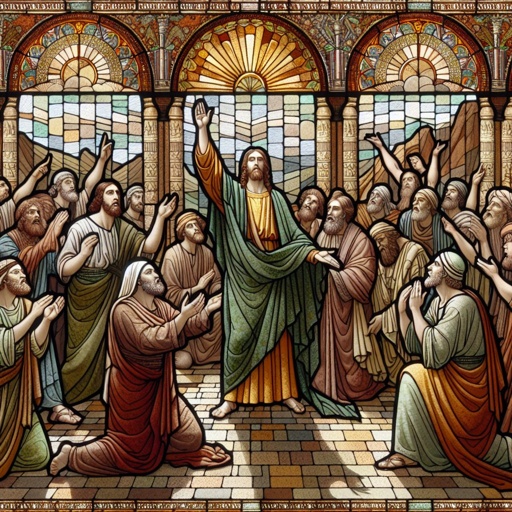
Mark 15:18 - "And began to salute him, Hail, King of the Jews!"

Mark 15:47 - "And Mary Magdalene and Mary the mother of Joses beheld where he was laid."

Psalms 38:15 - "For in thee, O LORD, do I hope: thou wilt hear, O Lord my God."

Mark 9:38 - "¶ And John answered him, saying, Master, we saw one casting out devils in thy name, and he followeth not us: and we forbad him, because he followeth not us."

Mark 15:30 - "Save thyself, and come down from the cross."

Exodus 38:15 - "And for the other side of the court gate, on this hand and that hand, were hangings of fifteen cubits; their pillars three, and their sockets three."

Mark 15:28 - "And the scripture was fulfilled, which saith, And he was numbered with the transgressors."

Mark 3:15 - "And to have power to heal sicknesses, and to cast out devils:"

Mark 15:5 - "But Jesus yet answered nothing; so that Pilate marvelled."