What does Mark 1:35 mean?
“And in the morning, rising up a great while before day, he went out, and departed into a solitary place, and there prayed.” — Mark 1:35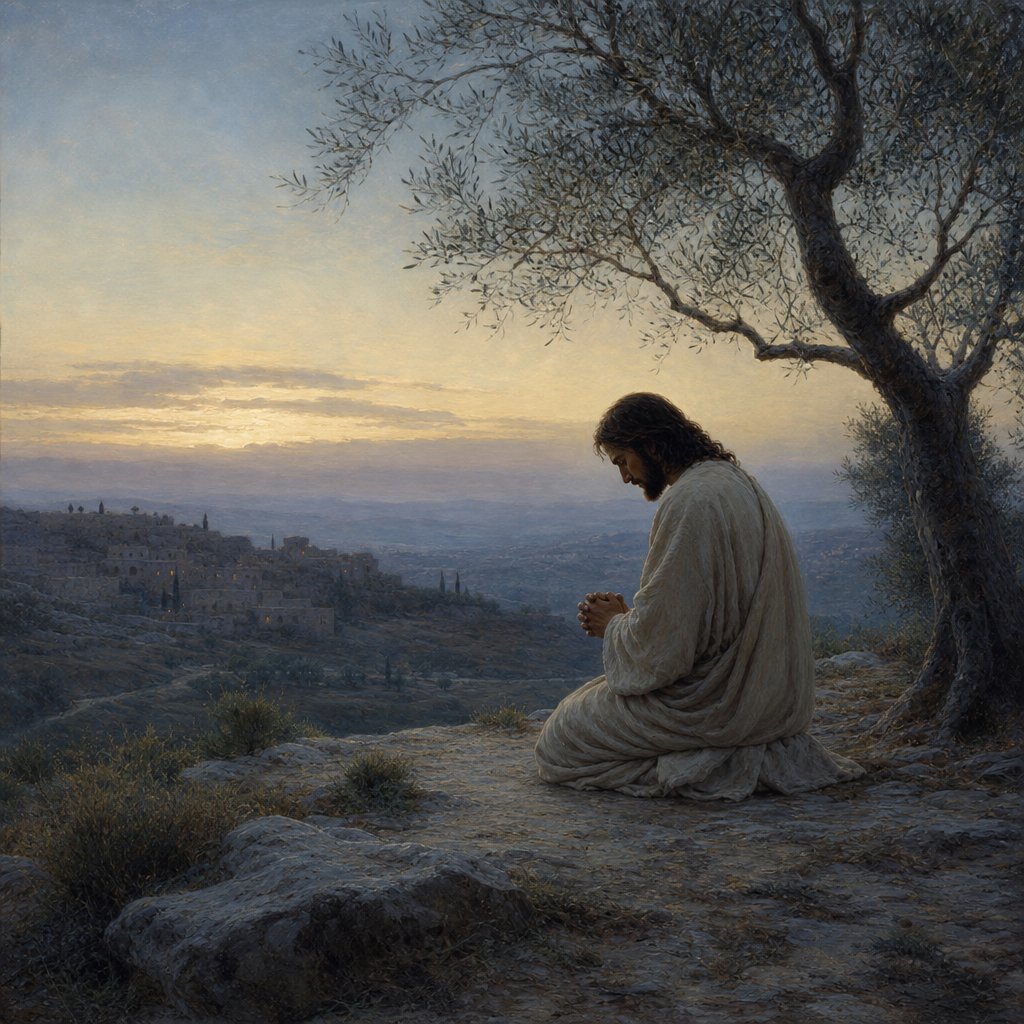
Mark 1:35 in the King James Version reads, “And in the morning, rising up a great while before day, he went out, and departed into a solitary place, and there prayed.” In one sentence Mark sets before the reader a pattern in the life of Jesus: deliberate withdrawal from noise and demand, chosen darkness before dawn, and communion with God that is not incidental to his work but foundational to it. The verse is simple in its wording, yet it sits at a decisive moment in Mark’s opening chapter and quietly interprets everything that has just happened and everything that is about to follow.
The immediate context is a day of striking public power and rapidly increasing attention. Earlier in Mark 1 Jesus has been teaching with authority, casting out an unclean spirit in the synagogue, healing Simon’s wife’s mother, and then, as the chapter describes, receiving multitudes at the door and healing “many that were sick of divers diseases” and casting out “many devils.” The sense is of mounting momentum and expanding fame; Mark even says, “all the city was gathered together at the door.” Mark 1:35 comes right after this wave of ministry. Its placement matters. The verse shows that Jesus does not allow even holy success to govern him. When the needs are real and the crowds are urgent, he still chooses to seek the Father first. The prayer is not presented as a retreat from mission but as the wellspring of mission.
The time marker, “in the morning… a great while before day,” carries both practical and spiritual weight. Practically, it is a time when others are still asleep and demands have not yet begun, suggesting intentionality: Jesus orders his time so that prayer is not crowded out. Spiritually, the language of predawn darkness implies that communion with God precedes and outruns visibility. The works that will be seen in the day are rooted in a hidden life with God before the day breaks. Mark does not say he prayed after the crowds dispersed; it emphasizes that before another day of public labour begins, he seeks God.
The motion in the verse is also significant. Jesus “went out, and departed into a solitary place.” Mark’s wording doubles the idea of leaving, underscoring separation. The “solitary place” in Mark often evokes the wilderness setting, a space away from towns and applause, a place associated with testing, dependence, and encounter with God. Earlier in Mark 1 Jesus was “in the wilderness” during temptation; the solitary place here echoes that landscape of reliance. Symbolically, it is a return to the place where distractions are stripped away, where a person stands before God without props. It also contrasts with the crowded doorway of the previous verses: from “all the city” to “a solitary place.” The movement suggests that spiritual authority is not sustained by constant engagement with people alone but by sustained fellowship with God.
The verse also highlights the humanity of Jesus without diminishing his divinity. Mark presents him as the one who teaches and heals with divine authority, yet here he is the one who prays. That combination teaches that power in ministry is not self-derived or self-directed. Jesus does not act as an independent wonder-worker; he lives in faithful dependence upon the Father. The prayer life of Jesus is therefore not mere example in a moralistic sense; it reveals the character of his mission as obedient and God-centered. He rises, he withdraws, he prays: the Son doing the Father’s will, not the crowd’s will, not even the disciples’ expectations.
The significance becomes even clearer when the narrative continues. Soon after this verse, Simon and others “followed after him,” and tell him, “All men seek for thee.” That line shows the pressure of popularity and the temptation to stay where demand is loudest. But the prayer of Mark 1:35 stands behind Jesus’ next decision: “Let us go into the next towns, that I may preach there also: for therefore came I forth.” The solitary prayer precedes a clarifying of purpose. In other words, Mark 1:35 is not simply about private devotion; it is the quiet hinge on which public direction turns. Prayer is the place where the mission is held steady and kept true.
There is also symbolism in the contrast between solitude and the kingdom work that follows. Jesus’ withdrawal is not escapism; it is consecration. The solitary place is not the goal; it is the source. Mark portrays a rhythm: engagement with the broken and needy, then retreat to God, then renewed advance into towns to preach. The verse suggests that the kingdom of God is advanced not only by visible acts of power but by invisible dependence. What happens “there” in prayer shapes what happens “there” in villages and synagogues.
Themes therefore gather around this one verse: the priority of communion with God, the necessity of solitude, the discipline of seeking God early, and the alignment of ministry with divine purpose rather than human demand. It also contains a quiet rebuke to the idea that busyness is the measure of faithfulness. Even when the door is surrounded and the city is calling, Jesus chooses the solitary place and prayer. Mark 1:35 shows that the most fruitful public life is anchored in a hidden life with God, and that the true direction of a day—and of a mission—is set “a great while before day” in prayer.
Get our apps


Artwork for Mark 1:35

Mark 1:35 - "And in the morning, rising up a great while before day, he went out, and departed into a solitary place, and there prayed."

"And in the morning, rising up a great while before day, he went out, and departed into a solitary place, and there prayed." - Mark 1:35
"And in the morning, rising up a great while before day, he went out, and departed into a solitary place, and there prayed." - Mark 1:35

Mark 8:35

Mark 8:35

Mark 8:35

Mark 8:35

Mark 8:27 - 35

Mark 10:35-45

Mark 10:35-45

Mark 4:35-41

Mark 10:35-45

Mark 8:27 - 35

Mark 8:27 - 35

Mark 8:27 - 35

Mark 10:35-45

Mark 8:27 - 35

Mark 4:35-37

Mark 15:35 - "And some of them that stood by, when they heard it, said, Behold, he calleth Elias."

Mark 3:35 - "For whosoever shall do the will of God, the same is my brother, and my sister, and mother."

Mark 13:35 (KJVA) 35 Watch ye therefore: for ye know not when the master of the house cometh, at even, or at midnight, or at the cockcrowing, or in the morning:

Mark 7:35 - "And straightway his ears were opened, and the string of his tongue was loosed, and he spake plain."

Mark 13:35 - "Watch ye therefore: for ye know not when the master of the house cometh, at even, or at midnight, or at the cockcrowing, or in the morning:"

Mark 12:35 - "¶ And Jesus answered and said, while he taught in the temple, How say the scribes that Christ is the Son of David?"

Mark 10:35 Then James and John, the sons of Zebedee, came to Him,

Mark 14:35 - "And he went forward a little, and fell on the ground, and prayed that, if it were possible, the hour might pass from him."

Mark 4:35 - "And the same day, when the even was come, he saith unto them, Let us pass over unto the other side."

Mark 6:35 - "And when the day was now far spent, his disciples came unto him, and said, This is a desert place, and now the time is far passed:"

Mark 5::24-35 woman touches Jesus hem and is healed people of color

Mark 8:35 - "For whosoever will save his life shall lose it; but whosoever shall lose his life for my sake and the gospel's, the same shall save it."