What does Mark 2:10 mean?
"But that ye may know that the Son of man hath power on earth to forgive sins, (he saith to the sick of the palsy,)" - Mark 2:10
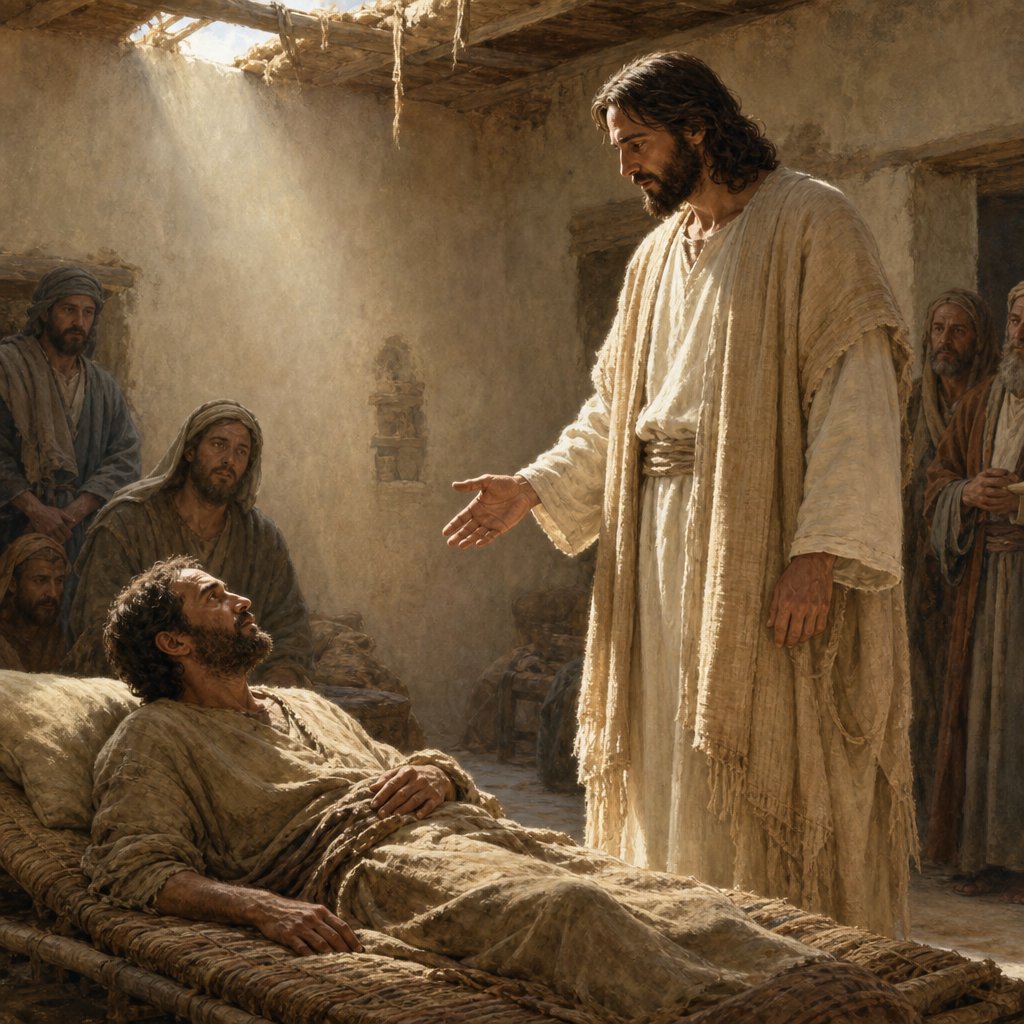
The Bible verse Mark 2:10 from the King James Version (KJV) reads, "But that ye may know that the Son of man hath power on earth to forgive sins, (he saith to the sick of the palsy,) I say unto thee, Arise, and take up thy bed, and go thy way into thine house." This verse is part of a larger story in the book of Mark, where Jesus performs a miraculous healing on a paralyzed man. The verse is significant in its portrayal of Jesus' divine power to forgive sins and perform miracles, and it offers important insights into the themes of faith, power, and authority.
In its broader context, this verse is part of a series of events recounted in Mark 2:1-12. Jesus is in Capernaum, and a large crowd has gathered to hear him speak. Four men bring a paralyzed man to Jesus, hoping for healing. However, the crowd is so dense that they cannot get close to Jesus. Undeterred, the men climb onto the roof, dig through the roof, and lower the paralyzed man down to Jesus. Seeing their faith, Jesus tells the man that his sins are forgiven. This causes a stir among the scribes and Pharisees, who question Jesus' authority to forgive sins. To demonstrate his authority, Jesus instructs the paralyzed man to rise, take up his bed, and go home, and the man is miraculously healed.
The verse Mark 2:10 is pivotal in this story because it highlights the divine authority of Jesus to forgive sins and perform miracles. The phrase, "the Son of man hath power on earth to forgive sins," is a bold assertion of Jesus' divine authority. In using the term "Son of man," Jesus is referring to himself as the Messiah, the fulfiller of Old Testament prophecies and the Savior of humanity. By claiming the power to forgive sins, Jesus is asserting his authority as the Son of God and the ultimate arbiter of redemption.
This assertion of divine authority is a central theme in the book of Mark and the Gospels as a whole. Throughout his ministry, Jesus performs numerous miracles and offers forgiveness to those who demonstrate faith in him. These miracles and acts of forgiveness serve as evidence of Jesus' divinity and the fulfillment of Old Testament prophecies. In the context of first-century Judaism, where forgiveness of sins was typically obtained through the temple sacrifices and rituals, Jesus' claim to forgive sins was radical and revolutionary. It challenged the existing religious authorities and presented a new way of understanding redemption and salvation.
The verse Mark 2:10 also speaks to the theme of faith. The actions of the paralyzed man's friends, who went to great lengths to bring him to Jesus, demonstrate their unwavering faith in Jesus' ability to heal. Likewise, Jesus responds to their faith by forgiving the man's sins and healing his paralysis. This emphasizes the importance of faith as a catalyst for receiving God's grace and mercy. The story encourages believers to approach Jesus with boldness and persistence, trusting in his power to transform lives and grant forgiveness.
Furthermore, the symbolism in this verse is rich and multi-layered. The paralyzed man symbolizes all of humanity's spiritual condition—helpless, unable to save themselves, and in need of divine intervention. Jesus, as the Son of God, symbolizes the ultimate authority and power to heal, redeem, and forgive. The command for the man to arise and take up his bed symbolizes a new life, free from the burdens of sin and infirmity. This symbolic act illustrates the transformative power of Jesus' forgiveness and the restoration of the human soul.
In conclusion, Mark 2:10 is a powerful and evocative verse that encapsulates the themes of Jesus' divine authority, the importance of faith, and the transformative power of forgiveness. It offers believers a profound understanding of Jesus' identity as the Son of God and the source of spiritual healing and redemption. The verse continues to inspire and challenge Christians to approach Jesus with faith and to trust in his power to forgive sins and transform lives.
Have questions about Mark 2:10?
Dive deeper into this scripture with Bible Chat — an AI-powered tool for exploring God's Word through conversation. Ask questions, get context, and grow in your understanding of the Bible.
Get Our Apps


Mark 2:10 Artwork

Mark 2:10

Mark 2:10 - "But that ye may know that the Son of man hath power on earth to forgive sins, (he saith to the sick of the palsy,)"
"But that ye may know that the Son of man hath power on earth to forgive sins, (he saith to the sick of the palsy,)" - Mark 2:10

Mark 10:2 - "¶ And the Pharisees came to him, and asked him, Is it lawful for a man to put away his wife? tempting him."

Mark 10
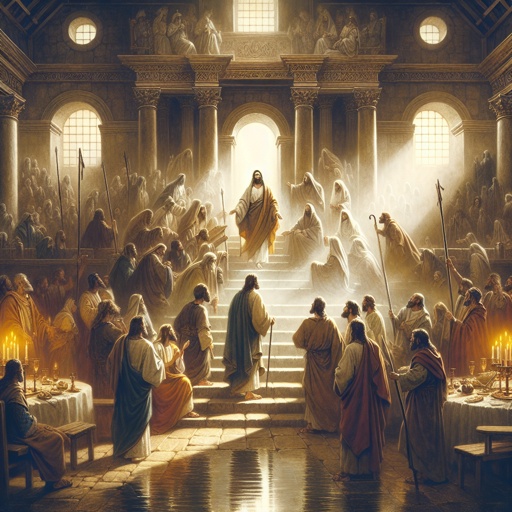
Mark 10
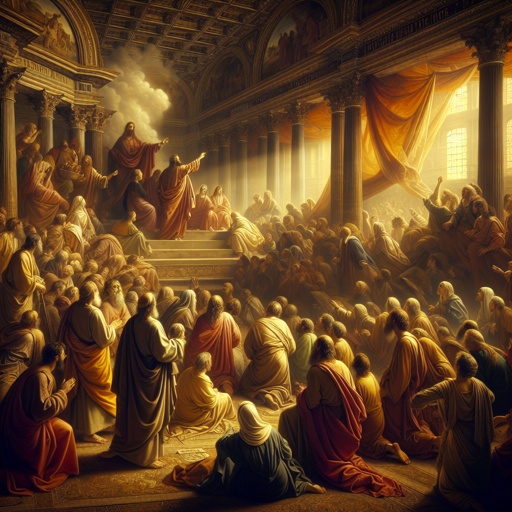
Mark 10
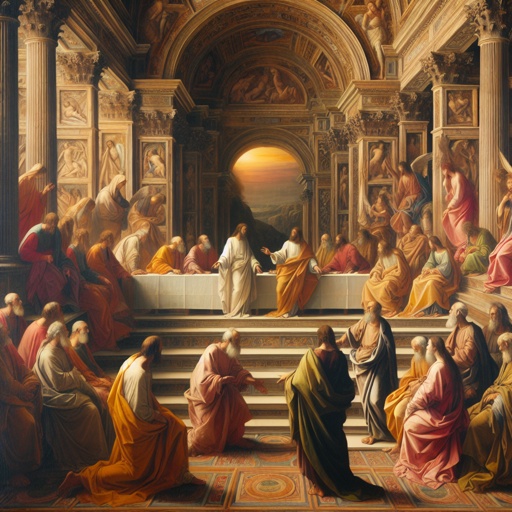
Mark 10
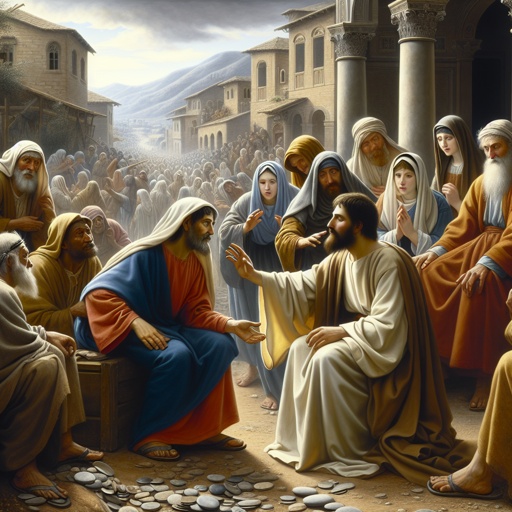
Mark 10:46

Mark 10:31

Mark 10:10 - "And in the house his disciples asked him again of the same matter."
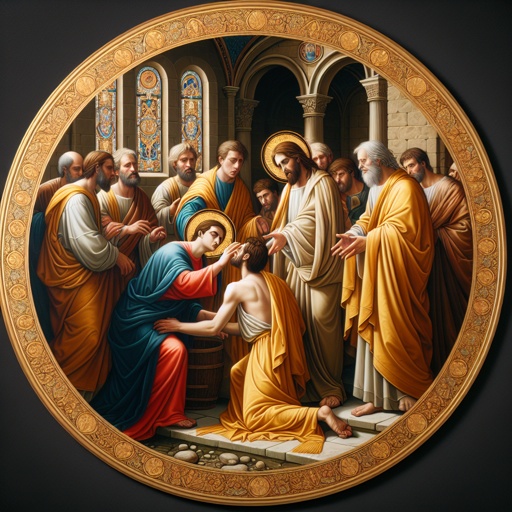
Mark 10:46

Mark 10:46

Mark 10:35-45

Mark 10:17-30

Mark 10:35-45

Mark 10:13–16

Mark 10:17-30

Mark 10:35-45

Mark 10:35-45

Mark 10:44 - "And whosoever of you will be the chiefest, shall be servant of all."

Mark 10:31 - "But many that are first shall be last; and the last first."

Mark 13:10 - "And the gospel must first be published among all nations."

Mark 2:2
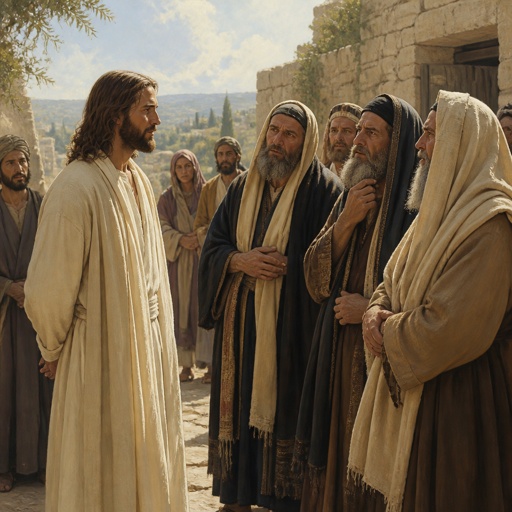
"¶ And the Pharisees came to him, and asked him, Is it lawful for a man to put away his wife? tempting him." - Mark 10:2

Mark 10:50 - "And he, casting away his garment, rose, and came to Jesus."

Mark 10:41 - "And when the ten heard it, they began to be much displeased with James and John."

Mark 10:6 - "But from the beginning of the creation God made them male and female."

Mark 15:10 - "For he knew that the chief priests had delivered him for envy."

Mark 10:8 - "And they twain shall be one flesh: so then they are no more twain, but one flesh."