What does Mark 3:1 mean?
“And he entered again into the synagogue; and there was a man there which had a withered hand.” — Mark 3:1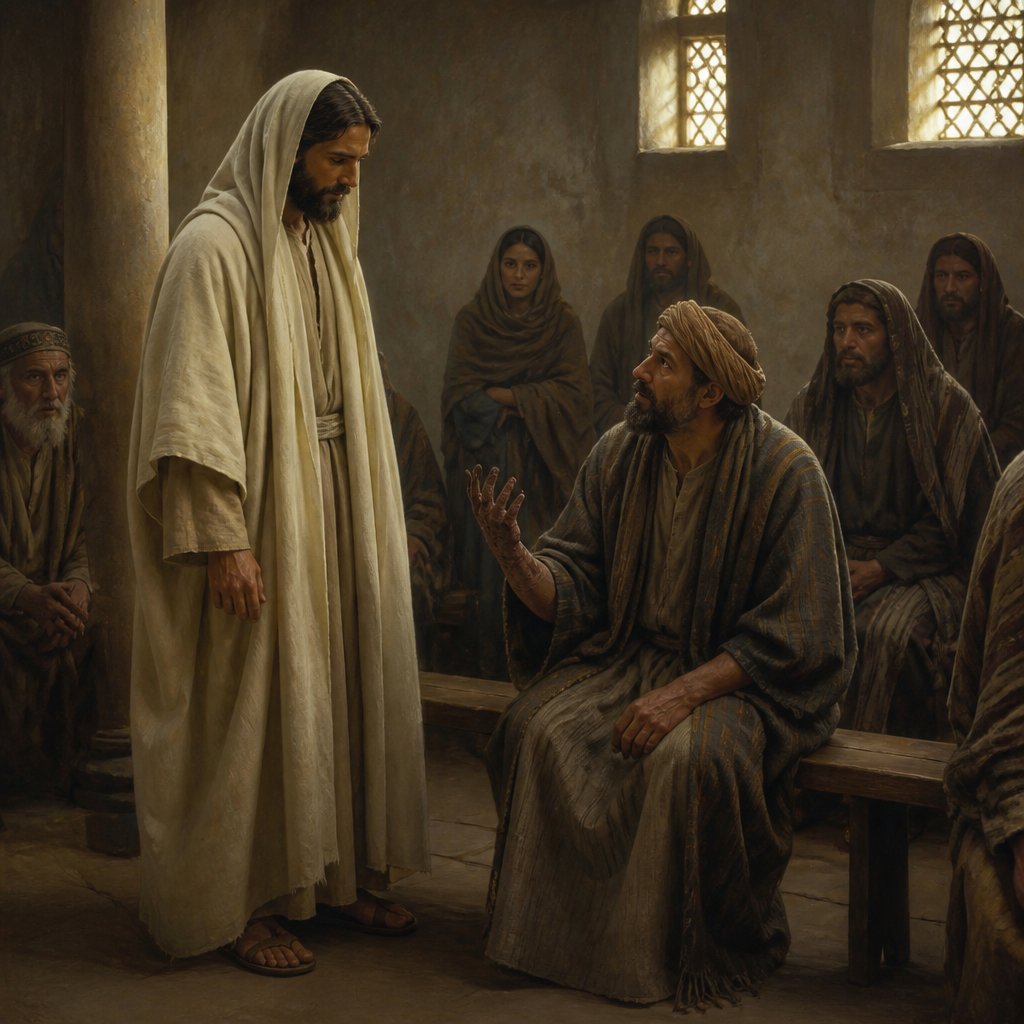
Mark 3:1 in the King James Version (KJV) states, "And he entered again into the synagogue; and there was a man there which had a withered hand." This verse is found in the Gospel of Mark, which is the second book of the New Testament. This particular passage is an important part of Jesus' ministry as it highlights his compassion and willingness to heal those who are suffering.
The verse begins with Jesus entering the synagogue once again. The synagogue was the place of worship for Jews and, similar to a modern-day church, was where people would gather for communal prayer and study of the scriptures. It is significant that Jesus chose to go to the synagogue, as it shows his commitment to teaching and ministering to the Jewish people.
As Jesus entered the synagogue, he encountered a man with a withered hand. This man's condition would have been a source of great suffering and limitation for him. In biblical times, physical deformities were often seen as a sign of God's punishment, and those who were afflicted were often marginalized and considered unclean. The fact that this man was in the synagogue indicates that he was seeking spiritual solace and possibly even healing.
The withered hand can also be seen as a metaphor for any kind of personal affliction, physical or otherwise, that hinders an individual from fully participating in life. This could be anything from a physical disability to a mental illness or emotional trauma. In approaching this man, Jesus demonstrates his desire to bring healing and restoration to all aspects of a person's being, both physical and spiritual.
At the core of this verse is the theme of compassion and mercy. Jesus did not overlook the man's condition or dismiss him as unimportant. Instead, he saw the man's suffering and responded with empathy and a desire to alleviate his pain. This exemplifies Jesus' teachings on the importance of loving one's neighbor and caring for those who are in need. It also serves as a reminder to us to approach others with a similar attitude of compassion and understanding.
There is also a deeper spiritual symbolism at play in this verse. The withered hand can be seen as a representation of mankind's spiritual condition. Without the healing touch of Jesus, our souls are withered and in need of restoration. The man's withered hand becomes a powerful metaphor for the brokenness that exists within all of us, and the hope that comes through encountering Jesus.
The actions of Jesus in this passage also serve as a reminder of his divine authority. By healing the man with the withered hand, Jesus demonstrates his power over physical ailments and his ability to bring about miraculous transformation. This is an important aspect of Jesus' ministry, as it validates his claim to be the Son of God and the promised Messiah.
In a broader context, this verse also speaks to the central message of the Gospel. Jesus came to bring healing and salvation to all who are in need. Just as he restored the man's withered hand, so too does he offer spiritual healing and redemption to all who come to him in faith.
In conclusion, Mark 3:1 is a powerful and poignant depiction of Jesus' compassion and authority. It serves as a reminder of his willingness to heal and restore, both physically and spiritually. This verse offers hope and encouragement to all who are suffering, reminding us that Jesus is the source of true and lasting transformation. It also challenges us to approach others with the same compassion and empathy that Jesus demonstrated, recognizing the inherent value and worth of every individual.
Get our apps


Artwork for Mark 3:1

Mark 3:1 - "And he entered again into the synagogue; and there was a man there which had a withered hand."

"And he entered again into the synagogue; and there was a man there which had a withered hand." - Mark 3:1

Mark 1:3 - "The voice of one crying in the wilderness, Prepare ye the way of the Lord, make his paths straight."

Mark 3:3 - "And he saith unto the man which had the withered hand, Stand forth."

Mark 3:31-34

Mark 3:16 - "And Simon he surnamed Peter;"

Mark 4:3 - "Hearken; Behold, there went out a sower to sow:"

Mark 3:30 - "Because they said, He hath an unclean spirit."

Mark 3:15 - "And to have power to heal sicknesses, and to cast out devils:"

"The voice of one crying in the wilderness, Prepare ye the way of the Lord, make his paths straight." - Mark 1:3

Mark 3:24 - "And if a kingdom be divided against itself, that kingdom cannot stand."

Mark 3:25 - "And if a house be divided against itself, that house cannot stand."

Mark 3:19 - "And Judas Iscariot, which also betrayed him: and they went into an house."

Mark 3:12 - "And he straitly charged them that they should not make him known."

Mark 12:3 - "And they caught him, and beat him, and sent him away empty."

Mark 3:33 - "And he answered them, saying, Who is my mother, or my brethren?"

Lamentations 3:12 - "He hath bent his bow, and set me as a mark for the arrow."

Mark 15:3 - "And the chief priests accused him of many things: but he answered nothing."

Philippians 3:14 - "I press toward the mark for the prize of the high calling of God in Christ Jesus."

Psalms 130:3 - "If thou, LORD, shouldest mark iniquities, O Lord, who shall stand?"

Mark 3:20 - "And the multitude cometh together again, so that they could not so much as eat bread."

"And Simon he surnamed Peter;" - Mark 3:16

Book of Mark in the Bible. Just with the word “Mark” in a Bible. No person or animal in the image

Mark 2:3 - "And they come unto him, bringing one sick of the palsy, which was borne of four."

Mark 3:35 - "For whosoever shall do the will of God, the same is my brother, and my sister, and mother."

Mark 10:3 - "And he answered and said unto them, What did Moses command you?"

Mark 3:14 - "And he ordained twelve, that they should be with him, and that he might send them forth to preach,"

Mark 7:3 - "For the Pharisees, and all the Jews, except they wash their hands oft, eat not, holding the tradition of the elders."

Mark 5:3 - "Who had his dwelling among the tombs; and no man could bind him, no, not with chains:"

Mark 3:26 - "And if Satan rise up against himself, and be divided, he cannot stand, but hath an end."