What does Mark 4:40 mean?
“And he said unto them, Why are ye so fearful? how is it that ye have no faith?” — Mark 4:40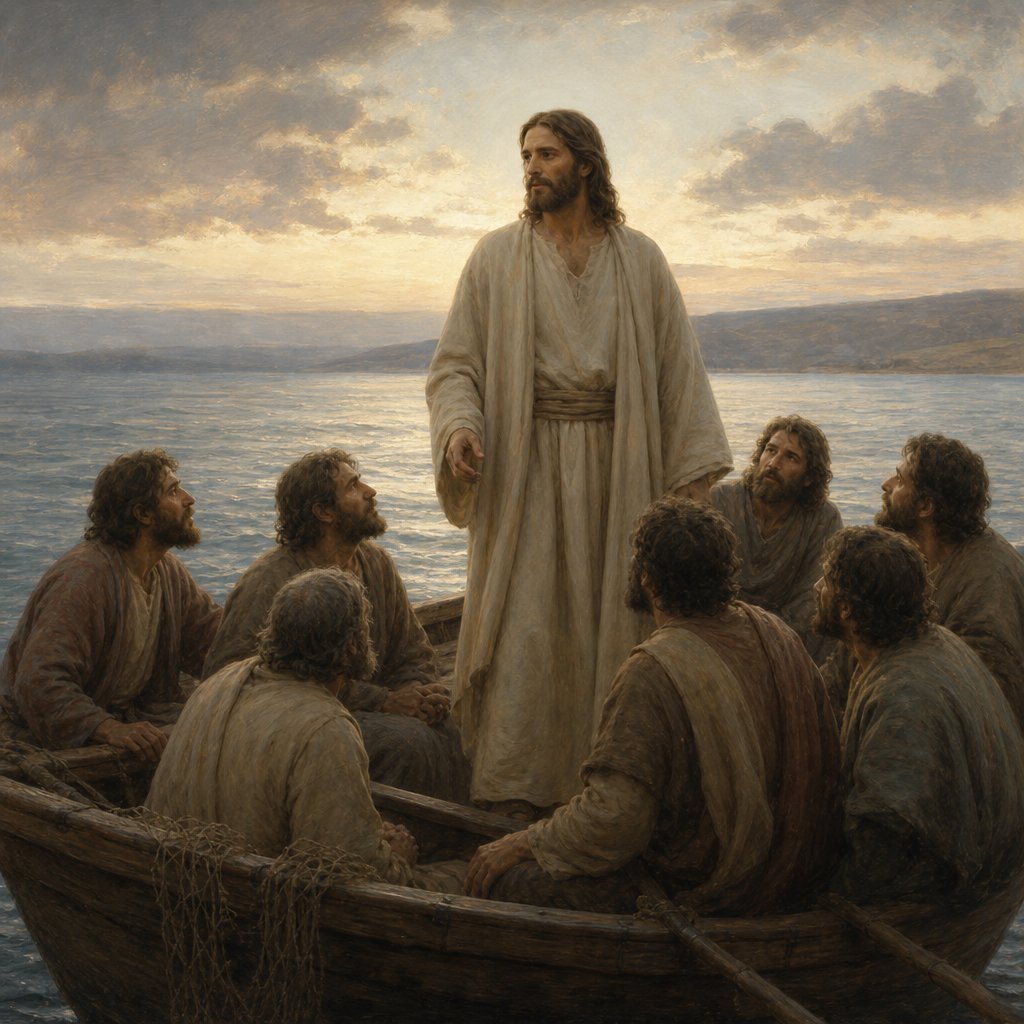
Mark 4:40 in the King James Version reads, “And he said unto them, Why are ye so fearful? how is it that ye have no faith?” It comes at the close of one of the Gospels’ most vivid scenes: Jesus and his disciples cross the sea, a great storm arises, the ship is in danger, and the disciples—some of them experienced fishermen—cry out in alarm. Jesus, who has been asleep in the hinder part of the ship, arises and speaks with divine authority to the elements, and there is a great calm. Only then does he turn from the wind and waves to address what the storm has revealed in the hearts of his followers. The verse is not merely a rebuke about panic in bad weather; it is a searching question about what they truly believed him to be, and what it means to be with him.
The force of Jesus’ words depends on what has just happened and what has just been taught. In Mark 4 the Lord has been speaking in parables about the kingdom of God—seed sown, hidden growth, small beginnings that become great. These teachings emphasize that God’s rule advances according to God’s power and timing, often in ways that are not immediately visible, and that the issue in the hearer is whether he has ears to hear. The transition from parable to storm is significant: the disciples have heard the word, but they are about to be tested on whether they can trust the word. The question in Mark 4:40, “how is it that ye have no faith?” presses them beyond intellectual assent to lived confidence. The storm becomes a living parable: the kingdom may appear threatened, the boat may seem overwhelmed, and yet the presence of Christ is the decisive reality.
When Jesus asks, “Why are ye so fearful?” he exposes fear as more than a natural reaction; in this context it is the spiritual posture that arises when circumstances are permitted to define reality more than Christ does. The disciples’ fear is not simply that the sea is dangerous, but that danger has convinced them they are abandoned: earlier they had said, “Master, carest thou not that we perish?” Mark 4:40 answers that accusation indirectly. His question implies that his care has never been absent, even when he was asleep. The sleeping Christ is not the indifferent Christ; rather, his calm in the midst of peril stands as a silent testimony that he is not threatened by what terrifies them. His rest also highlights the contrast between divine composure and human agitation: the same boat contains both, and the disciples are invited into his peace through faith.
The second question, “how is it that ye have no faith?” is sharper. Jesus does not say they have little skill, little strength, or little effort; he names the central deficiency as faith. In Mark’s Gospel, faith is not portrayed as a vague optimism but as trust in the person and authority of Jesus. They have seen him teach with authority and act with power; now they witness authority on a scale that belongs to God alone. By asking “how is it,” Jesus treats their faithlessness as incongruous—out of place given what they have already seen and heard. The point is not that a storm is unreal or that peril is imaginary, but that fear becomes spiritually unreasonable when set beside the reality of who Jesus is. The verse therefore is not meant to shame honest weakness so much as to awaken them to the mismatch between their view of Christ and the truth of Christ.
The immediate context deepens the meaning by showing that this rebuke comes after deliverance, not before it. Jesus stills the storm first and then addresses their hearts. That order matters: their faith is not the cause of the calm; his authority is. He does not say, “If ye have faith, I will save you,” as though rescue must be earned; he rescues, and then calls them to interpret the rescue rightly. Mark 4:40 therefore teaches that the foundation of faith is the character and power of Christ, not the performance of the disciple. Yet it also teaches that deliverance is meant to educate the soul. The calm sea is not only a mercy to their bodies but a lesson to their spirits.
Symbolically, the ship can be read as the disciples’ shared life with Christ—indeed, the life of those who follow him—moving forward according to his direction, yet passing through real adversity. The sea in Scripture often functions as an image of unrest, threat, and forces beyond human control. The “great storm of wind” and the waves beating into the ship picture the sudden invasions of trouble that overwhelm human confidence. In that setting, Jesus’ command over the wind and sea reveals him as Lord over chaos. Mark 4:40 then becomes a call to recognize that the One in the boat is greater than the storm outside it. Faith, in this sense, is not denial of the waves but recognition of the Lord.
The verse also carries a quiet theme of discipleship: being near Jesus does not exempt one from storms, but it does redefine what storms mean. The disciples are exactly where Jesus has led them, and yet the trial comes. Their fear might have seemed justified because obedience did not prevent distress. Jesus’ question corrects the assumption that hardship proves God’s neglect. In his presence, the storm becomes a place where faith is formed. Mark 4:40 thus speaks to the recurring human temptation to measure God’s care by immediate comfort. Jesus’ question turns the measurement around: the presence and promise of Christ are the measure, even when circumstances roar.
Finally, Mark 4:40 points beyond the incident to the larger revelation of Christ’s identity. The disciples’ fear in the storm is followed by another kind of fear—the awe that arises when they realize the magnitude of the One with them. Though that is stated in the next verse, it is implied here: their “no faith” is tied to not yet grasping who he is. If they truly apprehended him as the One whose word governs creation, fear would not be their ruling response. The verse therefore is an invitation to grow from seeing Jesus as merely “Master” in the boat to trusting him as Lord over all. In that light, Mark 4:40 remains significant because it still addresses the central spiritual conflict in moments of trouble: whether fear will interpret the storm, or faith will interpret it through the presence, power, and authority of Jesus Christ.
Get our apps


Artwork for Mark 4:40

Mark 4:40 - "And he said unto them, Why are ye so fearful? how is it that ye have no faith?"

"And he said unto them, Why are ye so fearful? how is it that ye have no faith?" - Mark 4:40
"And he said unto them, Why are ye so fearful? how is it that ye have no faith?" - Mark 4:40

Mark 9:40 - "For he that is not against us is on our part."

Mark 6:40 - "And they sat down in ranks, by hundreds, and by fifties."

"And they sat down in ranks, by hundreds, and by fifties." - Mark 6:40

"For he that is not against us is on our part." - Mark 9:40

Mark 15:40 - "There were also women looking on afar off: among whom was Mary Magdalene, and Mary the mother of James the less and of Joses, and Salome;"

Isaiah 40:4

Mark 10:40 - "But to sit on my right hand and on my left hand is not mine to give; but it shall be given to them for whom it is prepared."

Mark 14:40 - "And when he returned, he found them asleep again, (for their eyes were heavy,) neither wist they what to answer him."

Mark 1:40 - "And there came a leper to him, beseeching him, and kneeling down to him, and saying unto him, If thou wilt, thou canst make me clean."

Mark 12:40 - "Which devour widows' houses, and for a pretence make long prayers: these shall receive greater damnation." The image should not depict explicit or offensive content but be symbolic.

Mark 5:40 - "And they laughed him to scorn. But when he had put them all out, he taketh the father and the mother of the damsel, and them that were with him, and entereth in where the damsel was lying."

mark 2:4

mark 2:4

mark 2:4

mark 2:4

Mark 4:41

Mark 4:41

mark 2:4

Mark 4:41

Mark 2:4

mark 2:4

Mark 4:41

Mark 4:14 - "¶ The sower soweth the word."

Genesis 40:4 - "And the captain of the guard charged Joseph with them, and he served them: and they continued a season in ward."

Mark 4:36-37

Mark 4:36-37

Mark 16:4-5