What does Mark 6:3 mean?
“Is not this the carpenter, the son of Mary, the brother of James, and Joses, and of Juda, and Simon? and are not his sisters here with us? And they were offended at him.” — Mark 6:3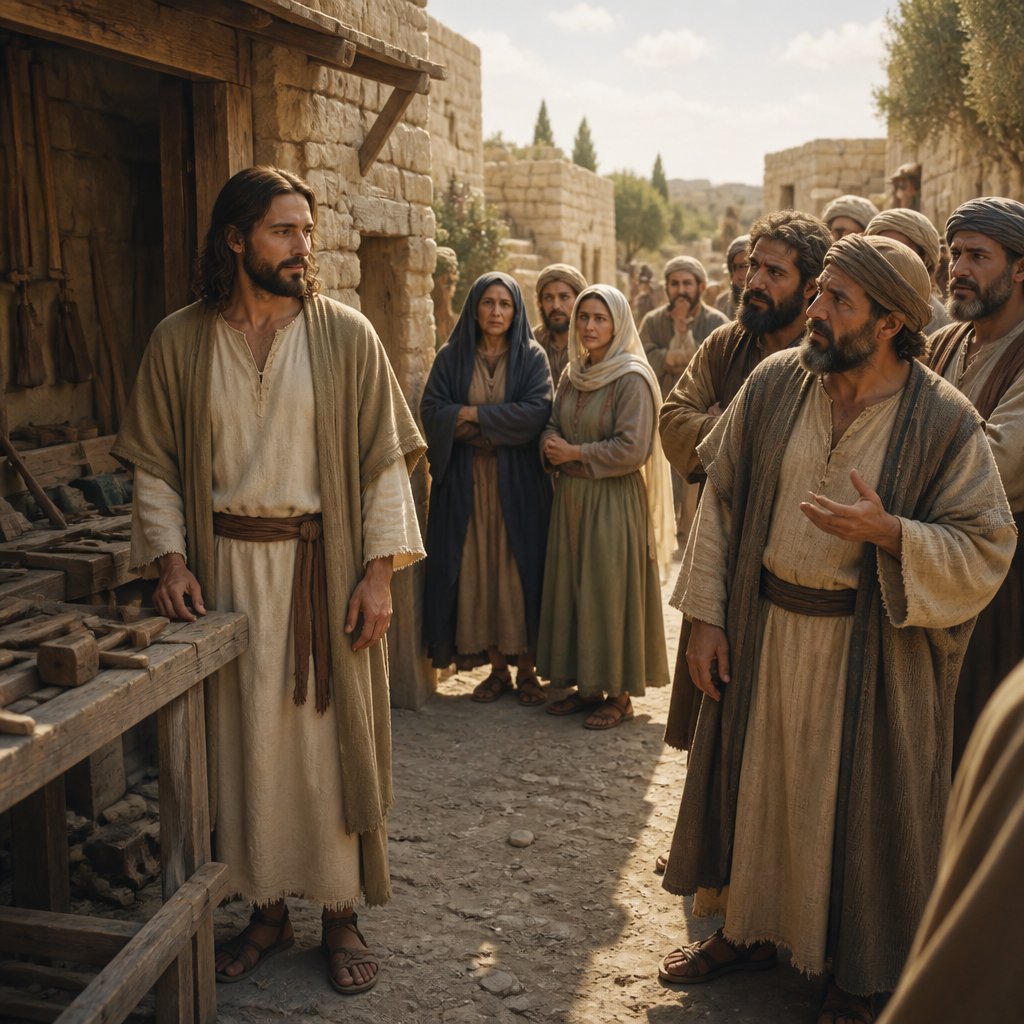
"Is not this the carpenter, the son of Mary, the brother of James, and Joses, and of Juda, and Simon? and are not his sisters here with us? And they were offended at him."
This verse from the Gospel of Mark gives us insight into the identity of Jesus Christ and the reactions of those around him. It provides an opportunity to delve into themes of disbelief, familiarity, and societal expectations. The context in which this verse is situated is crucial to understanding its significance.
At this point in the Gospel of Mark, Jesus has already begun his ministry, performing miracles and teaching the people. The people of Nazareth, where Jesus grew up, are familiar with him and his family. The verse begins with the question "Is not this the carpenter?" This highlights the disbelief and incredulousness of the people. They are essentially saying, "Is this not the man we know as a carpenter? How can he now be teaching and performing miracles?" This questioning of Jesus' identity and abilities serves as a central theme in the Gospel of Mark and is known as the "Messianic Secret."
The reference to Jesus as "the son of Mary" is significant because during this time, it was customary to reference someone as the son of their father. This use of "son of Mary" could be seen as an insult, as it implies that Jesus is illegitimate or lacks a proper lineage. This reflects the societal stigma that would have been associated with Jesus' birth, as his conception was through the Holy Spirit and not through a human father.
The mention of Jesus' brothers and sisters also raises questions about his family and background. The use of the word "brother" here has been a topic of debate among biblical scholars, as it is unclear whether these individuals were actual siblings of Jesus or cousins or members of his extended family. Regardless, the mention of Jesus' familial connections serves to remind the people of his ordinary upbringing and earthly family ties, which could have led to their skepticism about his divine authority.
The people of Nazareth's reaction to Jesus' presence and teachings reveals the theme of familiarity. They are unable to reconcile the Jesus they once knew as a carpenter with the man who is now performing miracles and claiming divine authority. This theme of familiarity can be seen as a barrier to belief, as the people are unable to see beyond the boundaries of their preconceived notions and expectations of who Jesus should be.
The societal expectations of the Messiah as a powerful and authoritative figure add to the disbelief and offense the people feel. They cannot fathom that someone whom they knew as a humble carpenter could be the long-awaited Messiah. This highlights the contrast between earthly expectations and divine reality, a recurring theme in the Gospels.
In terms of symbolism, the mention of Jesus as a carpenter holds deep significance. As a carpenter, Jesus would have worked with wood, shaping and crafting it into something useful. This symbolizes his ability to shape and transform lives, as he did with his disciples and all who came into contact with him. Additionally, the act of carpentry requires patience, precision, and care, qualities that can be attributed to Jesus' ministry and teachings.
Overall, Mark 6:3 provides a rich and layered reflection on the themes of disbelief, familiarity, and societal expectations. It invites readers to consider their own preconceived notions and expectations of who Jesus is and challenges them to open their hearts and minds to the truth of his divine identity. This verse reminds us that the true significance of Jesus's identity cannot be limited by familiarity or societal norms, but rather should be embraced with faith and openness.
Get our apps


Artwork for Mark 6:3

Mark 6:3 - "Is not this the carpenter, the son of Mary, the brother of James, and Joses, and of Juda, and Simon? and are not his sisters here with us? And they were offended at him."
"Is not this the carpenter, the son of Mary, the brother of James, and Joses, and of Juda, and Simon? and are not his sisters here with us? And they were offended at him." - Mark 6:3

Mark 3:6 - "And the Pharisees went forth, and straightway took counsel with the Herodians against him, how they might destroy him."

Mark 6:1-6
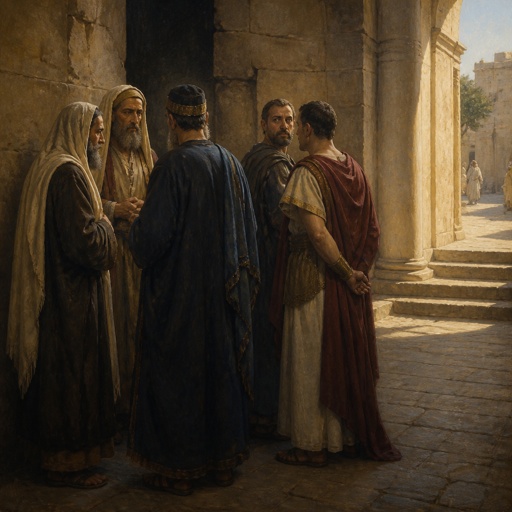
"And the Pharisees went forth, and straightway took counsel with the Herodians against him, how they might destroy him." - Mark 3:6

Mark 16:6-8

Mark 16:6-8

Mark 6:6 - "And he marvelled because of their unbelief. And he went round about the villages, teaching."

Mark 16:6-8

Mark 3:3 - "And he saith unto the man which had the withered hand, Stand forth."

Mark 6:32 - "And they departed into a desert place by ship privately."
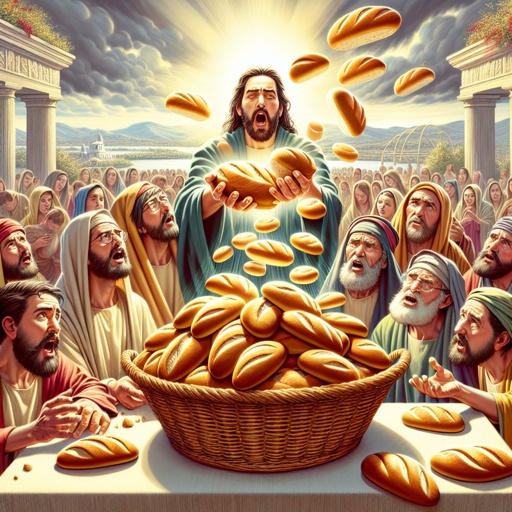
Mark 6:52 - "For they considered not the miracle of the loaves: for their heart was hardened."

Mark 6:9 - "But be shod with sandals; and not put on two coats."

Mark 6:40 - "And they sat down in ranks, by hundreds, and by fifties."

Mark 6:42 - "And they did all eat, and were filled."

Mark 3:31-34

Mark 3:16 - "And Simon he surnamed Peter;"

Mark 2:6 - "But there were certain of the scribes sitting there, and reasoning in their hearts,"
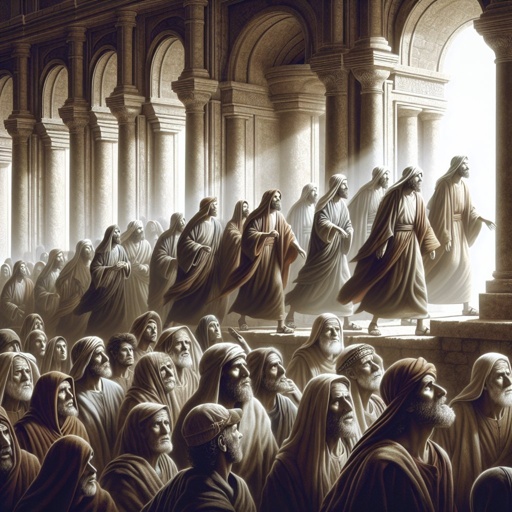
Mark 6:12 - "And they went out, and preached that men should repent."

Mark 6:43 - "And they took up twelve baskets full of the fragments, and of the fishes."

Mark 9:6 - "For he wist not what to say; for they were sore afraid."

Mark 4:3 - "Hearken; Behold, there went out a sower to sow:"

Mark 6:44 - "And they that did eat of the loaves were about five thousand men."

Mark 6:15 - "Others said, That it is Elias. And others said, That it is a prophet, or as one of the prophets."

Mark 3:30 - "Because they said, He hath an unclean spirit."

Mark 10:6 - "But from the beginning of the creation God made them male and female."

Mark 6:54 - "And when they were come out of the ship, straightway they knew him,"

Mark 3:15 - "And to have power to heal sicknesses, and to cast out devils:"

Mark 6:47 - "And when even was come, the ship was in the midst of the sea, and he alone on the land."

Mark 3:24 - "And if a kingdom be divided against itself, that kingdom cannot stand."