What does Mark 9:25 mean?
"When Jesus saw that the people came running together, he rebuked the foul spirit, saying unto him, Thou dumb and deaf spirit, I charge thee, come out of him, and enter no more into him." - Mark 9:25
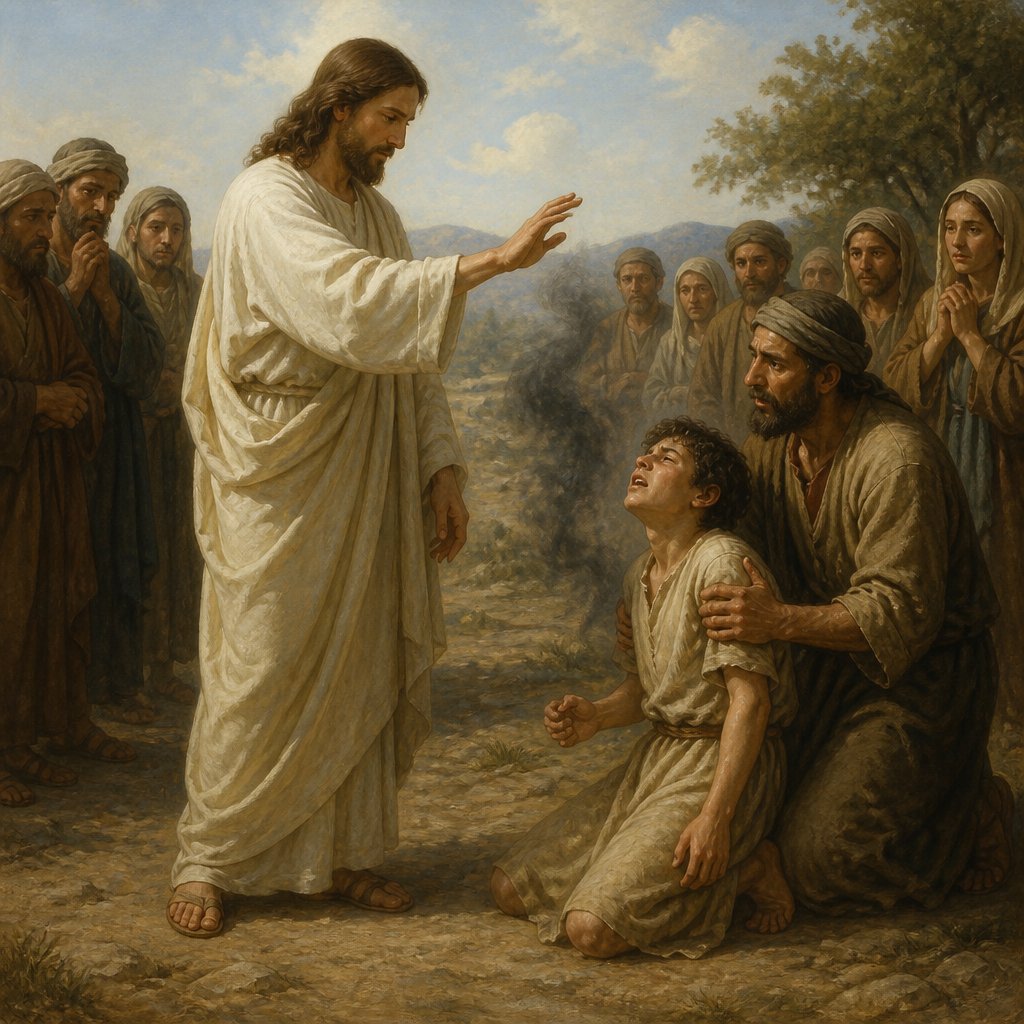
Mark 9:25 (KJV) says, "When Jesus saw that the people came running together, he rebuked the foul spirit, saying unto him, Thou dumb and deaf spirit, I charge thee, come out of him, and enter no more into him."
This verse comes from the New Testament of the Bible and is part of the account of Jesus's healing of a boy with an unclean spirit. The context of this verse is important because it shows Jesus's power over demonic forces and his compassion for those who were suffering. The theme of this verse revolves around the miraculous power of Jesus and the spiritual battles that Jesus fought on behalf of humanity.
In this passage, a man brings his son to Jesus, asking for help with his condition (Mark 9:17-18). The disciples had tried to cast out the unclean spirit but were unsuccessful. When Jesus arrives, he is met with a crowd of people and is immediately informed of the situation. Jesus then rebukes the unclean spirit and commands it to leave the boy, freeing him from his torment.
The use of the terms "dumb and deaf spirit" in this verse is symbolic and holds a deeper meaning. The spirit not only affected the boy physically, rendering him unable to speak and hear, but it also had a spiritual and psychological impact, symbolizing the oppressive nature of demonic forces. By addressing the spirit as both "dumb and deaf," Jesus is acknowledging the comprehensive nature of the affliction and demonstrating his authority over it.
The phrase "I charge thee, come out of him, and enter no more into him" reflects Jesus's power to command unclean spirits and banish them from the afflicted. This command is an example of Jesus's divine authority and dominance over the spiritual realm. Additionally, the instruction for the spirit to "enter no more into him" indicates Jesus's desire to permanently free the boy from the torment of this unclean spirit.
One of the key themes in this passage is the concept of faith. The disciples' failure to cast out the unclean spirit raises questions about their level of belief and trust in Jesus's power. When Jesus rebukes the spirit, he addresses the father's lack of faith, saying, "If thou canst believe, all things are possible to him that believeth" (Mark 9:23). This emphasizes the importance of faith in experiencing the miraculous power of God. It also serves as a reminder that true faith is necessary to overcome the spiritual battles and challenges in life.
Furthermore, the encounter between Jesus and the unclean spirit serves to illustrate the ongoing spiritual warfare between good and evil. The unclean spirit represents the forces of darkness, while Jesus embodies the ultimate power of light and goodness. This spiritual warfare is a recurring theme throughout the New Testament and serves as a reminder to believers of the constant struggle between the flesh and the spirit.
In conclusion, Mark 9:25 from the King James Version of the Bible provides a powerful depiction of Jesus's authority over unclean spirits and the importance of faith in experiencing spiritual victory. The verse carries deep symbolic meaning, emphasizing the comprehensive impact of spiritual afflictions and Jesus's ability to deliver individuals from them. The themes of faith and spiritual warfare are central to this passage, providing a profound message for believers about the power of God and the ongoing battle against evil.
Have questions about Mark 9:25?
Dive deeper into this scripture with Bible Chat — an AI-powered tool for exploring God's Word through conversation. Ask questions, get context, and grow in your understanding of the Bible.
Get Our Apps


Mark 9:25 Artwork

Mark 9:25 - "When Jesus saw that the people came running together, he rebuked the foul spirit, saying unto him, Thou dumb and deaf spirit, I charge thee, come out of him, and enter no more into him."
"When Jesus saw that the people came running together, he rebuked the foul spirit, saying unto him, Thou dumb and deaf spirit, I charge thee, come out of him, and enter no more into him." - Mark 9:25

Mark 15:25 - "And it was the third hour, and they crucified him."

Mark 3:25 - "And if a house be divided against itself, that house cannot stand."

Mark 9:2 Show only 4 people Show a mountain area According to Mark 9:2

Mark 2:9

Mark 13:25 - "And the stars of heaven shall fall, and the powers that are in heaven shall be shaken."

Mark 5:25 - "And a certain woman, which had an issue of blood twelve years,"

Mark 9:2 Show only 4 people and one of them is Jesus Show a mountain area According to Mark 9:2

Mark 9:38

Mark 2:9

"And it was the third hour, and they crucified him." - Mark 15:25

Mark 1:25 - "And Jesus rebuked him, saying, Hold thy peace, and come out of him."

Mark 9:36-37

Mark 10:25 - "It is easier for a camel to go through the eye of a needle, than for a rich man to enter into the kingdom of God."

1 Corinthians 9:25-27

1 Corinthians 9:25-27

Mark 9:48 - "Where their worm dieth not, and the fire is not quenched."

Mark 6:9 - "But be shod with sandals; and not put on two coats."

1 Corinthians 9:25-27

1 Corinthians 9:25-27

Genesis 25-9

Mark 12:25 - "For when they shall rise from the dead, they neither marry, nor are given in marriage; but are as the angels which are in heaven."

Mark 9:40 - "For he that is not against us is on our part."

Mark 9:46 - "Where their worm dieth not, and the fire is not quenched."

Mark 9:44 - "Where their worm dieth not, and the fire is not quenched."

Mark 9:32 - "But they understood not that saying, and were afraid to ask him."

Mark 7:25 - "For a certain woman, whose young daughter had an unclean spirit, heard of him, and came and fell at his feet:"
Mark 4:25 - "For he that hath, to him shall be given: and he that hath not, from him shall be taken even that which he hath."

Acts 12:25 - "And Barnabas and Saul returned from Jerusalem, when they had fulfilled their ministry, and took with them John, whose surname was Mark."